Hindi Diwas Latest News
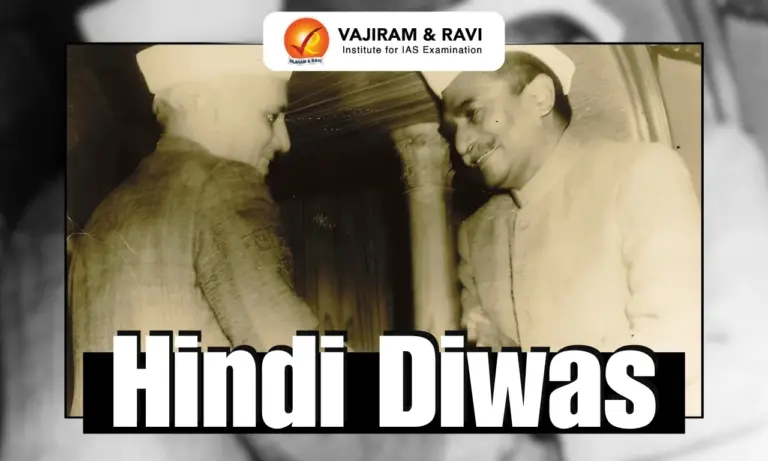
- Hindi Diwas is observed every year on September 14 to commemorate the decision of the Constituent Assembly on September 14, 1949, regarding the official language of the Union.
- After prolonged and contentious debates, the Assembly adopted the compromise commonly known as the Munshi-Ayyangar formula.
Background: The Language Question in the Constituent Assembly
- At Independence, India was a highly multilingual country, with Hindi being the most widely spoken language while numerous regional languages were used across different parts of the country.
- English, despite being spoken by less than 1% of Indians, remained the language of colonial administration, law and higher official communication.
- The central questions before the Constituent Assembly were:
- Whether English should be replaced by an Indian language?
- Which language should receive official status at the Union level?
- Whether Hindi should replace English immediately or through a transition?
- How could linguistic diversity be reconciled with national unity?
- The debate broadly divided members into Hindi-speaking representatives, representatives of non-Hindi-speaking regions and moderate Congress leaders.


Hindi versus Linguistic Diversity
- Hindi-speaking representatives largely argued that Hindi should become India’s national language and replace English.
- Some members viewed a common language as essential for national integration. Seth Govind Das argued for one language and one script for the country.
- However, representatives from non-Hindi-speaking regions opposed the idea that linguistic uniformity was necessary for national unity. Shankarrao Deo of Bombay emphasised the principle of “unity in diversity”.
- Moderate leaders also recognised the practical difficulties involved in immediately replacing English. Concerns were raised regarding Hindi’s limited vocabulary for modern administration, law and technical subjects.
- Maulana Abul Kalam Azad argued that a language should develop organically and become capable of expressing complex technical subjects before being made the sole language of administration.
Majority Rule versus Consensus
- The language controversy also raised an important constitutional question: Should the language issue be settled by a simple majority or through consensus?
- Supporters of Hindi argued that democratic principles required the majority view to prevail.
- Opponents warned that imposing a language through a majoritarian vote could alienate linguistic minorities. S.P. Mookerjee cautioned against using constitutional provisions to impose one language through coercion.
- Constituent Assembly President Rajendra Prasad similarly stressed that any language decision had to be acceptable to the country as a whole. A decision passed by a majority but rejected by a considerable section of society, he argued, could make implementation of the Constitution difficult.
The Munshi-Ayyangar Formula
- The eventual solution was the Munshi–Ayyangar formula, named after K.M. Munshi and N. Gopalaswamy Ayyangar, who were members of the seven-member Drafting Committee chaired by B.R. Ambedkar.
- The compromise did not designate Hindi as India’s “national language.” Instead, it designated Hindi in Devanagari script as the official language of the Union.
- At the same time, English was permitted to continue for all official purposes for 15 years after the commencement of the Constitution.
- This arrangement was subsequently incorporated into Articles 343-351 in Part XVII of the Constitution.
Evolution of Hindi and English
- The constitutional arrangement envisaged a 15-year transition period, during which the Union could progressively increase the use of Hindi.
- The Constitution also recognised 14 other languages in the Eighth Schedule at the time.
- States were permitted to select a regional language or English for their internal administration, while English continued to play an important role in communication between States.
- However, when the 15-year transition period ended in 1965, Hindi had not become sufficiently widespread in Union government functioning.
- The prospect of replacing English with Hindi generated strong opposition in several non-Hindi-speaking States, particularly in southern India. Protests and violent agitations during the 1960s demonstrated the political sensitivity of the language question.
- Consequently, the original expectation of eventually replacing English with Hindi was modified.
- The Official Languages Act, 1963, provided for the continued use of English alongside Hindi for official purposes. Thus, the constitutional framework evolved into a dual-language arrangement rather than establishing Hindi as the exclusive language of Union administration.
Constitutional Framework
- The language provisions are primarily contained in Part XVII of the Constitution.
- Article 343: Official language of the Union.
- Articles 344-345: Language-related arrangements involving the Union and States.
- Articles 346-347: Communication between States and recognition of languages.
- Article 348: Language used in the Supreme Court, High Courts and legislation.
- Article 350A: Facilities for instruction in the mother tongue at the primary stage.
- Article 350B: Special Officer for linguistic minorities.
- Article 351: Directive for development of Hindi.
- Thus, India’s constitutional language policy seeks to balance Hindi’s development with multilingualism and linguistic rights.
Significance
- Hindi Diwas is significant not merely as a celebration of the Hindi language but as a reminder of the constitutional compromise that helped accommodate India’s linguistic diversity.
- The Constituent Assembly’s experience demonstrates that linguistic policy in a diverse democracy requires consensus-building rather than simple majoritarianism.
- It also illustrates the flexibility of the Indian constitutional system, where an initial transition plan could evolve in response to social and political realities.
Source: IE

 Last updated on Sep, 2026
→ UPSC 2027 Notification will be released on 13 January 2027 at upsconline.nic.in.
→ Check out the latest UPSC Syllabus here.
→ Download UPSC Model Answers for Mains 2026
→ UPSC Mains Question Paper 2026 is out now for Essay & GS Paper 1, 2, 3 & 4.
→ UPSC Calendar 2027 has been released.
→ Enroll in Vajiram & Ravi’s UPSC Mains Test Series 2027 for structured answer writing practice, expert evaluation, and exam-oriented feedback.
→ Join Vajiram & Ravi’s UPSC Mentorship Program 2027 for personalized guidance, strategy planning, and one-to-one support from experienced mentors.
→ Go through the UPSC Mains Previous Year Papers to enhance your preparation.
→ UPSC has released UPSC Toppers List 2025 with the Civil Services final result on its official website.
→ Also check Best UPSC Coaching in India
Hindi Diwas FAQs
Q1. Why is Hindi Diwas observed on September 14?+
Q2. Did the Constitution declare Hindi India's national language?+
Q3. What is the Munshi-Ayyangar formula?+
Q4. Which Constitutional Articles deal with official languages?+
Q5. Why did English continue after 1965?+
Tags: hindi diwas mains articles upsc current affairs upsc mains current affairs