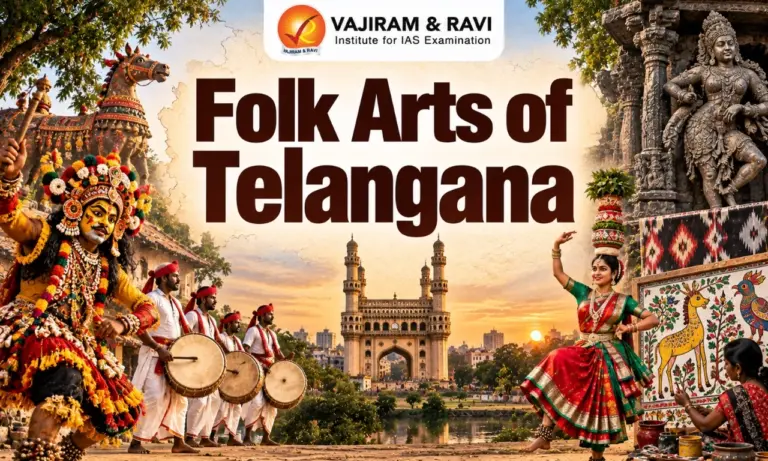
Folk Arts of Telangana reflect the region’s diverse cultural history, community traditions, religious practices, storytelling, weaving and craftsmanship. These traditions developed through generations and remain closely linked with everyday social life. Major forms include Cheriyal scroll paintings, Pochampally Ikat, Gadwal and Narayanpet sarees, Nirmal paintings, Warangal durries, Pembarthi metal craft, Karimnagar silver filigree and several folk dance, music and storytelling traditions.
Folk Arts of Telangana 2026
Telangana has a rich tradition of folk arts shaped by local communities, historical kingdoms and regional cultural exchanges. Its artists use cotton, silk, metal, wood and natural colours to create distinctive textiles, paintings, crafts, dances, music and storytelling forms. The Kakatiya period, Deccan Sultanates and Asaf Jahi rule influenced several traditions. Folk Arts of Telangana also preserve mythology, religious beliefs, social customs and regional identity through visual and performing traditions.
List of Famous Folk Arts of Telangana 2026
The Famous Folk Arts of Telangana 2026 include traditional dances, music, storytelling, handlooms, paintings and metal crafts with strong regional and community connections.
Folk Dance of Telangana 2026
- Perini Sivatandavam: Also called Perinin Thandavam, this ancient male dance is known as the Dance of Warriors. It flourished under the Kakatiyas of Warangal and is associated with Lord Shiva.
- Bonalu: Bonalu celebrations feature female dancers carrying decorated pots dedicated to Mahakali. Male Pothurajus lead processions using whips and neem leaves with rhythmic performances near temples.
- Chakka Bhajana: This rural dance is performed while moving from house to house. Artists use the Chakka musical instrument and ankle bells to maintain the rhythm.
- Gangireddulata: This traditional performance involves a trained bull dancing under the direction of an artist. Sannayi and Dolu provide musical accompaniment and mark changes in dance movements.
- Peddammalollu: Female folk artists from wandering communities perform this tradition. One performer carries a goddess statue on her head and plays the Dolu while another performs the dance.
Music and Devotional Performance of Telangana 2026
- Telangana Folk Songs: Folk songs became important during the Telangana statehood movement. Artists including Gaddar, Belli Lalitha, Sai Chand, Vimalakka, Deshapati Srinivas and Rasamayi Balakishan contributed to this cultural expression.
- Oggu Katha: Oggu Katha is a traditional ballad tradition of the Yadav and Kuruma Golla communities. Performers narrate stories of Mallanna, Beerappa and Yellamma through singing, dialogue and dramatization.
- Dasarulu: Dasarulu follow Veera Vaishnavism and traditionally sustain themselves through devotional singing dedicated to Lord Vishnu and related religious practices.
- Runjala Varu: The Runjala community performs devotional songs using the Runj. They follow Shaivism and are also known as Rudra Maheswaras or Rudrangas because of their devotion to Lord Shiva.
- Asadhulu: Asadhulu perform religious ceremonies connected with goddess worship. Their traditions are associated with deities such as Yellamma, Maisamma and Peddamma and use Javika and Chedika instruments.
Folk Storytelling and Theatre of Telangana 2026
- Sharada Stories: Veera Mushti and Jangam communities perform Sharada stories using the Tambura. Narratives cover historical, social and mythological subjects while combining entertainment with moral and educational messages.
- Pichakuntla Stories: The Shaiva Pichakuntla community traditionally performs these stories in groups of three. Narratives focus mainly on caste gotras and include Palnati Veera Charitra and Kunti Malla Reddy Charitra.
- Mandechu Artists: Mandechu artists associated with the Yadava or Golla community narrate the story of Katamaraju. They use 100 to 200 small figures stored in a Jeevasthalam Pette as storytelling props.
- Pagati Veshalu: Meaning daytime disguises, this performance is presented during the day. Budige Jangam Shaivas use costumes, humour and satire to discuss social problems and superstitions.
- Yanadi Bhagavatam: Also called Garudachala Bhagavatam, this tradition of the Yanadi community combines storytelling, music and dance. Chenchu Lakshmi is among its prominent emotional narratives.
- Gante Bhagavatulu: This is a night performance in which artists carry bells called Ganta. A small lamp is used to illuminate performers’ faces so audiences can observe their expressions.
- Vipra Vinodulu: Vipra Vinodulu are known for traditional magical acts and illusions. Their performances include producing vibhuthi and creating magical statues using controlled movements, timing and music.
Textiles and Weaving of Telangana 2026
- Pochampally Ikat: Pochampally Ikat originates from Bhoodan Pochampally in Yadadri Bhuvanagiri district. Its double Ikat method tie-dyes warp and weft before weaving. The saree received GI status in 2005.
- Gadwal Saree: Gadwal Sarees developed under Gadwal Samsthanam patronage during the 18th–19th centuries. Cotton bodies are interlocked with silk borders and pallus using kuttu or kupadam. GI registration came in 2010.
- Narayanpet Saree: Narayanpet Sarees come from Narayanpet town and feature checks, contrasting pallus and zari borders. Their weaving tradition reflects Maharashtra influence and received GI registration in 2015.
- Telia Rumal: Telia Rumal means oily handkerchief and originated in the early 19th century. Practised mainly in Puttapaka, it uses oil treated yarn in double Ikat weaving and received GI registration in 2020.
- Siddipet Gollabhama Saree: Siddipet Gollabhama Sarees are known for figurative female motifs representing milkmaids or pastoral women. Kolatam, Bathukamma and Gollabhama designs are used, with GI registration granted in 2012.
- Warangal Dhurries: Warangal Dhurries are traditional flat weave cotton floor coverings made on pit or frame looms. Their designs include geometric patterns and bold contrasts. GI registration was granted in 2018.
Painting and Visual Arts of Telangana 2026
- Nirmal Painting: Nirmal Paintings developed in Nirmal under Deccan Sultanate and Asaf Jahi patronage. They commonly show Ramayana, Mahabharata and Puranic themes with bright colours and golden effects. GI status came in 2008.
- Cheriyal Scroll Paintings: Cheriyal paintings are narrative cloth scrolls traditionally used by folk storytellers. They present mythological and folk stories in sequential scenes, usually with a red background. GI status was granted in 2008.
- Golconda Painting Style: The Golconda style developed during the 16th century as a Deccan painting tradition. It shows foreign artistic influence and is recognised for luminous gold and white colours.
- Hyderabad Painting Style: The Hyderabad style developed during the 17th century under the Nizams. Mughal influence is visible in its bright colours and depictions of regional landscapes, costumes, culture and jewellery.
Metal and Decorative Crafts of Telangana 2026
- Pembarthi Metal Craft: Pembarthi Metal Craft developed in Pembarthi of Warangal district and gained prominence under the Kakatiyas. Craftsmen work with brass, bronze and copper sheet metal. GI recognition came in 2010.
- Karimnagar Silver Filigree: Karimnagar Silver Filigree originated around the Elagandal region about 200 years ago. Vishwakarma goldsmiths create fine silver threads, loops and patterns. The craft received GI registration in 2007.
Ritual and Community Performance of Telangana 2026
- Bonalu: Bonalu celebrations feature colourfully dressed women carrying decorated pots dedicated to Mahakali. Male Pothuraju performers traditionally precede them with whips and neem leaves during temple related festivities.
- Pagati Veshalu: Pagati Veshalu means daytime disguises and is performed during the day. Budige Jangam Shaivas use costumes, humour and satire to address social problems and superstitions.
- Asadhulu: Asadhulu are traditional priests associated with worship of goddesses such as Yellamma, Maisamma and Peddamma. They perform religious ceremonies using Javika and Chedika instruments.
- Yanadi Bhagavatam: Yanadi Bhagavatam, also called Garudachala Bhagavatam, combines storytelling, music and dance. The Yanadi community presents narratives such as the story of Chenchu Lakshmi.
- Vipra Vinodulu: Vipra Vinodulu are known for traditional magical performances and illusions. Their repertoire includes producing vibhuthi and creating apparently magical statues through coordinated movement, timing and music.
- Gante Bhagavatulu: Gante Bhagavatulu is a night performance in which artists carry bells called Ganta. A small lamp is used to illuminate their faces so audiences can observe expressions.


Folk Arts of Telangana Significance
Folk Arts of Telangana preserve regional identity through traditional skills, community memory, religious practices, storytelling and economic activity. They also provide important evidence of the state’s historical cultural exchanges.
- Cultural Heritage: These traditions preserve knowledge transmitted across generations. Pochampally, Gadwal, Cheriyal, Nirmal and Pembarthi represent distinctive regional craftsmanship and artistic practices.
- Community Identity: Many performances remain closely linked with particular communities. Oggu Katha, Pichakuntla Stories, Sharada Stories and Mandechu performances show how communities preserve collective traditions.
- Historical Continuity: Kakatiya, Deccan Sultanate, Mughal, Maratha and Asaf Jahi influences shaped different artistic forms. These interactions contributed new designs, techniques, themes and performance practices.
- Economic Importance: Handloom and handicraft traditions support artisan livelihoods. Sarees, dhurries, paintings, metalware and silver filigree also connect traditional skills with contemporary markets.
- Geographical Identity: GI recognition strengthens the regional identity of Telangana crafts. Pochampally Ikat, Gadwal Saree, Narayanpet Saree, Telia Rumal, Cheriyal, Pembarthi Metal Craft, Warangal Dhurries, Siddipet Gollabhama Saree, Nirmal Painting and Karimnagar Silver Filigree have received GI recognition.
- Preservation of Folk Knowledge: Telangana’s folk arts preserve traditional designs, materials, instruments, narratives, rituals and performance methods. Their continuation helps maintain the state’s distinctive cultural heritage.

 Last updated on Sep, 2026
→ UPSC 2027 Notification will be released on 13 January 2027 at upsconline.nic.in.
→ Check out the latest UPSC Syllabus here.
→ Download UPSC Model Answers for Mains 2026
→ UPSC Mains Question Paper 2026 is out now for Essay & GS Paper 1, 2, 3 & 4.
→ UPSC Calendar 2027 has been released.
→ Enroll in Vajiram & Ravi’s UPSC Mains Test Series 2027 for structured answer writing practice, expert evaluation, and exam-oriented feedback.
→ Join Vajiram & Ravi’s UPSC Mentorship Program 2027 for personalized guidance, strategy planning, and one-to-one support from experienced mentors.
→ Go through the UPSC Mains Previous Year Papers to enhance your preparation.
→ UPSC has released UPSC Toppers List 2025 with the Civil Services final result on its official website.
→ Also check Best UPSC Coaching in India
Folk Arts of Telangana FAQs
Q1. What are the Famous Folk Arts of Telangana?+
Q2. Which is the Famous Folk Dance of Telangana?+
Q3. What is Cheriyal Painting of Telangana famous for?+
Q4. What are the famous Textiles of Telangana?+
Q5. What is Oggu Katha in Telangana?+
Q6. Which Folk Art of Telangana is associated with the Kakatiyas?+
Q7. Which Telangana Folk Art has a GI Tag?+
Q8. What is the Traditional Storytelling Art of Telangana?+
Q9. What are the famous Handicrafts of Telangana?+
Q10. Which Telangana Folk Art is known for Double Ikat Weaving?+
Tags: folk arts of telangana folk arts of telangana 2026