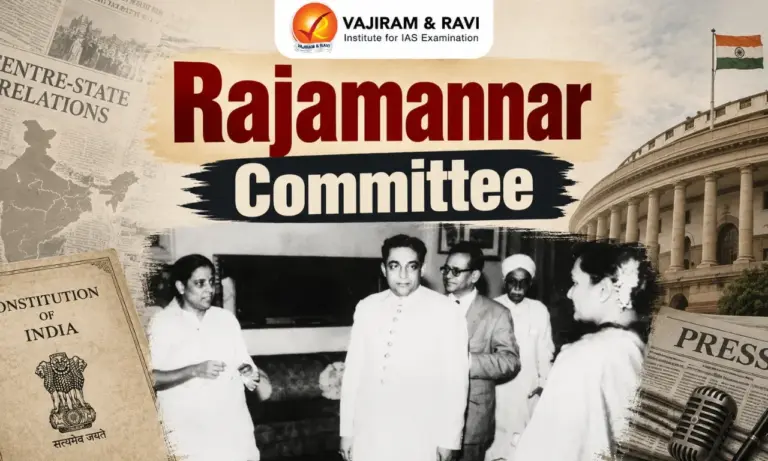
The Rajamannar Committee was an important initiative related to Centre-State relations and Indian federalism. Set up by the Tamil Nadu Government in 1969, the committee examined the distribution of powers, financial resources and administrative responsibilities between the Centre and the States. Its recommendations focused on greater state autonomy and a more balanced federal structure.
What is the Rajamannar Committee?
The Rajamannar Committee was a three-member committee appointed by the DMK government of Tamil Nadu in 1969 to examine Centre-State relations and suggest measures to give greater autonomy to the states. It was headed by Dr. P. V. Rajamannar, former Chief Justice of the Madras High Court, with A. Lakshmanaswami Mudaliar and P. Chandra Reddy as its members.
- The committee was constituted on 22 September 1969 to examine the distribution of powers and resources between the Centre and the States.
- It was the first state-level initiative to undertake a detailed review of Centre-State relations under the Indian Constitution.
- The committee examined constitutional, administrative and financial arrangements that, in its view, had increased the centralisation of power.
- It submitted its report to the Tamil Nadu Government in 1971, recommending several changes to strengthen state autonomy and the federal structure.
- The committee particularly focused on the Seventh Schedule, financial relations, emergency provisions, All-India Services and the role of institutions such as the Planning Commission.
Rajamannar Committee Background
The Rajamannar Committee was set up against the background of growing concerns in Tamil Nadu about the increasing powers of the Union government and the limited autonomy available to states.
- The committee believed that several constitutional provisions gave the Centre extensive powers, which could affect the autonomy of elected state governments.
- It identified the centralisation of financial resources as another concern, as states depended heavily on the Centre for financial assistance.
- The committee also examined the role of the Planning Commission, which had a major role in central planning and the allocation of resources to states.
- It argued that the existing distribution of legislative powers under the Union, State and Concurrent Lists needed to be reconsidered to create a better federal balance.
- The committee also examined the use of provisions such as Articles 356, 357 and 365, which could increase Union control over state governments.
- Its objective was to suggest constitutional and administrative changes that would provide greater autonomy to states while maintaining the federal structure.


Key Recommendations of the Rajamannar Committee
The Rajamannar Committee recommendations focused on reducing excessive centralisation and strengthening the powers of state governments. Some of its major recommendations were:
- Strengthening the Inter-State Council: The committee recommended the immediate establishment of a strong Inter-State Council under Article 263 to promote consultation and resolve differences between the Centre and States.
- Making the Finance Commission permanent: It suggested making the Finance Commission a permanent body to provide a more stable mechanism for Centre-State financial relations.
- Revising the Seventh Schedule: The committee called for a re-examination and redistribution of subjects in the Union, State and Concurrent Lists to give states greater legislative powers.
- Transfer of subjects to the State List: It recommended transferring certain subjects from the Union and Concurrent Lists to the State List, including areas such as trade unions, industrial and labour disputes, electricity and some aspects of inland waterways.
- Transfer of residuary powers: The committee recommended that residuary legislative powers should be given to the States instead of being vested with Parliament.
- Repealing Articles 356, 357 and 365: It called for the deletion of these provisions, particularly Article 356, which allows the imposition of President’s Rule in a state.
- Abolition of All-India Services: It recommended abolishing All-India Services such as the IAS, IPS and IFS to reduce the Centre’s influence over state administration.
- Replacing the Planning Commission: The committee proposed replacing the Planning Commission with a statutory body, arguing that the existing arrangement increased the Centre’s influence over state finances and planning.
- Greater financial resources for states: It called for widening the basis of revenue devolution so that states could have greater financial resources and reduce their dependence on the Centre.
Significance of the Rajamannar Committee for Centre-State Relations
The Rajamannar Committee holds an important place in the evolution of India’s debate on federalism and Centre-State relations. Although its recommendations were not implemented in full, its report brought several issues of state autonomy into national discussion.
- It highlighted concerns about the growing centralisation of political, administrative and financial powers in India.
- Its recommendations strengthened the debate on creating a more balanced relationship between the Union and State governments.
- The proposal for a stronger Inter-State Council later became an important part of discussions on cooperative federalism.
- Its recommendations on Article 356 and state autonomy contributed to the wider debate on the use of President’s Rule and the constitutional balance between the Centre and States.
- The committee’s views also influenced subsequent discussions and studies on Centre-State relations, including the Sarkaria Commission and later the Punchhi Commission.
- Although the Central Government did not accept its recommendations, the report remains an important reference point in understanding demands for greater state autonomy and fiscal devolution.
- The Rajamannar Committee therefore represents an important milestone in India’s continuing debate over how to balance a strong Union with meaningful state autonomy.

 Last updated on Sep, 2026
→ UPSC 2027 Notification will be released on 13 January 2027 at upsconline.nic.in.
→ Asian Games 2026 are being held in Aichi-Nagoya, Japan, from 19 September to 4 October.
→ Check out the latest UPSC Syllabus here.
→ Download UPSC Model Answers for Mains 2026
→ UPSC Mains Question Paper 2026 is out now for Essay & GS Paper 1, 2, 3 & 4.
→ UPSC Calendar 2027 has been released.
→ Enroll in Vajiram & Ravi’s UPSC Mains Test Series 2027 for structured answer writing practice, expert evaluation, and exam-oriented feedback.
→ Join Vajiram & Ravi’s UPSC Mentorship Program 2027 for personalized guidance, strategy planning, and one-to-one support from experienced mentors.
→ Go through the UPSC Mains Previous Year Papers to enhance your preparation.
→ UPSC has released UPSC Toppers List 2025 with the Civil Services final result on its official website.
→ Also check Best UPSC Coaching in India
Rajamannar Committee FAQs
Q1. What is the Rajamannar Committee?+
Q2. Who was the Chairman of the Rajamannar Committee?+
Q3. When did the Rajamannar Committee submit its report?+
Q4. What were the major recommendations of the Rajamannar Committee?+
Q5. What did the Rajamannar Committee recommend about Article 356?+
Q6. What did the Rajamannar Committee recommend about All-India Services?+
Q7. Why is the Rajamannar Committee important?+
Tags: indian polity indian polity notes rajamannar committee