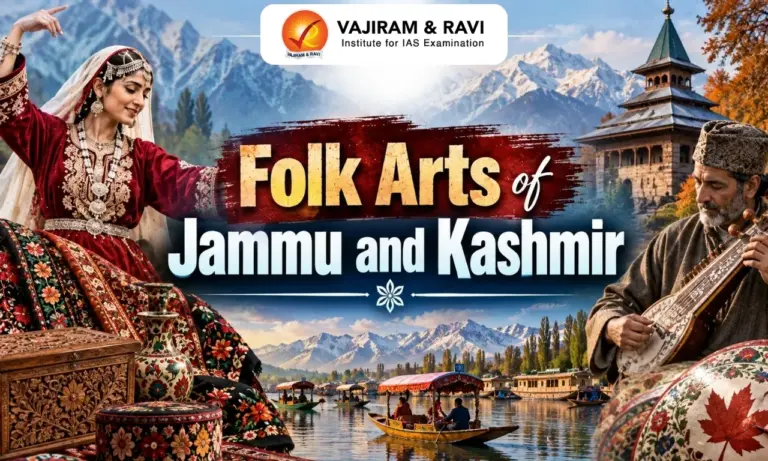
The Folk Arts of Jammu and Kashmir reflect the region’s diverse communities, languages, religious traditions and mountain way of life. They include folk songs, dances, theatre, storytelling, painting, embroidery, weaving, woodwork and other traditional crafts. The Jammu and Kashmir regions have developed distinct cultural traditions, giving the Union Territory a wide variety of folk art forms.
Folk Dances and Performing Arts of Jammu
The folk traditions of Jammu are closely connected with festivals, weddings, religious practices and village life.
- Chajja: Chajja, also known as Dandaras, is a traditional Dogri dance performed during Lohri. Boys carry a large decorated model of a peacock called a Chajja and dance in a procession accompanied by drums and shehnai.
- Haran: Haran is a folk opera of the Duggar region that combines dance, drama and music. It is traditionally performed around Lohri and features performers representing a deer, along with narrators and other characters.
- Geetru: Geetru is a Dogra-Pahari dance-song performed during festivals, feasts and weddings. Both men and women participate in it in traditional dress.
- Kud Dance: Kud is a community dance of the middle mountain ranges of Jammu. It is traditionally performed after the harvest, when villagers gather near the local deity to express gratitude for the protection of their crops, cattle and children.
- Phummian: Phummian is a folk dance of rural Jammu. The word refers to blooming, and the dancers use movements of their fingers to represent flowers coming into bloom.
- Dheku: Dheku is a traditional dance of Bhaderwah and adjoining areas. It is also known as Kudd or Kodd and is performed during fairs and religious occasions, accompanied by instruments such as the dhol, narsingha and flute.
- Gojri Dance: Gojri dance is associated with the Gujjar community. It is performed by men and women, particularly during weddings and other celebrations, with traditional dress, music and jewellery.
Also Read:- Festivals of Jammu and Kashmir 2026
Folk Music and Storytelling
Jammu and Kashmir has a strong tradition of oral music and storytelling. Folk songs often preserve local histories, religious traditions, heroic stories and everyday experiences.
- Bhaakh: Bhaakh is a traditional Dogri group folk-song. It is usually sung by a small group without musical instruments and reflects the social and everyday life of the Dogra region.
- Baaran: Baaran are Dogri folk ballads associated with valour and adventure. They are traditionally sung by folk singers with instruments such as the dhol and sarangi.
- Kaarkaan: Kaarkaan are religious folk ballads associated with the worship of folk deities. They are traditionally sung by performers such as Jogis and Gardis, accompanied by the dhol and sarangi.
- Bait: Bait is a popular form of Gojri folk music. It is primarily vocal and reflects the nomadic life and culture of the Gujjar-Bakarwal community.
- Baar: Baar is another Gojri musical tradition consisting of folk ballads about heroes, battles and love stories. It is traditionally accompanied by instruments such as the sarangi.


Folk Dances and Performing Arts of Kashmir
Kashmir has its own rich tradition of dance, music, theatre and oral performance.
- Rouf: Rouf is a traditional Kashmiri women’s dance performed in groups, particularly during festivals and festive occasions such as Eid and the evenings of Ramadan. The dancers face each other and perform simple rhythmic foot movements to poetic songs.
- Dhamali: Dhamali is a devotional dance performed by men in Kashmir. It is associated with visits to shrines and is performed to seek the blessings of saints and seers.
- Chakri: Chakri is a popular form of Kashmiri folk music, traditionally performed by a group of musicians. Instruments such as the sarangi, rabab, tumbaknari and nout accompany the singing. It is commonly associated with weddings, festivals and feasts.
- Bhand Pather: Bhand Pather is a traditional Kashmiri folk theatre that combines acting, dance and satire. It uses humour and realistic performances to portray social issues as well as mythological and local themes.
- Ladi Shah: Ladi Shah is a form of satirical folk poetry and storytelling in Kashmir. Performers use humour and sarcasm to comment on social and political issues.
- Vanvun: Vanvun is a traditional Kashmiri Pandit singing tradition performed mainly by women during weddings, religious ceremonies and festivals. It uses rhythmic verses to express blessings, devotion and celebration.
Also Read:- Folk Dances of Jammu and Kashmir
Traditional Crafts of Jammu and Kashmir
The handicraft tradition of Jammu and Kashmir is particularly known for fine embroidery, shawl weaving, carpets, woodwork, papier-mache and other crafts. Several of these have received Geographical Indication (GI) recognition. It includes Kashmir Pashmina, Kani Shawl, Kashmir Sozani Craft, Kashmir Papier-Mache, Kashmir Walnut Wood Carving and Khatamband among GI-registered crafts.
- Kashmir Pashmina: Pashmina is one of the best-known textile traditions of Kashmir. It uses fine pashmina wool and is woven into shawls and other products. Kashmir Pashmina received GI registration in 2008.
- Kani Shawl: Kani weaving is a specialised Kashmiri weaving tradition in which small wooden spools called kanis are used instead of ordinary shuttles. The designs are created through an extra-weft technique and often include floral, paisley and other intricate motifs.
- Sozani Craft: Sozani is a fine embroidery tradition of Kashmir, known for delicate needlework and intricate designs. It is commonly used to decorate shawls and other textiles and has GI recognition.
- Papier-Mache: Kashmir Papier-Mache involves making decorative objects from paper pulp and then applying detailed painted designs. The craft has a long history in Kashmir and has GI recognition.
- Walnut Wood Carving: Kashmir’s walnut wood carving is known for detailed floral, geometric and calligraphic designs. Artisans use walnut wood to make furniture, boxes, screens, doors and other objects. It is a GI-registered craft.
- Khatamband: Khatamband is a traditional Kashmiri woodcraft used especially for decorative ceilings. Small pieces of wood are carefully fitted together to create geometric patterns without nails or glue. It received GI registration in 2012.
- Willow Wicker: Willow wicker is an important craft of Kashmir. Willow stems are processed and woven into baskets and other products, including the traditional kangri basket.
- Tilla Work: Tilla work is a traditional form of metallic-thread embroidery used particularly on Kashmiri garments and textiles. It continues to feature among the crafts supported by the Handicrafts Development programmes in the Union Territory.
- Namda: Namda is a traditional felted textile craft of Kashmir, used for floor coverings and other decorative products. It continues to be included among the crafts promoted through official handicraft programmes.
- Gabba and Crewel: Gabba and crewel work are traditional textile crafts associated with Kashmir. They form part of the region’s wider embroidery and floor-covering traditions and continue to be supported under government handicraft programmes.
Traditional Painting and Visual Art
The Jammu region has a rich miniature painting tradition, with Basohli emerging as its best-known school.
- Basohli Painting: A miniature painting tradition from Basohli in Kathua, known for bright colours, bold lines and detailed figures. Its themes include Hindu mythology, religious stories and literary works. Basohli Painting has a GI tag.
- Dogra and Pahari Miniature Tradition: Jammu is also part of the wider Pahari miniature painting tradition. The Jammu and Basohli schools developed around regional courts and mainly depicted religious stories, literary themes and court life.
Folk Arts of Jammu and Kashmir Significance
- Regional diversity: Jammu and Kashmir demonstrates how different regions within the same Union Territory have developed distinct forms of dance, music, theatre and crafts.
- Culture and community: Folk traditions such as Rouf, Gojri dance, Kud and Vanvun are closely connected with festivals, weddings, religious practices and community life.
- Oral traditions: Bhaakh, Baaran, Kaarkaan and Ladi Shah show how songs and storytelling preserve local memories, heroic traditions, religious beliefs and social commentary.
- Traditional knowledge and livelihoods: Pashmina, Kani, Sozani, papier-mache and walnut wood carving combine inherited skills with livelihoods based on handicrafts and handlooms.
- GI and cultural heritage: GI recognition of crafts such as Kashmir Pashmina, Kani Shawl, Sozani, Papier-Mache, Walnut Wood Carving, Khatamband and Basohli Painting provides an important link between cultural identity, authenticity and economic activity.

 Last updated on Sep, 2026
→ UPSC 2027 Notification will be released on 13 January 2027 at upsconline.nic.in.
→ Asian Games 2026 are being held in Aichi-Nagoya, Japan, from 19 September to 4 October.
→ Check out the latest UPSC Syllabus here.
→ Download UPSC Model Answers for Mains 2026
→ UPSC Mains Question Paper 2026 is out now for Essay & GS Paper 1, 2, 3 & 4.
→ UPSC Calendar 2027 has been released.
→ Enroll in Vajiram & Ravi’s UPSC Mains Test Series 2027 for structured answer writing practice, expert evaluation, and exam-oriented feedback.
→ Join Vajiram & Ravi’s UPSC Mentorship Program 2027 for personalized guidance, strategy planning, and one-to-one support from experienced mentors.
→ Go through the UPSC Mains Previous Year Papers to enhance your preparation.
→ UPSC has released UPSC Toppers List 2025 with the Civil Services final result on its official website.
→ Also check Best UPSC Coaching in India
Folk Arts of Jammu and Kashmir FAQs
Q1. What are the major types of folk arts of Jammu and Kashmir?+
Q2. What are the important folk dances of Jammu and Kashmir?+
Q3. What are the important folk music and storytelling traditions of Jammu and Kashmir?+
Q4. Which are the major traditional crafts of Jammu and Kashmir?+
Q5. What is Basohli Painting?+
Q6. What is Bhand Pather?+
Tags: folk arts folk arts of jammu and kashmir