Euclid Space Telescope Latest News
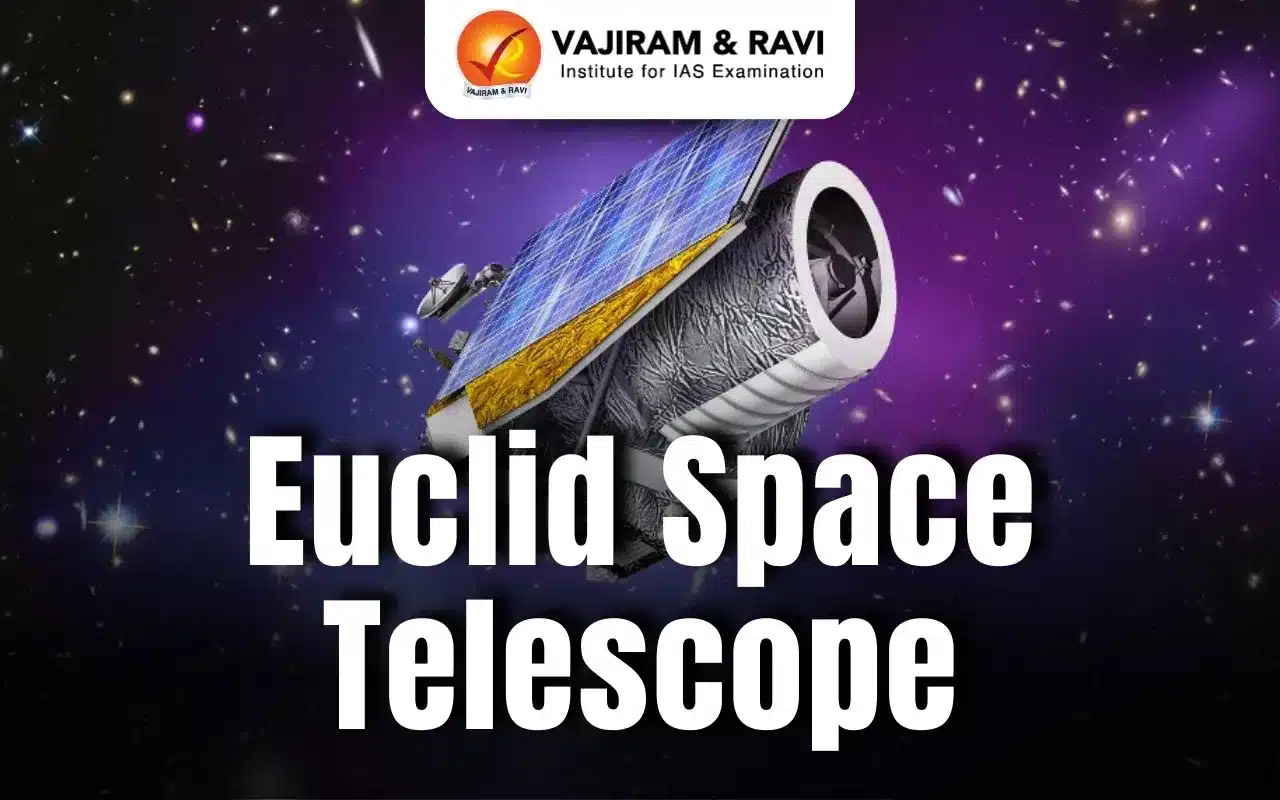
Recently, the Euclid space telescope has delivered one of the most detailed views ever captured of the Milky way galaxy’s crowded heart and revealed more than 60 million stars in a single extraordinary image.
About Euclid Space Telescope
- It is a 1.2-metre telescope launched in 2023 by the European Space Agency.
- Objectives
- It is designed to map large spatial structures, like galaxies, in our universe and help reconstruct how the universe expanded and how galaxy structures are shaped the way they appear today.
- It is designed to explore the composition and evolution of the dark Universe.
- The space telescope will create a great map of the large-scale structure of the Universe across space and time by observing billions of galaxies out to 10 billion light-years.
- It explores how the Universe has expanded and how structure has formed over cosmic history, revealing more about the role of gravity and the nature of dark energy and dark matter.


Payloads of Euclid Space Telescope
- It has two scientific payloads: Near-Infrared Spectrometer and Photometer (NISP) and Visible Imager (VIS).
- Visible-Wavelength Camera (VISible Instrument – VIS)
- It captures high-resolution images of galaxies.
- Helps detect tiny distortions in galaxy shapes caused by gravitational lensing—a method used to study dark matter.
- Near-Infrared Spectrometer and Photometer (NISP)
- It measures how fast galaxies are moving apart, providing insight into the influence of dark energy over time.
- Developed with NASA’s contribution, including sensor-chip electronics and detectors
Source: IT

 Last updated on Oct, 2026
→ UPSC 2027 Notification will be released on 13 January 2027 at upsconline.nic.in.
→ Check Nobel Prize 2026 Winners List here.
→ Download PIB PRiSM Monthly Magazine 2026 here.
→ Check UPSC Monthly Current Affairs Magazine The Recitals here.
→ Check out the latest UPSC Syllabus here.
→ Download UPSC Model Answers for Mains 2026
→ UPSC Mains Question Paper 2026 is out now for Essay & GS Paper 1, 2, 3 & 4.
→ UPSC Calendar 2027 has been released.
→ Enroll in Vajiram & Ravi’s UPSC Mains Test Series 2027 for structured answer writing practice, expert evaluation, and exam-oriented feedback.
→ Join Vajiram & Ravi’s UPSC Mentorship Program 2027 for personalized guidance, strategy planning, and one-to-one support from experienced mentors.
→ Go through the UPSC Mains Previous Year Papers to enhance your preparation.
→ UPSC has released UPSC Toppers List 2025 with the Civil Services final result on its official website.
→ Also check Best UPSC Coaching in India
Euclid Space Telescope FAQs
Q1. Why is L2 chosen for Euclid?+
Q2. When & where was Euclid launched?+
Tags: euclid space telescope prelims pointers upsc current affairs upsc prelims current affairs