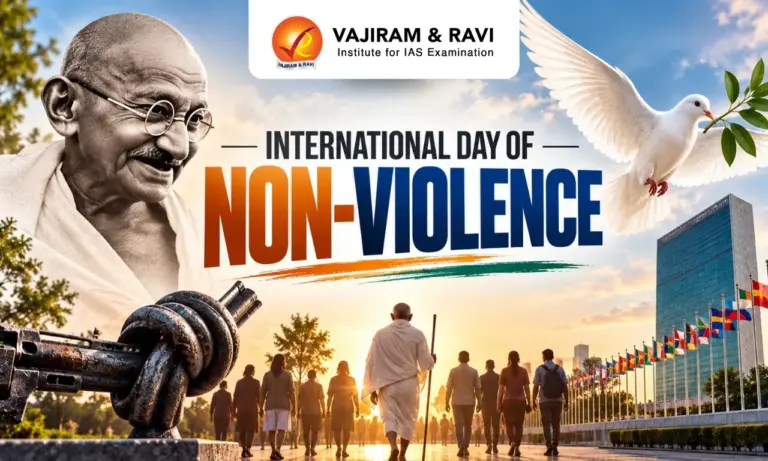
The International Day of Non-Violence is observed annually on the birth anniversary of Mahatma Gandhi, to promote the universal principles of non-violence, peace, tolerance and understanding.
About International Day of Non-Violence
- The International Day of Non-Violence is observed on 2 October, marking the birth anniversary of Mahatma Gandhi.
- The United Nations General Assembly established the International Day of Non-Violence through Resolution A/RES/61/271, adopted on 15 June 2007.
- The observance seeks to spread the message of non-violence through education and public awareness and reaffirm its relevance in building peaceful societies.
Gandhi’s Philosophy of Non-Violence
Gandhi’s philosophy of non-violence can be captured in his words: “Non-violence is the greatest force at the disposal of mankind. It is mightier than the mightiest weapon of destruction.” For Gandhi, non-violence was not passive submission to injustice but a method of resisting injustice through truth, moral force and peaceful action.
- Ahimsa: Gandhi regarded non-violence as an ethical principle and a way of life, rather than merely the absence of physical violence.
- Satyagraha: It represented the pursuit of truth through non-violent resistance and moral force.
- Non-Cooperation: It involved withdrawing cooperation from an unjust authority as a means of peaceful resistance.
- Civil Disobedience: It involved peacefully refusing to obey unjust laws while accepting the legal consequences.
- Dandi March 1930: It demonstrated how disciplined, non-violent mass mobilisation could challenge colonial authority.
Gandhi’s approach later influenced movements beyond India, including the US Civil Rights Movement led by Martin Luther King Jr., while the broader Gandhian tradition influenced several struggles for political and social change. The United Nations’ recognition of 2 October reflects the wider international relevance of this philosophy.


Contemporary Relevance
In a world marked by prolonged wars, armed conflicts, social polarisation and competing claims of justice, the principles underlying the International Day of Non-Violence remain relevant to the pursuit of peace and human dignity.
- Conflict and Justice: The pursuit of justice should not become a justification for hatred, indiscriminate violence or the denial of human dignity.
- Means and Ends: Gandhi’s philosophy emphasises that ethical ends must be pursued through ethical means.
- Peaceful Resolution: Dialogue, negotiation and reconciliation can address grievances while reducing the human costs of prolonged conflicts.
- Human Dignity: Ahimsa places respect for human life at the centre of responses to political and social conflicts.
- Tolerance and Pluralism: Non-violence encourages acceptance of differences and peaceful coexistence in diverse societies.
- Public Life: Values such as truth, self-restraint, empathy and compassion remain relevant to integrity and responsible conduct in public service.
- Global Peace: Gandhian thought reinforces the importance of dialogue, cooperation and the peaceful settlement of disputes.

 Last updated on Sep, 2026
→ UPSC 2027 Notification will be released on 13 January 2027 at upsconline.nic.in.
→ Asian Games 2026 are being held in Aichi-Nagoya, Japan, from 19 September to 4 October.
→ Check out the latest UPSC Syllabus here.
→ Download UPSC Model Answers for Mains 2026
→ UPSC Mains Question Paper 2026 is out now for Essay & GS Paper 1, 2, 3 & 4.
→ UPSC Calendar 2027 has been released.
→ Enroll in Vajiram & Ravi’s UPSC Mains Test Series 2027 for structured answer writing practice, expert evaluation, and exam-oriented feedback.
→ Join Vajiram & Ravi’s UPSC Mentorship Program 2027 for personalized guidance, strategy planning, and one-to-one support from experienced mentors.
→ Go through the UPSC Mains Previous Year Papers to enhance your preparation.
→ UPSC has released UPSC Toppers List 2025 with the Civil Services final result on its official website.
→ Also check Best UPSC Coaching in India
International Day of Non-Violence FAQs
Q1. When is the International Day of Non-Violence observed?+
Q2. When was the International Day of Non-Violence established?+
Q3. What is the objective of the International Day of Non-Violence?+
Q4. What is Satyagraha in Gandhi’s philosophy of non-violence?+
Q5. What is the significance of Gandhi’s philosophy for the International Day of Non-Violence?+
Tags: international day international day of non-violence