OCI Cardholders’ Rights in India Latest News
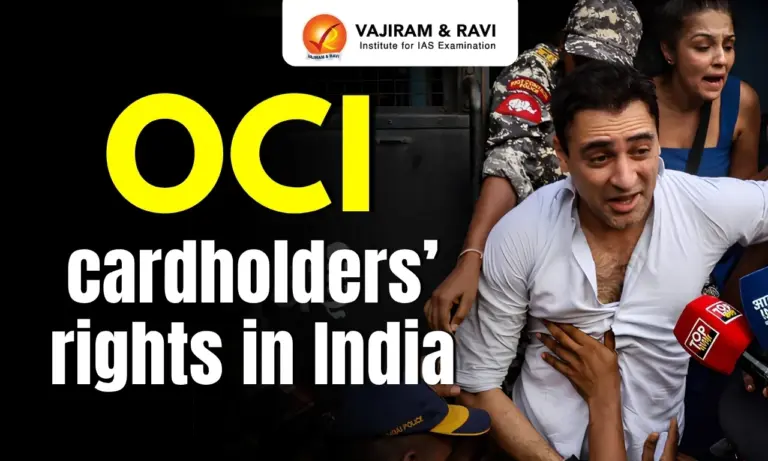
- Actor Imran Khan, a US citizen and Overseas Citizen of India (OCI) cardholder, was asked by the Foreigners Regional Registration Office (FRRO) to leave India by October 28.
- The FRRO issued the notice days after he joined a protest on October 10 at Mumbai’s August Kranti Maidan, demanding the resignation of Chief Election Commissioner Gyanesh Kumar.
- The episode raises a crucial constitutional question: what powers does the government actually hold over OCI cardholders?
Who Is an OCI, and What Rights Does the Status Carry?
- The OCI scheme was introduced in 2005 for certain foreign nationals of Indian origin.
- India does not permit dual citizenship — an OCI remains a foreign national holding another country’s passport.
- Key privileges: A multiple-entry lifelong visa, and exemption from FRRO registration regardless of stay duration. OCIs also get parity with Indian citizens/NRIs in certain property, educational, and professional matters.
Restrictions Under a March 2021 Notification
- OCIs need special permission before undertaking:
- Research, missionary/Tabligh work, mountaineering, journalistic activity.
- Certain employment/internships in foreign diplomatic establishments.
- Entering protected, restricted, or prohibited areas.
- Crucially: political protests are NOT listed among activities requiring prior permission.
Political Rights Denied to OCIs
- Under Section 7B of the Citizenship Act, OCIs cannot vote or contest elections.
- Article 19 rights (freedom of speech, peaceful assembly) are guaranteed specifically to citizens, not OCIs.


Can an OCI Be Asked to Leave for Joining a Protest?
- The Immigration and Foreigners Act, 2025 (in force since September 2025, replacing the Foreigners Act, 1946) gives the government wide powers over foreign nationals — and an OCI remains a foreigner for this purpose.
- No explicit ban exists on foreigners attending political rallies, but the law grants considerable executive discretion.
- Provisions Invoked Against Khan
- Section 7(2)(c): Empowers government to direct a foreigner shall not remain in India or in any specified area therein.
- Section 29: Empowers removal of a foreigner for violating the Act/rules, or based on an adverse security report. Officers may exercise reasonable enforcement powers.
- Key insight: The statute doesn’t designate “political protest” as prohibited conduct — but it gives the executive latitude to prohibit activities through specific orders or directions.
- Delegation of power: A September 2025 notification delegated powers under Sections 7(2) and 29 to FRROs and Foreigners Registration Officers — not confined to the Union Home Ministry alone.
A Relevant Precedent: The Kamil Siedczynski Case (2020)
- The Calcutta High Court quashed a Leave India Notice against Kamil Siedczynski, a Polish student who had joined an anti-CAA rally in Kolkata.
- The Court, applying the then Foreigners Act, held that mere participation in a political rally alone was insufficient to justify such action.
- It should be noted that the 2025 Act has since replaced that law, though it retains similarly broad executive powers.
OCI Registration Cancellation: A Separate, Stricter Process
- This is governed by Section 7D of the Citizenship Act — distinct from a “Leave India” notice.
- Grounds For Cancellation
- OCI obtained through fraud, false representation, or concealment.
- Disaffection towards the Constitution.
- Helping an enemy during war.
- Conviction for serious crime (in specified circumstances).
- Widest ground — Section 7D(e): Cancellation where the government deems it necessary for sovereignty, integrity, security of India, friendly relations with foreign countries, or “the general public.”
- Key safeguard: Unlike the power to direct a foreign national to leave India, cancellation expressly requires that the person be given a reasonable opportunity to be heard.
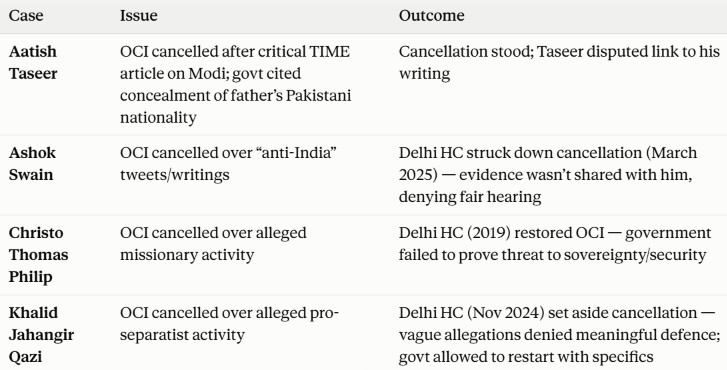
Precedents: How Courts Have Handled OCI Cancellations
- Courts have consistently struck down cancellations where evidence wasn’t disclosed or allegations were too vague to allow a fair defence.

What Can Khan Do Now?
- He can seek withdrawal/reconsideration from the FRRO or Central Government — but no comparable “right to be heard” is spelt out under Section 7 (unlike Section 7D cancellations).
- His stronger remedy: Approach the High Court under Article 226, challenging the notice’s legality and seeking interim protection. His lawyers have reportedly already done so.
- Unless withdrawn, modified, or stayed, the notice requires him to leave India by October 28.
Conclusion
- The Imran Khan episode exposes a structural asymmetry in how Indian law treats OCI cardholders: while cancelling OCI status demands a fair hearing under Section 7D, the “Leave India” power under the 2025 Immigration Act offers no equivalent procedural safeguard, resting instead on broad executive discretion.
- Past precedents — from Siedczynski to Swain to Qazi — suggest courts are willing to intervene when vague allegations substitute for evidence, but each case turns on specific facts.
- Whether Khan’s challenge succeeds will likely hinge on the same question: did mere participation in a protest, without more, justify invoking the law’s broadest immigration powers?

 Last updated on Oct, 2026
→ UPSC 2027 Notification will be released on 13 January 2027 at upsconline.nic.in.
→ Check Nobel Prize 2026 Winners List here.
→ Download PIB PRiSM Monthly Magazine 2026 here.
→ Check UPSC Monthly Current Affairs Magazine The Recitals here.
→ Check out the latest UPSC Syllabus here.
→ Download UPSC Model Answers for Mains 2026
→ UPSC Mains Question Paper 2026 is out now for Essay & GS Paper 1, 2, 3 & 4.
→ UPSC Calendar 2027 has been released.
→ Enroll in Vajiram & Ravi’s UPSC Mains Test Series 2027 for structured answer writing practice, expert evaluation, and exam-oriented feedback.
→ Join Vajiram & Ravi’s UPSC Mentorship Program 2027 for personalized guidance, strategy planning, and one-to-one support from experienced mentors.
→ Go through the UPSC Mains Previous Year Papers to enhance your preparation.
→ UPSC has released UPSC Toppers List 2025 with the Civil Services final result on its official website.
→ Also check Best UPSC Coaching in India
OCI Cardholders’ Rights in India FAQs
Q1. Who is an Overseas Citizen of India (OCI) cardholder? +
Q2. Can OCI cardholders participate in political protests in India? +
Q3. Which law allows authorities to direct an OCI cardholder to leave India? +
Q4. How does OCI registration cancellation differ from a Leave India notice? +
Q5. What legal remedy can an OCI cardholder pursue against a Leave India notice? +
Tags: mains articles OCI cardholders’ rights in India upsc current affairs upsc mains current affairs