Ladakh Governance Crisis Latest News
- The Centre took two significant steps in the seven-year-old Union Territory of Ladakh recently: a Ministry of Home Affairs (MHA) sub-committee shared a 32-page draft proposal with civil society leaders, while the Lieutenant Governor’s administration announced Sankoo as Ladakh’s eighth district.
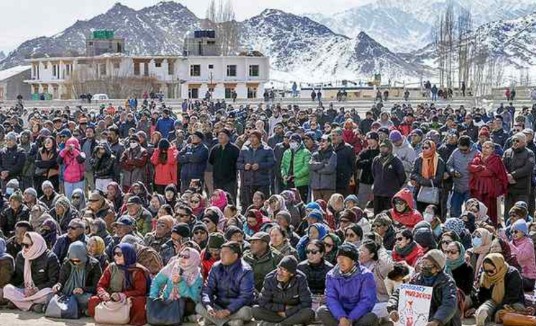
- Though seemingly unrelated, both moves reflect the Centre’s evolving approach to Ladakh’s persistent demands for Statehood and inclusion in the Sixth Schedule — demands that have fuelled recurring street protests since Ladakh was carved out as a UT from Jammu & Kashmir in 2019.
Why the Draft Proposal Was Rejected
- The Leh Apex Body (LAB) and Kargil Democratic Alliance (KDA) jointly rejected the draft in principle.
- Key grievances:
- The draft marked a significant departure from assurances made during earlier sub-committee meetings.
- It failed to address the demand for a legislative assembly.
- It offered no constitutional safeguards under Article 371 tailored to Ladakh’s unique circumstances.
- LAB and KDA urged the MHA to instead accept their own draft Memorandum of Understanding (MoU), submitted recently in Leh.
- Notably, not all civil society groups agree: The Civil Society Forum of Ladakh, led by ex-MP Thupstan Chhewang, welcomed the MHA’s roadmap — exposing growing internal friction among Ladakh’s civil society organisations.


Background: The High-Powered Committee (HPC)
- Amid rising protests, the MHA constituted a High-Powered Committee (HPC) in 2023, chaired by MoS Home Affairs Nityanand Rai.
- HPC’s Mandate:
- Protect Ladakh’s unique culture and language, factoring in its strategic location.
- Safeguard land and employment for locals.
- Promote inclusive development.
- Empower the Ladakh Autonomous Hill Development Councils (LAHDCs) of Leh and Kargil.
- Recommend constitutional safeguards to secure the above.
The May 2026 Commitment — And Why the New Draft Fell Short
- Centre-Ladakh talks in May 2026 produced minutes stating:
- Statehood would remain the long-term aspiration.
- As a first step, a “customised model of governance” via a UT-level elected body with executive, financial, and legislative powers would be established.
- A “sui generis” (unique) model under Article 371 was proposed.
- A key agreement: the elected body would gain control and supervision over civil servants, with Transaction of Business Rules to define power-sharing between the elected body and the Lieutenant Governor.
- LAB and KDA’s complaint: The new draft instead resembles a North-East Frontier Agency-type arrangement — closer to a Territorial Council model with power concentrated in the LG’s administration, falling far short of the legislature-backed sui generis model promised in May.
New Districts: A Parallel Governance Push
- Since 1947, Ladakh (population ~3.5 lakh, spread over 59,146 sq km of challenging cold-desert terrain) had only two districts: Leh (Buddhist-majority) and Kargil (Shia Muslim-majority).
- 2026 Reform: Creation of six new districts — Sankoo, Sham, Nubra, Changthang, Zanskar, and Drass — aimed at bringing administration closer to people.
- Each new district will get a hill council, with locals electing 26 members per council — intended to boost local representation.
- Existing hill councils: LAHDC-Leh (1995) and LAHDC-Kargil (2003) historically set local priorities and budgets, but their influence declined after 2019 under direct Central rule.
- The Ladakh administration is also pushing a three-tier representation system — elections for panchayats, municipalities, and hill councils — to strengthen participatory governance in a UT that still lacks a legislature.
Conclusion
- The Centre’s twin moves — a contested governance draft and the creation of new districts — reveal a dual-track strategy for Ladakh: offering administrative decentralisation through more districts and hill councils, while sidestepping the core political demand for a full legislature and constitutional safeguards.
- For Ladakh’s civil society, this distinction matters deeply — administrative proximity is not the same as political empowerment.
- Until the gap between the Centre’s May 2026 promises and its October draft is bridged, Ladakh’s demand for Statehood and Sixth Schedule protection is likely to remain a live political fault line, even as governance on the ground gradually decentralises.
Source: TH

 Last updated on Oct, 2026
→ UPSC 2027 Notification will be released on 13 January 2027 at upsconline.nic.in.
→ Check Nobel Prize 2026 Winners List here.
→ Download PIB PRiSM Monthly Magazine 2026 here.
→ Check UPSC Monthly Current Affairs Magazine The Recitals here.
→ Check out the latest UPSC Syllabus here.
→ Download UPSC Model Answers for Mains 2026
→ UPSC Mains Question Paper 2026 is out now for Essay & GS Paper 1, 2, 3 & 4.
→ UPSC Calendar 2027 has been released.
→ Enroll in Vajiram & Ravi’s UPSC Mains Test Series 2027 for structured answer writing practice, expert evaluation, and exam-oriented feedback.
→ Join Vajiram & Ravi’s UPSC Mentorship Program 2027 for personalized guidance, strategy planning, and one-to-one support from experienced mentors.
→ Go through the UPSC Mains Previous Year Papers to enhance your preparation.
→ UPSC has released UPSC Toppers List 2025 with the Civil Services final result on its official website.
→ Also check Best UPSC Coaching in India
Ladakh Governance Crisis FAQs
Q1. What is the main cause of the Ladakh governance crisis? +
Q2. Why did Ladakh’s civil society groups reject the Centre’s draft proposal? +
Q3. What role does the High-Powered Committee play in Ladakh? +
Q4. How will the creation of new districts affect Ladakh’s governance? +
Q5. Why is the Sixth Schedule important in the Ladakh governance crisis? +
Tags: Ladakh governance crisis mains articles upsc current affairs upsc mains current affairs