Advanced Emergency Braking System Latest News
The Ministry of Road Transport and Highways (MoRTH) recently proposed making Advanced Emergency Braking Systems (AEBS) mandatory for all new car models from October 1, 2030, to help reduce road accidents.
About Advanced Emergency Braking System
- AEBS is an active vehicle safety technology designed to prevent collisions or reduce their severity.
- It is a combination of braking and sensor technology integrated into automobiles to recognise and prevent crashes.
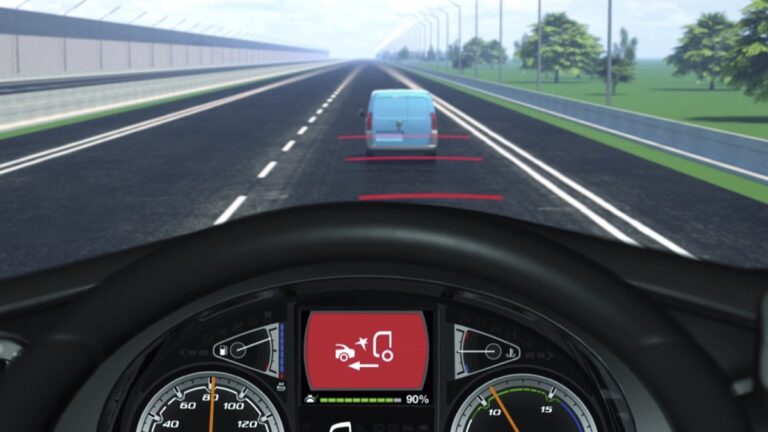
- The system continuously monitors the road ahead, warns the driver when it detects a potential collision with another vehicle, pedestrian, or cyclist, and automatically applies the brakes if the driver fails to respond in time.
- AEBS is a key feature of Advanced Driver Assistance Systems (ADAS), a collection of more than 100 electronic technologies designed to improve road safety.
- How does AEBS work?
- AEBS operates continuously while a vehicle is moving.
- It uses a combination of radar sensors, cameras, or Light Detection and Ranging (LiDAR) technology, typically mounted near the front bumper or windscreen, to assess the distance from obstacles, their relative speed, and the time remaining before a potential collision.
- The system generally works in three stages:
- Warning stage: When the system detects an obstacle approaching rapidly and calculates that a collision is imminent, it issues an audio-visual alert, such as a dashboard warning light and a beeping sound, prompting the driver to brake.
- Partial or pre-braking stage: If the driver does not respond, the system may apply a brief, sharp brake pulse as a warning and pre-charge the braking system to maximise stopping power.
- Full emergency braking stage: If the driver still fails to take action and a collision is imminent, AEBS automatically applies maximum braking force.
- AEBS can reduce the impact of various crashes, including head-on, rear-end, right-turn, and pedestrian collisions.


Which countries have adopted AEBS?
- The European Union made AEBS mandatory for new commercial vehicle and truck models from 2015.
- Under updated safety regulations, the requirement was extended to every newly registered passenger vehicle sold by May 2024.
- Japan adopted AEBS early, making it legally mandatory for all new passenger vehicles from the year 2021.
- United States: Between 2016 and 2022, a voluntary agreement between the National Highway Traffic Safety Administration (NHTSA) and 20 major automakers led to basic AEBS becoming standard in more than 95 percent of new cars.
- United Kingdom:
- The United Kingdom requires AEBS as standard on all newly registered passenger cars.
- China has also seen widespread adoption of AEBS, with more than 60 per cent of new passenger vehicles sold in the country already featuring the technology.
News: BS

 Last updated on Oct, 2026
→ UPSC 2027 Notification will be released on 13 January 2027 at upsconline.nic.in.
→ Check Nobel Prize 2026 Winners List here.
→ Download PIB PRiSM Monthly Magazine 2026 here.
→ Check UPSC Monthly Current Affairs Magazine The Recitals here.
→ Check out the latest UPSC Syllabus here.
→ Download UPSC Model Answers for Mains 2026
→ UPSC Mains Question Paper 2026 is out now for Essay & GS Paper 1, 2, 3 & 4.
→ UPSC Calendar 2027 has been released.
→ Enroll in Vajiram & Ravi’s UPSC Mains Test Series 2027 for structured answer writing practice, expert evaluation, and exam-oriented feedback.
→ Join Vajiram & Ravi’s UPSC Mentorship Program 2027 for personalized guidance, strategy planning, and one-to-one support from experienced mentors.
→ Go through the UPSC Mains Previous Year Papers to enhance your preparation.
→ UPSC has released UPSC Toppers List 2025 with the Civil Services final result on its official website.
→ Also check Best UPSC Coaching in India
Advanced Emergency Braking System FAQs
Q1. What is the Advanced Emergency Braking System (AEBS)?+
Q2. What is the primary objective of Advanced Emergency Braking System (AEBS)?+
Q3. Which technologies are commonly used by Advanced Emergency Braking System (AEBS) to detect obstacles?+
Q4. What factors does Advanced Emergency Braking System (AEBS) assess to identify a potential collision?+
Tags: advanced emergency braking system prelims pointers upsc current affairs upsc prelims current affairs