Lake Untersee Latest News
In January 2019, a rare glacial flood caused Lake Untersee to rise by two metres after a neighbouring lake released 17.5 million cubic metres of water.
About Lake Untersee
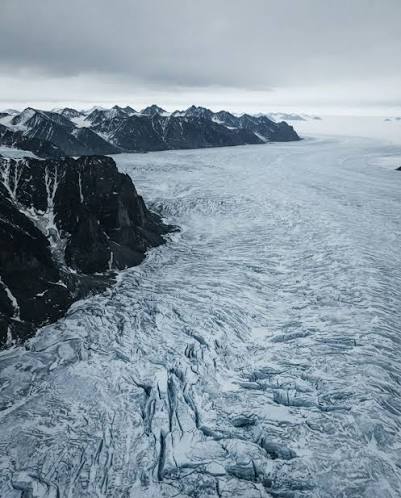
- Lake Untersee, meaning “lower lake” in German, is a uniquely isolated freshwater lake in Antarctica.
- It is one of Antarctica’s largest and deepest surface lakes.
- The lake’s maximum depth is thought to reach nearly 170 meters (558 feet).
- Despite being a surface lake, it remains frozen throughout the year because the region experiences mean annual temperatures of around- 10 degrees Celsius.
- Several meters of thick ice seal the lake from the atmosphere.
- Sunlight can still penetrate the ice and warm the water beneath it, but strong winds and cold surface temperatures cause evaporation and sublimation that prevent the ice from melting significantly.
- The lake’s water mainly comes from seasonal meltwater draining from the edges of the nearby Anuchin Glacier, which flows south from the Gruber Mountains.
- It is known for its distinctive water chemistry.
- Its ice-covered waters contain high levels of dissolved oxygen, very low levels of dissolved carbon dioxide, and a strongly alkaline, or basic, pH.
- It is one of the only perennially frozen lakes with a community of large, conical stromatolites.
- Stromatolites are layered microbial reef structures formed by communities of photosynthetic microbes, mainly cyanobacteria.
- These microbes grow slowly upward by trapping sediment on sticky surfaces and forming calcium carbonate mineral crusts. Over time, this process builds the layered formations.
- Stromatolites are some of the oldest biological structures on Earth, with fossils dating back more than 3 billion years.
- Untersee’s stromatolites grow unusually tall because they are sheltered from tides and waves beneath permanent ice, live in exceptionally clear waters with little sediment, grow toward limited light, and face little grazing.
- These conical stromatolites—as well as pinnacle and flat forms of the microbial communities—release oxygen that becomes trapped under the ice, increasing its concentration in the lake.
- The lake’s largest creatures are tardigrades—microscopic “water bear” invertebrates known for their ability to survive in extreme environments.
- Its icy environment and unusual chemistry make it a possible analogue for conditions on other worlds.
- Although Lake Unter-See appears stable, scientists have observed occasional changes.
- During fieldwork in 2019, researchers noticed that the lake’s water levels had risen.
News: TOI


 Last updated on Oct, 2026
→ UPSC 2027 Notification will be released on 13 January 2027 at upsconline.nic.in.
→ Check Nobel Prize 2026 Winners List here.
→ Download PIB PRiSM Monthly Magazine 2026 here.
→ Check UPSC Monthly Current Affairs Magazine The Recitals here.
→ Check out the latest UPSC Syllabus here.
→ Download UPSC Model Answers for Mains 2026
→ UPSC Mains Question Paper 2026 is out now for Essay & GS Paper 1, 2, 3 & 4.
→ UPSC Calendar 2027 has been released.
→ Enroll in Vajiram & Ravi’s UPSC Mains Test Series 2027 for structured answer writing practice, expert evaluation, and exam-oriented feedback.
→ Join Vajiram & Ravi’s UPSC Mentorship Program 2027 for personalized guidance, strategy planning, and one-to-one support from experienced mentors.
→ Go through the UPSC Mains Previous Year Papers to enhance your preparation.
→ UPSC has released UPSC Toppers List 2025 with the Civil Services final result on its official website.
→ Also check Best UPSC Coaching in India
Lake Untersee FAQs
Q1. What is Lake Untersee?+
Q2. Why is Lake Untersee significant?+
Q3. Why does the ice on Lake Untersee not melt significantly?+
Q4. What is the main source of water for Lake Untersee?+
Q5. What are the distinctive chemical characteristics of Lake Untersee?+
Tags: lake untersee prelims pointers upsc current affairs upsc prelims current affairs