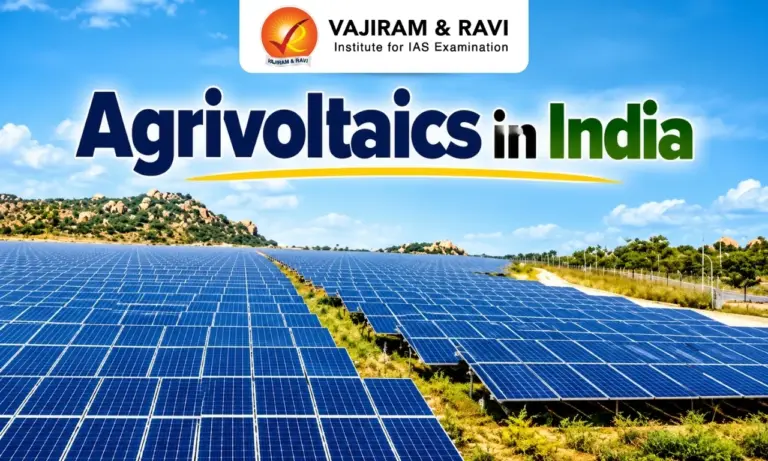
Agrivoltaics in India Latest News
- The Government recently announced plans to introduce agri-photovoltaics (agrivoltaics) under the second phase of PM-KUSUM (Pradhan Mantri Kisan Urja Suraksha evam Utthaan Mahabhiyan) — its flagship scheme to solarise irrigation.
- The approach combines solar power generation with crop cultivation on the same land, letting farmers keep growing crops while earning extra income from electricity generation.
- The announcement came at the Agrivoltaics World Conference 2026 – “Powering the Global South” in New Delhi on October 25.
What Is Agrivoltaics?
- Agri-photovoltaics (agri-PV) involves installing solar panels on elevated structures over agricultural land.
- This lets farmers continue cultivation underneath, while electricity is generated from the same plot.
- Technology-wise, the photovoltaic panels themselves are identical to those used in conventional ground-mounted solar projects.
- The key difference: the additional infrastructure needed to elevate the panels, leaving enough space below for farming activities to continue.
- As per MNRE, panels are installed at a height of 3.5 to 4 metres above ground — enough to allow routine agricultural operations, including movement of machinery, without interruption.


Why the Government Is Pushing This
- The govt said the approach could address the shortage of land for solar projects while letting farming continue beneath elevated panels.
- Around 30% of India’s 160 million hectares of cropland could be suitable for agrivoltaic projects.
- Potential capacity estimated at 1-2 terawatts (TW), or 1,000-2,000 gigawatts (GW) — a massive scale compared to India’s current total renewable capacity.
- Agri-PV is expected to mainly help states with less non-agricultural land, enabling large-scale solar deployment without compromising food security requirements.
Not All Crops Are Suitable
- Agrivoltaics doesn’t work uniformly across all crop types.
- Government assessment studies show agri-PV is suitable for fruits and leafy vegetables.
- It has not been found suitable for crops like rice and sugarcane — meaning the approach currently applies to a limited crop range.
The Cost Factor
- Agri-photovoltaic projects cost around 25-30% more than conventional ground-mounted solar projects, due to the additional civil and structural infrastructure needed to elevate panels.
- This higher upfront cost is a key challenge for scaling the model, especially for small and marginal farmers.
Concerns Over Crop Yields and Farmers’ Interests
- Most agri-PV projects in India are still at the pilot stage.
- The government faces the challenge of developing a policy framework that allows solar power generation to expand without compromising crop yields, soil health, or farmers’ livelihoods.
- Union Agriculture Minister Shivraj Singh Chouhan, speaking at the conference, flagged several issues needing resolution before the approach can be scaled up.
- Key farmer-equity concern: Over 85% of India’s farmers are small and marginal, with average landholding just 0.96 hectares.
- The minister stressed that the policy must be designed to benefit small farmers and protect agricultural production — not sideline them in favour of large-scale solar developers.
- The model must ensure farmers don’t lose control of their agricultural land or suffer a decline in crop production.
- Since most projects remain at the pilot stage, their impact on farming must be properly assessed before scaling up.
Conclusion
- Agrivoltaics represents a genuinely promising solution to one of India’s toughest land-use dilemmas: how to expand solar capacity without competing with agriculture for scarce land.
- With an estimated 1-2 terawatt potential, the approach could meaningfully advance India’s renewable energy goals while giving farmers a new income stream.
- However, with over 85% of India’s farmers being small and marginal landholders, and projects still largely at the pilot stage, the real test will be whether the policy framework protects farmer control over land, crop yields, and livelihoods — rather than letting higher project costs and limited crop suitability turn agrivoltaics into a model that benefits large developers more than the smallholders it is meant to serve.

 Last updated on Oct, 2026
→ UPSC 2027 Notification will be released on 13 January 2027 at upsconline.nic.in.
→ Check Nobel Prize 2026 Winners List here.
→ Download PIB PRiSM Monthly Magazine 2026 here.
→ Check UPSC Monthly Current Affairs Magazine The Recitals here.
→ Check out the latest UPSC Syllabus here.
→ Download UPSC Model Answers for Mains 2026
→ UPSC Mains Question Paper 2026 is out now for Essay & GS Paper 1, 2, 3 & 4.
→ UPSC Calendar 2027 has been released.
→ Enroll in Vajiram & Ravi’s UPSC Mains Test Series 2027 for structured answer writing practice, expert evaluation, and exam-oriented feedback.
→ Join Vajiram & Ravi’s UPSC Mentorship Program 2027 for personalized guidance, strategy planning, and one-to-one support from experienced mentors.
→ Go through the UPSC Mains Previous Year Papers to enhance your preparation.
→ UPSC has released UPSC Toppers List 2025 with the Civil Services final result on its official website.
→ Also check Best UPSC Coaching in India
Agrivoltaics in India FAQs
Q1. What is agrivoltaics in India? +
Q2. What are the benefits of agrivoltaics in India? +
Q3. Which crops are suitable for agrivoltaics in India? +
Q4. How much does agrivoltaics in India cost? +
Q5. What are the major challenges of agrivoltaics in India? +
Tags: Agrivoltaics in India mains articles upsc current affairs upsc mains current affairs