Special Executive Magistrates Latest News
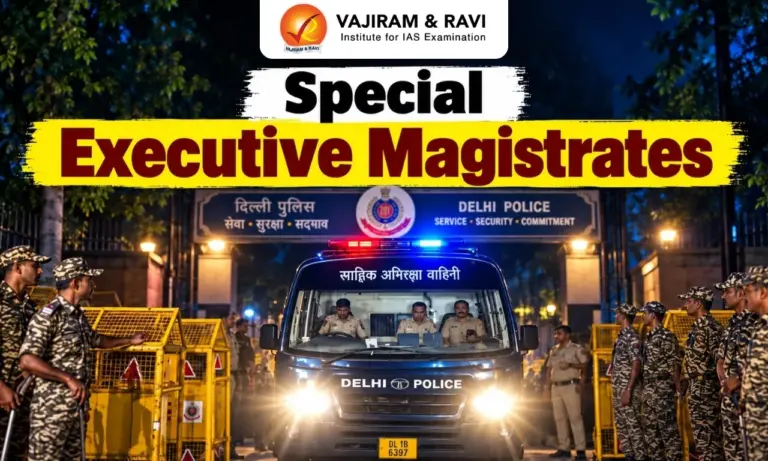
- The detention and subsequent bail of Cockroach Janta Party (CJP) activists Saurav Das and Ashutosh Ranka, along with a notice to AISA president Neha Bora, has brought the powers of Special Executive Magistrates (SEMs) under sharp scrutiny.
- Arrested on October 14, 2026, for allegedly breaching security at Jantar Mantar during protests against the Special Intensive Revision (SIR) of electoral rolls, their case has reopened a long-running debate: how much power should non-judicial officials wield over personal liberty?
Who Are SEMs, and How Do They Differ from Judicial Magistrates?
- State governments appoint SEMs for specific areas, periods, or purposes, granting them powers of Executive Magistrates under Section 15 of the BNSS (Bharatiya Nagarik Suraksha Sanhita), 2023.
- In Delhi, the Delhi Police Act empowers the Centre to authorise the Police Commissioner and officers not below ACP rank to exercise district/executive magistrate powers.
Key Distinction
- Executive Magistrates/SEMs function under the government, performing administrative and preventive roles. Their career progression depends on executive superiors, not the judiciary.
- Judicial Magistrates (BNSS Section 9) are appointed by High Courts, form part of the judicial system, and can conduct trials, grant bail, and impose sentences.
- SEMs cannot conduct criminal trials or convict — their role is strictly preventive, aimed at intervening before a disturbance occurs rather than punishing after an offence.


What Powers Do SEMs Actually Exercise?
- Peace Bonds (Section 126, BNSS): An SEM can require someone likely to breach peace to show cause why they shouldn’t execute a bond to maintain peace, for up to one year.
- Inquiry Process (Section 135): The magistrate inquires into the matter and may order a person to furnish security during the inquiry, recording reasons in writing.
- Breach Consequences (Section 141(1)(b)): If a peace bond is breached, the magistrate can order arrest or detention for the bond’s remaining period.
- Urgent Preventive Orders: SEMs can act against nuisance or apprehended danger — preventing obstruction, injury, threat to life, or public disturbance/riot.
- Preventive Arrest (Section 170): This is actually a police power, not exclusive to SEMs — police can arrest to prevent a cognisable offence.
Colonial Roots of Preventive Powers
- Preventive arrest provisions trace back to England’s Justices of the Peace Act, 1361, empowering “justices of peace” to restrain “offenders, rioters and barrators” via sureties of good behaviour.
- These provisions entered Indian law in 1861, continued through the CrPC, and now form part of the BNSS (enacted 2023, in force from July 1, 2024, replacing the CrPC).
A Recurring Pattern of Judicial Concern
- 1984 — Sunil Batra’s case: Death-row prisoner’s Tihar Jail application exposed unjustified arrests under old Section 107 CrPC, with cyclostyled (copy-pasted) proformas and no proper procedure. The Delhi HC directed individuals be informed of bond reasons, with warrants accompanying detention orders.
- 2018 — Delhi HC (Justices Muralidhar & Goel): Found nothing much appears to have changed since 1984 — cyclostyled proformas still in use. The court:
- Called for an oversight mechanism, possibly including retired district judges.
- Suggested renaming SEMs as “Special Executive Officers” to avoid confusion with judicial magistrates (not implemented).
- Recommended separate jail spaces for preventive detainees.
- Found “palpable bias” — a disproportionate share of detainees from minority communities and economically weaker sections unable to furnish sureties.
- 2018 — Delhi HC order: Capped preventive judicial custody at seven days at a time, requiring weekly SEM review of continued detention need.
- 2007 — Delhi HC (endorsing MP HC ruling): SEMs must record statements before initiating proceedings under Sections 107/116/151 CrPC, and orders must be well-reasoned, not mechanical.
- 2008 — Narmada Bachao Andolan case: MP High Court held that arresting Medha Patkar and 120 other protesters without due process violated their fundamental right to peaceful protest; ordered ₹10,000 compensation each for wrongful detention.
Can SEM Actions Be Challenged?
- Yes — SEM orders are subject to judicial review and administrative oversight, and can be challenged before appropriate courts/authorities depending on the order’s nature.
Conclusion
- The SEM controversy reflects a deeper constitutional tension that India has grappled with since the colonial era: the risk of blending executive and judicial functions in matters touching personal liberty.
- Despite repeated judicial interventions — from the 1984 Sunil Batra case to the 2018 Delhi High Court directions — courts have found the same procedural lapses recurring decades apart, including cyclostyled orders and disproportionate impact on marginalised groups.
- As the CJP case shows, SEMs continue to wield significant preventive power over protesters, even as their orders remain subject to judicial review.
- Until recommendations like independent oversight mechanisms and renaming SEMs are actually implemented, the gap between constitutional safeguards and ground-level practice is likely to persist.

 Last updated on Oct, 2026
→ UPSC 2027 Notification will be released on 13 January 2027 at upsconline.nic.in.
→ Check Nobel Prize 2026 Winners List here.
→ Download PIB PRiSM Monthly Magazine 2026 here.
→ Check UPSC Monthly Current Affairs Magazine The Recitals here.
→ Check out the latest UPSC Syllabus here.
→ Download UPSC Model Answers for Mains 2026
→ UPSC Mains Question Paper 2026 is out now for Essay & GS Paper 1, 2, 3 & 4.
→ UPSC Calendar 2027 has been released.
→ Enroll in Vajiram & Ravi’s UPSC Mains Test Series 2027 for structured answer writing practice, expert evaluation, and exam-oriented feedback.
→ Join Vajiram & Ravi’s UPSC Mentorship Program 2027 for personalized guidance, strategy planning, and one-to-one support from experienced mentors.
→ Go through the UPSC Mains Previous Year Papers to enhance your preparation.
→ UPSC has released UPSC Toppers List 2025 with the Civil Services final result on its official website.
→ Also check Best UPSC Coaching in India
Special Executive Magistrates FAQs
Q1. Who are Special Executive Magistrates? +
Q2. What powers do Special Executive Magistrates have under the BNSS? +
Q3. Can Special Executive Magistrates conduct criminal trials? +
Q4. Can orders issued by Special Executive Magistrates be challenged?+
Q5. Why has the CJP protest controversy raised concerns about Special Executive Magistrates?+
Tags: mains articles Special Executive Magistrates upsc current affairs upsc mains current affairs