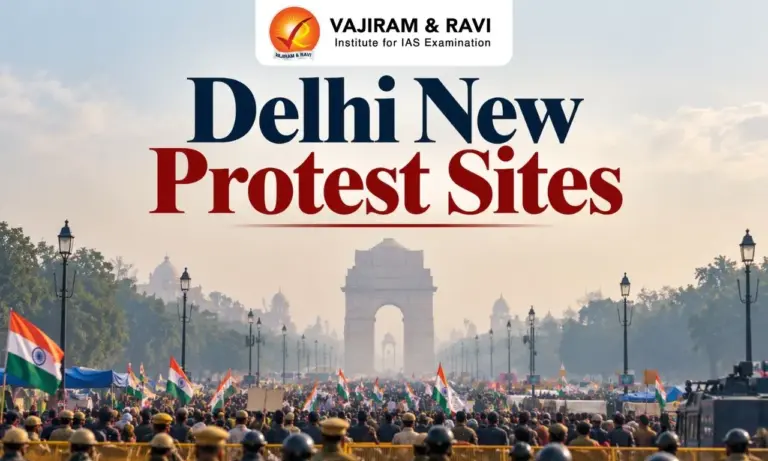
Delhi’s new protest sites have become a topic of discussion after Delhi Police removed Jantar Mantar from the list of designated protest venues in October 2026. The three alternative sites are Ramlila Maidan, Burari Ground and CBD Ground in East Delhi. The decision raises questions about the right to peaceful protest, public order and access to democratic spaces.
Why in News?
Delhi Police issued a Standing Order, removing Jantar Mantar as a designated protest site and identifying three alternative venues following recommendations from a committee constituted by the Union Ministry of Home Affairs.
Delhi New Protest Sites Three Alternative Venues
- Ramlila Maidan
- Location: Central Delhi.
- Capacity: Reportedly around 50,000 people.
- Significance: A major venue for political rallies and public demonstrations.
- Challenges: High booking costs, limited availability during major events and advance reservation requirements may make access difficult for smaller organisations.
- Burari Ground (Nirankari Ground)
- Location: North Delhi.
- Area: Approximately 50 acres.
- Significance: Its large open area can accommodate mass gatherings and large demonstrations.
- Challenges: Its distance from Parliament and central Delhi may increase travel costs and reduce the visibility of protests to policymakers and the media.
- CBD Ground
- Location: Shahdara, East Delhi.
- Area: Approximately 12 acres.
- Significance: Provides an additional venue for public demonstrations.
- Challenges: Its location in a busy residential and commercial area raises concerns about traffic congestion, accessibility and site management. <sup>[2]</sup>


Why Was Jantar Mantar Removed as a Protest Site?
Jantar Mantar was a prominent location for demonstrations because of its proximity to Parliament and other government institutions. The change has been associated with concerns about security, traffic management and the regulation of public gatherings.
However, shifting protests to distant venues may reduce their visibility and increase the financial and logistical burden on participants. The effectiveness of the new arrangements will depend on accessibility, reasonable booking conditions and transparent permission procedures.
Constitutional Provisions Related to the Right to Protest
Here are the important constitutional provisions related to the Right to Protest in India which are listed below.
- Article 19(1)(a): Protects freedom of speech and expression.
- Article 19(1)(b): Guarantees the right to assemble peaceably and without arms.
- Article 19(2): Permits reasonable restrictions on freedom of speech and expression on specified grounds.
- Article 19(3): Permits reasonable restrictions on peaceful assembly in the interests of India’s sovereignty and integrity and public order.
- Article 21: Protects life and personal liberty.
The right to protest is constitutionally protected but is not absolute. Authorities may regulate demonstrations to maintain public order, protect security and safeguard the rights of other citizens.
Supreme Court Judgments on the Right to Protest
Here are the important Supreme Court Judgments on the Right to Protest in India.
- Mazdoor Kisan Shakti Sangathan v. Union of India (2018): The Supreme Court emphasised the need to balance peaceful protest with the rights of residents and public order. The case concerned restrictions on demonstrations at Jantar Mantar.
- Amit Sahni v. Commissioner of Police (2020): The Court held that public roads and spaces cannot be occupied indefinitely in ways that seriously inconvenience others, while recognising the importance of peaceful dissent.
Challenges Associated with Delhi New Protest Sites
Important challenges associated with Delhi New Protest Sites have been highlighted below.
- Reduced visibility: Distant locations may weaken the reach and public impact of demonstrations.
- Financial barriers: Venue charges and transport costs may disproportionately affect smaller groups.
- Accessibility: Participants may face difficulties reaching sites located far from central Delhi.
- Infrastructure: Adequate sanitation, drinking water, shade and emergency services are essential.
- Public order: Authorities must balance the rights of protesters with traffic management and the interests of residents.
Way Forward
- Ensure that designated venues are accessible and affordable.
- Publish transparent rules for permissions, booking charges and capacity limits.
- Provide adequate public transport, sanitation and emergency facilities.
- Apply restrictions proportionately and provide clear reasons for denying permission.
- Maintain dialogue between police, protest organisers and local communities.
Conclusion
The issue of Delhi New Protest Sites highlights the need to balance peaceful dissent with public order. Designating alternative venues can help manage large gatherings, but these locations must provide a meaningful opportunity for citizens to express their grievances. Democratic governance requires both effective public administration and the protection of constitutional freedoms.

 Last updated on Oct, 2026
→ UPSC 2027 Notification will be released on 13 January 2027 at upsconline.nic.in.
→ Check Nobel Prize 2026 Winners List here.
→ Download PIB PRiSM Monthly Magazine 2026 here.
→ Check UPSC Monthly Current Affairs Magazine The Recitals here.
→ Check out the latest UPSC Syllabus here.
→ Download UPSC Model Answers for Mains 2026
→ UPSC Mains Question Paper 2026 is out now for Essay & GS Paper 1, 2, 3 & 4.
→ UPSC Calendar 2027 has been released.
→ Enroll in Vajiram & Ravi’s UPSC Mains Test Series 2027 for structured answer writing practice, expert evaluation, and exam-oriented feedback.
→ Join Vajiram & Ravi’s UPSC Mentorship Program 2027 for personalized guidance, strategy planning, and one-to-one support from experienced mentors.
→ Go through the UPSC Mains Previous Year Papers to enhance your preparation.
→ UPSC has released UPSC Toppers List 2025 with the Civil Services final result on its official website.
→ Also check Best UPSC Coaching in India
Delhi New Protest Sites FAQs
Q1. What are the new protest sites in Delhi?+
Q2. Why was Jantar Mantar removed as a designated protest site?+
Q3. Where is Ramlila Maidan located?+
Q4. Where is Burari Ground located?+
Q5. Where is CBD Ground located?+
Q6. Which constitutional articles protect the right to protest in India?+
Q7. Can the police restrict peaceful protests?+
Tags: delhi new protest sites protest sites