Coal Gasification Latest News
The Ministry of Coal has signed the Coal Gasification Plant Development and Production Agreement (CGPDPA) with selected applicants under Category II of the Coal Gasification Financial Incentive Scheme.
What is Coal Gasification?
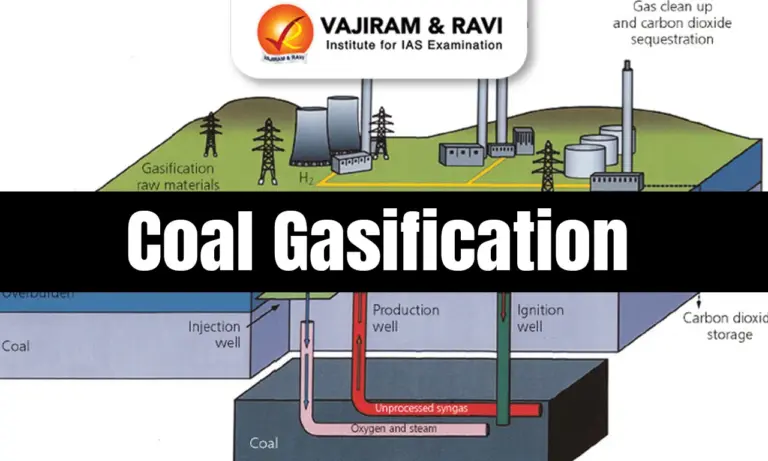
- Coal gasification is a thermo-chemical process that converts coal into syngas, a synthetic gas composed mainly of carbon monoxide (CO), hydrogen (H₂), carbon dioxide (CO₂), methane (CH₄), and water vapour (H₂O).
- Coal is reacted at high temperatures (1000–1400°C) with a controlled amount of oxygen and steam, producing syngas.
Process of Coal Gasification
- Preparation: Coal is finely crushed to increase surface area.
- Gasification reactor: The powdered coal is fed into a reactor with limited oxygen/air and steam.
- Chemical reactions: Coal breaks down into syngas components due to partial oxidation.
- Gas cleaning: Impurities like tar, sulfur, and dust are removed from raw syngas.





Ex-situ vs In-situ Gasification
|
Aspect |
Ex-situ Gasification |
In-situ Gasification |
|
Location |
Above ground in controlled gasifiers |
Underground, in coal seams |
|
Process |
Coal is extracted and gasified in reactors |
Oxygen and steam are injected into the coal seam to generate syngas underground |
|
Application |
Suitable for shallow reserves |
Ideal for deep or unmineable coal seams |
|
Efficiency |
More energy is used in mining and handling |
More energy-efficient for deeper deposits |
About the Coal Gasification Financial Incentive Scheme
- Launched: January 24, 2024.
- Total outlay: ₹8,500 crore.
- Target: Achieve 100 million tonnes of coal gasification by 2030.
- Aim: To efficiently utilise India’s domestic coal reserves for sustainable industrial development.
- It promotes both public and private sector participation for setting up coal gasification infrastructure.
- Aligned with India’s goal of a clean coal transition, energy security, and reduction of import dependency.
Coal Gasification FAQs
Q1. What is coal gasification?
Ans. Coal gasification is a process of converting coal into syngas (a mixture of carbon monoxide, hydrogen, and carbon dioxide), which can be used for power generation and as chemical feedstock.
Q2. What are syngas used for?
Ans. Syngas is used for electricity generation, production of methanol, fertilisers, and as a substitute for natural gas.
Source: PIB
Beta feature

 Last updated on March, 2026
→ UPSC Final Result 2025 is now out.
→ UPSC has released UPSC Toppers List 2025 with the Civil Services final result on its official website.
→ Anuj Agnihotri secured AIR 1 in the UPSC Civil Services Examination 2025.
→ UPSC Marksheet 2025 is now out.
→ UPSC Notification 2026 & UPSC IFoS Notification 2026 is now out on the official website at upsconline.nic.in.
→ UPSC Calendar 2026 has been released.
→ Check out the latest UPSC Syllabus 2026 here.
→ UPSC Prelims 2026 will be conducted on 24th May, 2026 & UPSC Mains 2026 will be conducted on 21st August 2026.
→ The UPSC Selection Process is of 3 stages-Prelims, Mains and Interview.
→ Prepare effectively with Vajiram & Ravi’s UPSC Prelims Test Series 2026 featuring full-length mock tests, detailed solutions, and performance analysis.
→ Enroll in Vajiram & Ravi’s UPSC Mains Test Series 2026 for structured answer writing practice, expert evaluation, and exam-oriented feedback.
→ Join Vajiram & Ravi’s Best UPSC Mentorship Program for personalized guidance, strategy planning, and one-to-one support from experienced mentors.
→ Shakti Dubey secures AIR 1 in UPSC CSE Exam 2024.
→ Also check Best UPSC Coaching in India
Tags: Coal Gasification prelims pointers upsc prelims current affairs