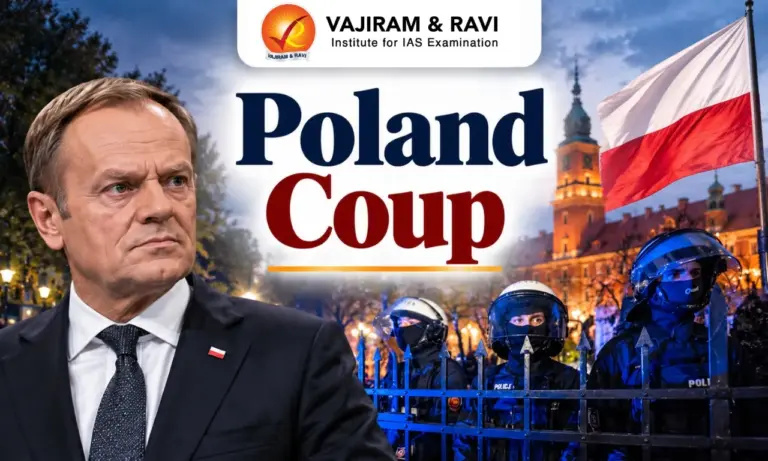
Poland is facing a major constitutional crisis following the reported suspension of the President of its Constitutional Tribunal, Bogdan Święczkowski, on 30 October 2026. The development has intensified the confrontation between Prime Minister Donald Tusk’s government and President Karol Nawrocki, backed by the opposition Law and Justice (PiS) party.
The opposition has described the move as a coup, while the government maintains that it is aimed at restoring judicial independence. However, there has been no confirmed military coup or overthrow of the elected government. The crisis centres on judicial appointments, the leadership of the Constitutional Tribunal and the limits of constitutional powers.
Poland’s Political System: President, Prime Minister and Constitutional Tribunal
Poland is a parliamentary republic with a directly elected President and a Prime Minister who heads the government.
- President: Head of State, elected directly by citizens. Has constitutional responsibilities, including a role in the judicial appointment process.
- Prime Minister: Head of Government, responsible for executive administration and dependent on parliamentary support.
- Parliament: Bicameral legislature comprising the Sejm (lower house) and Senate (upper house). The Sejm elects judges to the Constitutional Tribunal.
- Poland Constitutional Tribunal: Reviews the constitutionality of laws and other legal provisions.
The current crisis concerns the composition and leadership of this Tribunal.
Poland Constitutional Crisis 2026: What Happened on 30 October?
On 30 October 2026, Constitutional Tribunal judge Anna Korwin-Piotrowska announced the suspension of Tribunal President Bogdan Święczkowski and Vice-President Bartłomiej Sochański.
She accused the Tribunal’s leadership of obstructing judges elected by the current parliamentary majority from taking their positions.
However, the existing Tribunal leadership rejected the suspension and questioned Korwin-Piotrowska’s authority. It maintained that Święczkowski remained the Tribunal’s President.
The confrontation triggered protests in Warsaw and police deployment near the Tribunal. President Karol Nawrocki also cut short his visit to Senegal and returned to Poland amid the escalating dispute.
Also Read:- Poland


Background to the Poland Constitutional Crisis
The present crisis originates in the judicial reforms introduced by the Law and Justice (PiS) government and the subsequent efforts of Donald Tusk’s government to reverse them.
2015-2023: Judicial reforms under PiS
The conflict began in 2015 when the incoming PiS government challenged appointments of judges made by the outgoing Parliament. It subsequently introduced changes to the judicial system that raised concerns about political influence over courts.
The European Union questioned whether these reforms undermined judicial independence and the separation of powers.
2023: Donald Tusk comes to power
A coalition led by Donald Tusk defeated PiS and formed the government. It promised to restore judicial independence and address the rule-of-law concerns raised by the European Union.
2025-2026: Presidential opposition and judicial appointments
Karol Nawrocki became President in 2025 with PiS support. In 2026, he refused to swear in three of the six judges elected by Parliament to the Constitutional Tribunal. The Tribunal’s existing leadership also declined to allow judges elected by the current parliamentary majority to take their positions.
These disagreements deepened the conflict over the Tribunal’s composition and authority.
Why Has the Poland Constitutional Crisis Been Called a Coup?
The opposition has described the government’s actions as a coup because it believes that the government is attempting to take control of a constitutional institution by bypassing established procedures.
The government argues that the existing Tribunal leadership has obstructed legitimate judicial appointments and that corrective action is necessary to restore the rule of law.
The controversy raises an important constitutional question: Can a government restore judicial independence through actions whose own constitutionality is disputed?
Thus, the crisis is fundamentally about the conflict between institutional reform and adherence to constitutional procedures.
European Union’s Concerns over Judicial Independence in Poland
The European Union (EU) has raised concerns over Poland’s judicial reforms, arguing that they undermine judicial independence and the rule of law.
Article 7 of the Treaty on European Union (TEU)
- In 2017, the European Commission initiated proceedings under Article 7 of the TEU against Poland over concerns about the independence of its judiciary.
- Article 7 provides a mechanism to address a serious risk of a member state’s violation of the EU’s fundamental values, including democracy, human rights and the rule of law.
- The European Commission closed the proceedings against Poland in May 2024, following the new government’s commitments to restore judicial independence.
CJEU Ruling on Poland’s Constitutional Tribunal (2025)
On 18 December 2025, the Court of Justice of the European Union (CJEU) ruled in Commission v Poland Case that Poland’s Constitutional Tribunal did not meet the requirements of an independent and impartial court.
The ruling identified serious irregularities in the appointment of three judges and the Tribunal’s President. It also highlighted violations concerning the primacy of EU law and the right to effective judicial protection.
Constitutional Issues Raised by the Poland Crisis
The crisis highlights three important principles of constitutional governance:
- Judicial independence: Courts must function without improper political interference. Disputed judicial appointments can weaken public confidence in the impartiality of the judiciary.
- Separation of powers: The legislature, executive and judiciary must operate within their constitutionally defined powers. Institutional conflict can undermine this balance.
- Rule of law: Government actions, including judicial reforms, must follow established constitutional procedures. The objective of restoring judicial independence cannot justify arbitrary exercise of state power.
Implications for Poland and European Democracy
The continuing confrontation could lead to institutional deadlock, uncertainty over the validity of judicial decisions and declining public trust in the judiciary. It may also deepen political polarisation and renew concerns within the European Union about Poland’s commitment to the rule of law.
More broadly, the crisis demonstrates that electoral legitimacy alone cannot guarantee democratic governance. Independent institutions, constitutional accountability and respect for legal procedures are equally important.

 Last updated on Oct, 2026
→ UPSC 2027 Notification will be released on 13 January 2027 at upsconline.nic.in.
→ Check Nobel Prize 2026 Winners List here.
→ Download PIB PRiSM Monthly Magazine 2026 here.
→ Check UPSC Monthly Current Affairs Magazine The Recitals here.
→ Check out the latest UPSC Syllabus here.
→ Download UPSC Model Answers for Mains 2026
→ UPSC Mains Question Paper 2026 is out now for Essay & GS Paper 1, 2, 3 & 4.
→ UPSC Calendar 2027 has been released.
→ Enroll in Vajiram & Ravi’s UPSC Mains Test Series 2027 for structured answer writing practice, expert evaluation, and exam-oriented feedback.
→ Join Vajiram & Ravi’s UPSC Mentorship Program 2027 for personalized guidance, strategy planning, and one-to-one support from experienced mentors.
→ Go through the UPSC Mains Previous Year Papers to enhance your preparation.
→ UPSC has released UPSC Toppers List 2025 with the Civil Services final result on its official website.
→ Also check Best UPSC Coaching in India
Poland Coup 2026 FAQs
Q1. What is the Poland Coup 2026?+
Q2. Why is Poland facing a constitutional crisis in 2026?+
Q3. Who is the President and Prime Minister of Poland in 2026?+
Q4. What is the Constitutional Tribunal of Poland?+
Q5. What is Article 7 of the EU Treaty?+
Tags: poland coup poland coup 2026