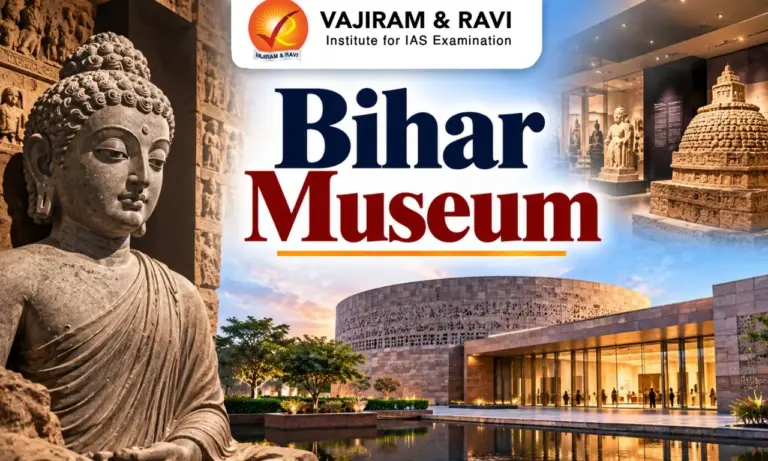
Bihar Museum is an important cultural and historical institution located in Patna, Bihar. It preserves and displays the rich historical heritage of the state through ancient sculptures, archaeological remains, coins, manuscripts, paintings and traditional artworks. The museum highlights Bihar’s contribution to ancient Indian civilisation, art, architecture and culture.
Established as a modern cultural institution, Bihar Museum provides visitors with an opportunity to explore different phases of the region’s history. It has also gained international recognition for its position in the World’s 100 Best Museums 2026 list.
Why in News?
The Bihar Museum in Patna secured the ninth position in the World’s 100 Best Museums 2026 list, published by the German travel publication Worth a Journey.
The major highlights of this achievement are:
- Ninth position globally: Bihar Museum secured the ninth rank among the world’s 100 best museums in 2026.
- Highest-ranked museum in Asia: It emerged as the highest-ranked museum in Asia on the list.
- Only Indian museum: It was the only museum from India to feature in the global top 100.
- International recognition: The museum received recognition alongside internationally renowned cultural institutions.
History of Bihar Museum
The Bihar Museum was established to preserve and promote the historical, archaeological and cultural heritage of Bihar. The idea behind its development was to create a modern institution with sufficient space to display the state’s extensive collection of historical artefacts.
The Patna Museum, established in 1917, had accumulated a large collection of historical objects. However, limited exhibition space restricted the display of many artefacts.
To address this challenge, the Bihar government planned a new museum with modern infrastructure and international architectural standards.
The important developments associated with Bihar Museum include:
- 2013: Construction of Bihar Museum began in Patna.
- 2015: The museum was partially opened to visitors.
- 2017: It became fully operational.
- Subsequent years: The institution expanded its exhibitions, educational activities, cultural programmes and conservation initiatives.
The museum houses collections representing different historical periods, from prehistoric times to 1764, along with traditional and contemporary artworks.


Architecture of Bihar Museum
The architecture of Bihar Museum combines modern architectural concepts with elements reflecting the cultural identity of Bihar. It was designed through an international collaboration involving Japanese architect Fumihiko Maki and Mumbai-based architectural firm Studio Opolis.
The major architectural features include:
- Contemporary design: The museum follows modern architectural principles while maintaining a connection with Bihar’s historical identity.
- Courtyards and open spaces: Its buildings are connected through open courtyards, corridors and landscaped areas.
- Weathering steel: The exterior features weathering steel, which gives the structure its distinctive rust-coloured appearance.
- Use of natural materials: Materials such as stone, terracotta and glass contribute to its architectural character.
- Modern galleries: The museum has organised exhibition spaces that allow visitors to explore different historical periods and artistic traditions.
Major Collections and Attractions of Bihar Museum
The Bihar Museum collections represent the historical, archaeological and artistic development of the region. They include sculptures, coins, terracotta objects, paintings, manuscripts and other artefacts.
1. Didarganj Yakshi
The Didarganj Yakshi is among the most famous attractions of Bihar Museum. It is a life-sized sculpture made from highly polished Chunar sandstone.
Important facts about the sculpture include:
- It was discovered at Didarganj in Patna in 1917.
- It represents a Yakshi, a female figure associated with ancient Indian religious and artistic traditions.
- The figure holds a fly-whisk, known as a chauri, in its right hand.
- It is approximately 5 feet 2 inches tall.
- The sculpture is particularly famous for its polished surface and detailed craftsmanship.
2. Mauryan and Gupta Period Artefacts
The museum displays several artefacts representing important historical periods, including the Mauryan, Sunga, Kushana, Gupta and Pala periods.
These collections provide information about the development of:
- Ancient Indian sculpture and architecture.
- Religious traditions and cultural practices.
- Stone-carving and artistic techniques.
- Political and social developments in different historical periods.
3. Kurkihar Bronzes
The Kurkihar bronzes represent the rich metalworking and religious artistic traditions of Bihar.
These bronze sculptures are particularly significant for understanding the development of Buddhist art and bronze craftsmanship in eastern India. They provide insights into the artistic excellence and religious traditions of the region.
4. Coins and Terracotta Artefacts
Bihar Museum also preserves ancient coins, terracotta objects and archaeological materials that provide information about the economic and social conditions of different historical periods.
These artefacts help researchers understand:
- Ancient trade and commercial activities.
- Economic conditions and monetary systems.
- Religious beliefs and cultural practices.
- Everyday life and traditional craftsmanship.
5. Patna Kalam Paintings
Patna Kalam is a traditional painting style that developed in and around Patna.
It is known for depicting everyday life, occupations, local markets, social customs and cultural activities. The artistic tradition provides valuable insights into the social history of the region.
The museum’s collections help preserve and promote Bihar’s traditional painting and artistic heritage.
6. Children’s Gallery
The Children’s Gallery at Bihar Museum provides an interactive learning environment for young visitors.
It includes educational activities, storytelling, sculpture puzzles, fossil replicas and other engaging displays.
The gallery aims to develop children’s interest in history, science, art and cultural heritage through interactive experiences.
Significance of Bihar Museum
The Bihar Museum plays an important role in preserving the historical and cultural identity of the state. Its contribution extends beyond displaying historical objects to promoting education, research, tourism and heritage conservation.
- Historical preservation: It preserves valuable archaeological objects, sculptures, manuscripts and artworks associated with Bihar’s history.
- Understanding ancient civilisation: Its collections provide insights into important historical periods, including the Mauryan, Gupta and Pala periods.
- Promotion of regional art: It showcases traditional artistic practices, including Patna Kalam, folk art and contemporary artworks.
- Educational importance: Its galleries and interactive facilities support students, researchers and history enthusiasts.
- Cultural tourism: It attracts visitors interested in Bihar’s historical and artistic heritage.
- International collaboration: Exhibitions and cultural programmes connect Bihar’s heritage with global audiences.
- Heritage conservation: Its conservation initiatives support the scientific preservation and restoration of valuable artefacts.
Bihar Museum’s Global Recognition Significance
The ninth position in the World’s 100 Best Museums 2026 list is an important milestone for Bihar’s cultural heritage.
This recognition is significant because:
- It brings international recognition to Bihar’s historical and artistic heritage.
- It highlights the importance of modern museum infrastructure in preserving cultural identity.
- It promotes cultural tourism and international collaboration.
- It encourages investment in heritage conservation and museum development.
- It strengthens India’s representation in the global cultural landscape.

 Last updated on Oct, 2026
→ UPSC 2027 Notification will be released on 13 January 2027 at upsconline.nic.in.
→ Check Nobel Prize 2026 Winners List here.
→ Download PIB PRiSM Monthly Magazine 2026 here.
→ Check UPSC Monthly Current Affairs Magazine The Recitals here.
→ Check out the latest UPSC Syllabus here.
→ Download UPSC Model Answers for Mains 2026
→ UPSC Mains Question Paper 2026 is out now for Essay & GS Paper 1, 2, 3 & 4.
→ UPSC Calendar 2027 has been released.
→ Enroll in Vajiram & Ravi’s UPSC Mains Test Series 2027 for structured answer writing practice, expert evaluation, and exam-oriented feedback.
→ Join Vajiram & Ravi’s UPSC Mentorship Program 2027 for personalized guidance, strategy planning, and one-to-one support from experienced mentors.
→ Go through the UPSC Mains Previous Year Papers to enhance your preparation.
→ UPSC has released UPSC Toppers List 2025 with the Civil Services final result on its official website.
→ Also check Best UPSC Coaching in India
Bihar Museum FAQs
Q1. Where is Bihar Museum located?+
Q2. Who designed Bihar Museum?+
Q3. When was Bihar Museum established?+
Q4. What is the most famous attraction of Bihar Museum?+
Q5. Why is Bihar Museum in the news in 2026?+
Q6. Which historical periods are represented in Bihar Museum?+
Tags: bihar museum