Gharials Latest News
Recently, 31 gharial hatchlings have been released in the Bagaha area along the Gandak River in Bihar.
About Gharials
- It is a freshwater crocodile belonging to the Crocodylia Order and Crocodylidae Family.
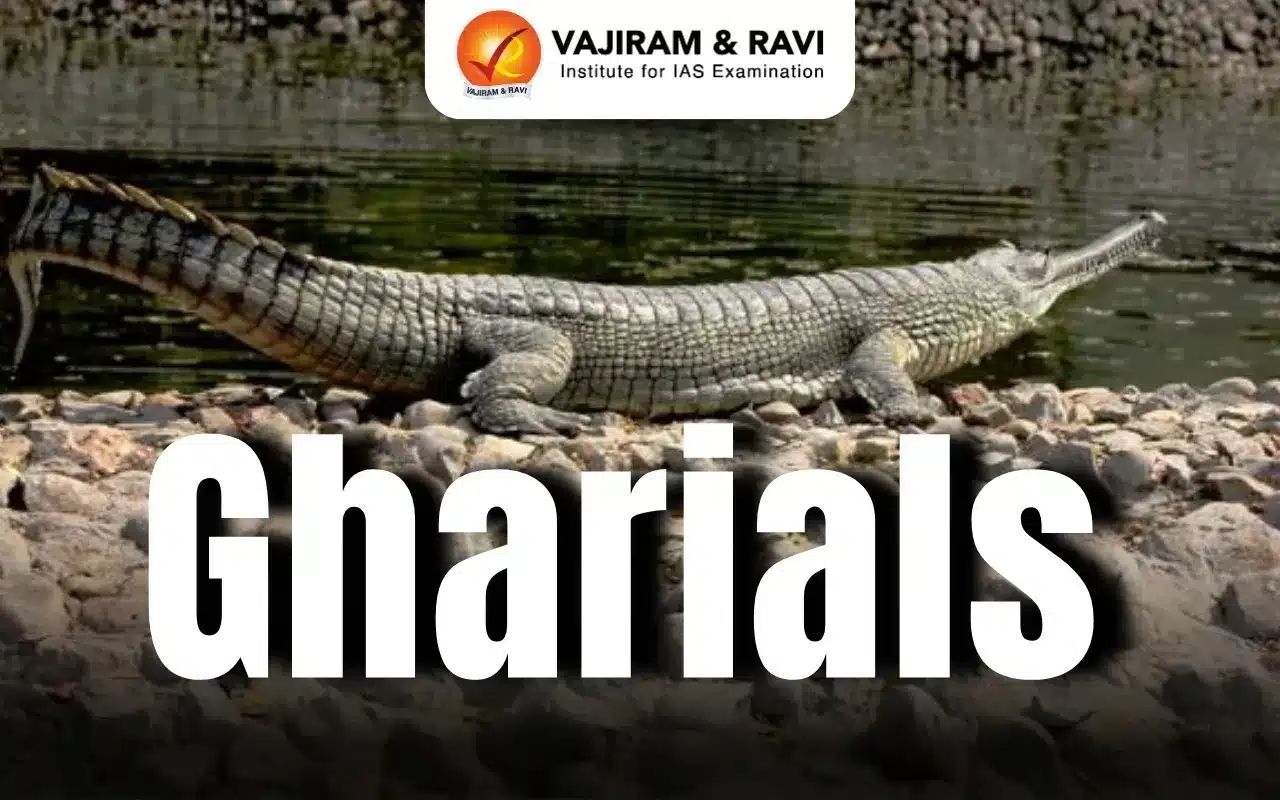
- The name ‘gharial’ comes from the Hindi word ghara, meaning pot or vessel, referring to the bulbous snout tip of adult males, which resembles an inverted pot.
- Habitat Preference: Gharials inhabit deep, clear, freshwater rivers with sandy banks, primarily within Himalayan river systems.
- Distribution: It is mainly found in the rivers of Bangladesh, Bhutan, India, Myanmar, Nepal, and Pakistan.
- Their major population occurs in three tributaries of the Ganga River: the Chambal (Hosts the largest wild population) and Girwa Rivers in India and the Rapti-Naryani River in Nepal.
- The Gharial reserves of India are located in three States: Uttar Pradesh, Madhya Pradesh, and Rajasthan.
- Diet: Predominantly piscivorous, gharials play a key role in regulating fish diversity and maintaining riverine ecological balance.


Features of Gharials
- It is one of the largest crocodilians.
- They have thick skin covered with smooth epidermal scales that do not overlap.
- The snout of the gharial is uniquely the thinnest and most elongated among all the crocodilians.
- In addition, the adult males sport a large bulb at the tip of their snout, called the ‘ghara’.
- It is also the most aquatic of all crocodilians, for it never moves far from the water. Individuals typically only leave the water to bask and nest on sandbanks.
- Reproduction: They mate during November–January and lay eggs March–May.
Conservation Status of Gharials
- IUCN Red List: Critically endangered
- CITES: Appendix I
- Wildlife Protection Act 1972: Schedule I.
Source: IT

 Last updated on Oct, 2026
→ UPSC 2027 Notification will be released on 13 January 2027 at upsconline.nic.in.
→ Check Nobel Prize 2026 Winners List here.
→ Download PIB PRiSM Monthly Magazine 2026 here.
→ Check UPSC Monthly Current Affairs Magazine The Recitals here.
→ Check out the latest UPSC Syllabus here.
→ Download UPSC Model Answers for Mains 2026
→ UPSC Mains Question Paper 2026 is out now for Essay & GS Paper 1, 2, 3 & 4.
→ UPSC Calendar 2027 has been released.
→ Enroll in Vajiram & Ravi’s UPSC Mains Test Series 2027 for structured answer writing practice, expert evaluation, and exam-oriented feedback.
→ Join Vajiram & Ravi’s UPSC Mentorship Program 2027 for personalized guidance, strategy planning, and one-to-one support from experienced mentors.
→ Go through the UPSC Mains Previous Year Papers to enhance your preparation.
→ UPSC has released UPSC Toppers List 2025 with the Civil Services final result on its official website.
→ Also check Best UPSC Coaching in India
Gharials FAQs
Q1. Gharial is listed under which Schedule of Wildlife Protection Act, 1972?+
Q2. Gharials are found mainly in which river system of India?+
Tags: gharials