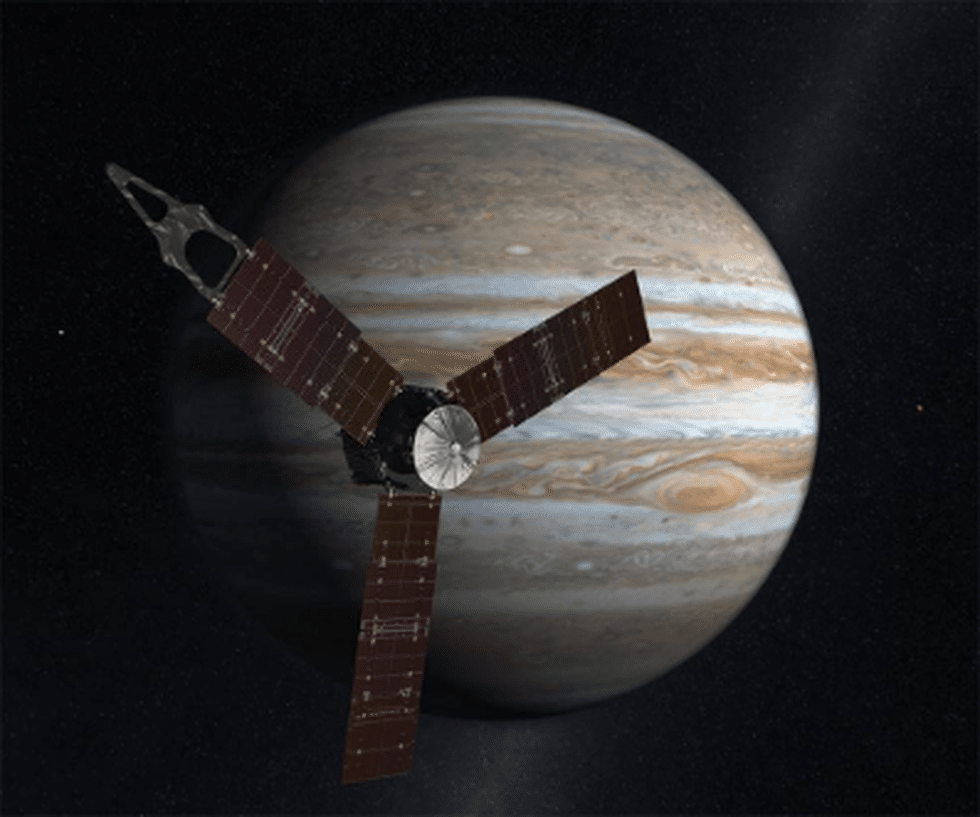
About Juno spacecraft:
- JUNO is an acronym for Jupiter Near-polar Orbiter.
- It was launched in 2011, the Juno spacecraft initially embarked on a 5-year journey to the largest planet in our solar system.
- Towards the end of its primary mission, the spacecraft’s objectives evolved, and it transitioned into a full Jupiter system explorer with flybys of Jovian moons.
- Goal: Understand the origin and evolution of Jupiter, look for a solid planetary core, map the magnetic field, measure water and ammonia in the deep atmosphere, and observe auroras.
Key facts about Moon Io
- Io is the most volcanically active world in solar system and it has hundreds of volcanoes that often erupt with molten lava and sulphurous gases.
- It is slightly larger than the Earth’s Moon and has a diameter that is about one-quarter that of our planet.
- It is tidally locked to Jupiter, meaning that one side of the Moon always faces the planet.
- It takes around 1.8 Earth days to both rotate on its axis and revolve once around Jupiter.
- It has a very thin atmosphere that is primarily made of sulphur dioxide but one of the most interesting features of the Jovian moons is its volcanoes.
- The Juno mission has given scientists the closest look at Io since 2007 and it will continue to gather images and science data during even close flybys later this year and early in 2024.
Q1) What is magnetic field?
A magnetic field is a region in space where magnetic forces are exerted on objects or particles that possess magnetic properties. Magnetic fields are created by the motion of electric charges, typically electrons, within atoms or by the motion of charged particles in electric currents.
Source: NASA’s Juno spacecraft captures spectacular portrait of Jupiter and its moon Io


 Last updated on Sep, 2026
→ UPSC 2027 Notification will be released on 13 January 2027 at upsconline.nic.in.
→ Asian Games 2026 are being held in Aichi-Nagoya, Japan, from 19 September to 4 October.
→ Check out the latest UPSC Syllabus here.
→ Download UPSC Model Answers for Mains 2026
→ UPSC Mains Question Paper 2026 is out now for Essay & GS Paper 1, 2, 3 & 4.
→ UPSC Calendar 2027 has been released.
→ Enroll in Vajiram & Ravi’s UPSC Mains Test Series 2027 for structured answer writing practice, expert evaluation, and exam-oriented feedback.
→ Join Vajiram & Ravi’s UPSC Mentorship Program 2027 for personalized guidance, strategy planning, and one-to-one support from experienced mentors.
→ Go through the UPSC Mains Previous Year Papers to enhance your preparation.
→ UPSC has released UPSC Toppers List 2025 with the Civil Services final result on its official website.
→ Also check Best UPSC Coaching in India