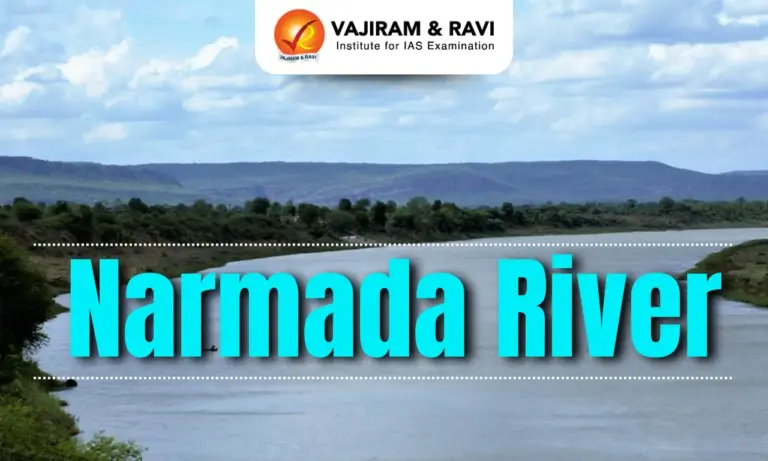
Narmada River Latest News
At least nine people were killed recently after a cruise boat carrying around 30 people on board sank in Narmada River’s Bargi dam area of Madhya Pradesh, Jabalpur.
About Narmada River
- It is the largest west-flowing river in peninsular India.
- Of the major rivers of peninsular India, only the Narmada, the Tapti, and the Mahirun from east to west.
- It has long been an important route between the Arabian Sea and the Ganges (Ganga) River valley.
- The Narmada was called Namade by the 2nd-century-ce Greek geographer Ptolemy.
- Course:
- The origin of the river is a tiny reservoir named Narmada Kund, which is situated on the Amarkantak Hill in East Madhya Pradesh at an elevation of 1,057 m on the border with Chhattisgarh.
- The river flows through Madhya Pradesh, Maharashtra, and Gujarat between Vindhya and Satpura hill ranges before falling into the Gulf of Cambay in the Arabian Sea about 10 km north of Bharuch, Gujarat.
- Length: The total length of the river is 1312 kilometres (815 miles). It is the fifth longest river of India.
- Narmada flows through the Hoshangabad plains, the Dhar upland, the Mahishmati plains, and the gorges at Mandhata and Murakta.
- The basin is bounded on the north by the Vindhyas, on the east by the Maikala range, on the south by the Satpuras, and on the west by the Arabian Sea.
- The Tropic of Cancer crosses the Narmada basin in the upper plains area, and a major part of the basin lies just below this line.
- It is one of the rivers that flow in a rift valley and acts as a divider between north India and south India.
- These rift valleys are the result of the faulting that took place when the northern flank of the Peninsula suffered subsidence.
- The river has numerous waterfalls, notably the Dhuandhar Falls, southwest of Jabalpur, Madhya Pradesh.
- Tributaries:
- The main tributaries of Narmada River are, namely, Hallon River, Banjar River, Barna River, and Tawa River.
- The Tawa River is the longest tributary of the Narmada River.
- There are also numerous pilgrimage spots on the banks of the river, the most important among them are Mahewswar and Omkareshwar temples.
- There are several dams along the course of the river, including major hydroelectric projects, such as the Sardar Sarovar Dam, the Indira Sagar Dam, the Omkareshwar Dam, the Bargi Dam, and the Maheshwar Dam.
Source: RW


 Last updated on Oct, 2026
→ UPSC 2027 Notification will be released on 13 January 2027 at upsconline.nic.in.
→ Check Nobel Prize 2026 Winners List here.
→ Download PIB PRiSM Monthly Magazine 2026 here.
→ Check UPSC Monthly Current Affairs Magazine The Recitals here.
→ Check out the latest UPSC Syllabus here.
→ Download UPSC Model Answers for Mains 2026
→ UPSC Mains Question Paper 2026 is out now for Essay & GS Paper 1, 2, 3 & 4.
→ UPSC Calendar 2027 has been released.
→ Enroll in Vajiram & Ravi’s UPSC Mains Test Series 2027 for structured answer writing practice, expert evaluation, and exam-oriented feedback.
→ Join Vajiram & Ravi’s UPSC Mentorship Program 2027 for personalized guidance, strategy planning, and one-to-one support from experienced mentors.
→ Go through the UPSC Mains Previous Year Papers to enhance your preparation.
→ UPSC has released UPSC Toppers List 2025 with the Civil Services final result on its official website.
→ Also check Best UPSC Coaching in India
Narmada River FAQs
Q1. Which is the largest west-flowing river in peninsular India?+
Q2. Where does the Narmada River originate?+
Q3. Which states does the Narmada River flow through?+
Q4. What is the total length of the Narmada River?+
Tags: narmada river prelims pointers upsc prelims current affairs