About Sidersaura marae
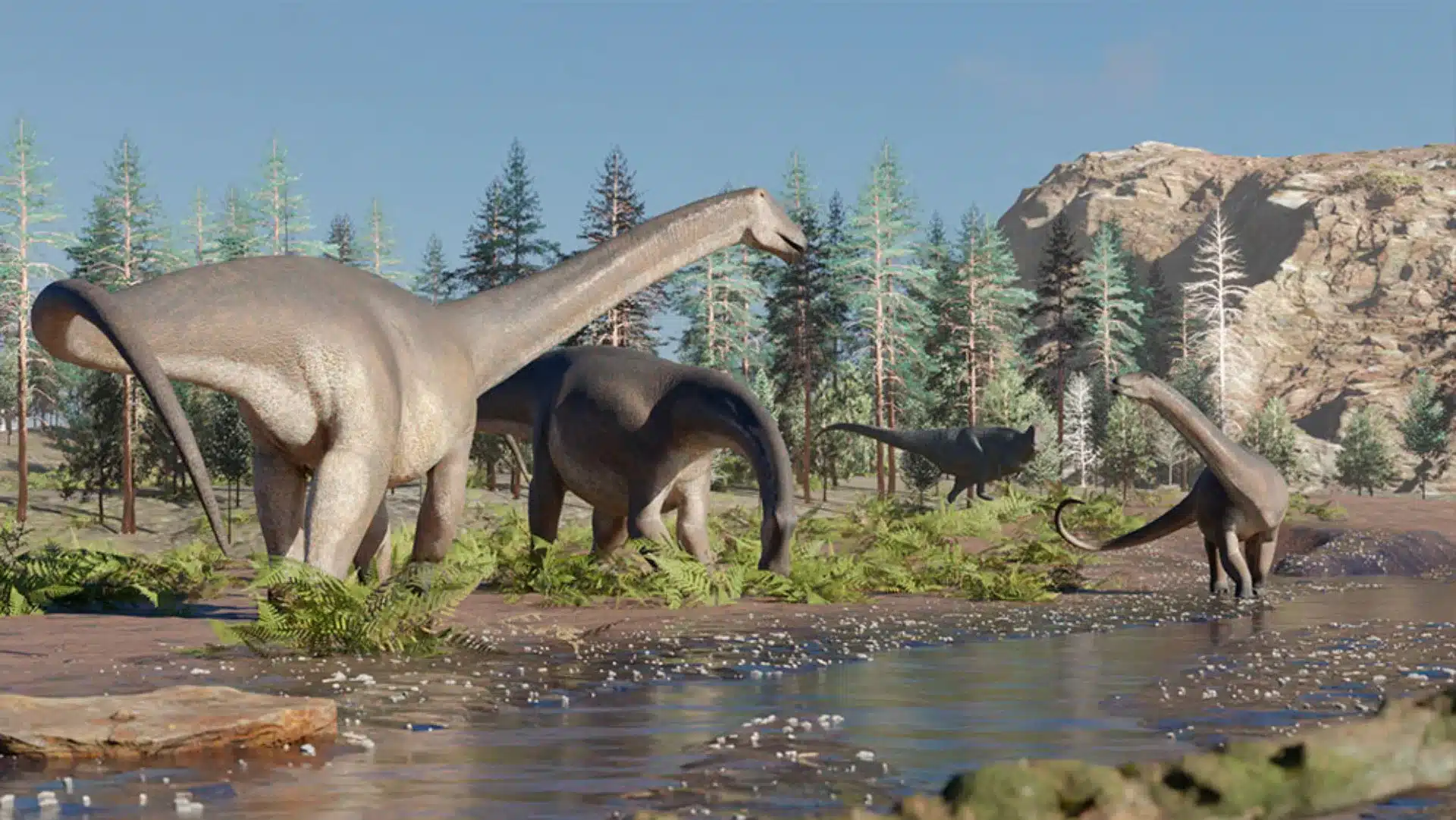
- It is a new species of sauropod dinosaur.
- It lived during the Cenomanian age of the Late Cretaceous epoch, between 96 and 93 million years ago, in today’s Patagonian region.
- It belongs to the Rebbachisauridae, a large family of sauropod dinosaurs known from fragmentary fossil remains from South America, Africa, North America, Europe, and Asia.
- These dinosaurs are distinguished from other sauropods by their distinctive teeth. Some species had tooth batteries similar to those of hadrosaurs and ceratopsian dinosaurs.
- Rebbachisaurids were very important dinosaurs in Cretaceous ecosystems and disappeared in the middle of this period in an extinction event that took place 90 million years ago.
- It is one of the last rebbachisaurids.
- Features of Sidersaura marae:
- It was up to 20 m in length, had an estimated mass of 15 tons, and had a very long tail.
- One of the characteristics that distinguishes Sidersaura marae from other dinosaurs is the star-shaped shape of the hemal arches (tail bones).
- Its skull bones are robust, unlike those of the rest of its closest relatives.
- Another cranial feature that differentiates Sidersaura marae from other rebbachisaurids is its frontoparietal foramen, which is basically a hole in the roof of the skull.
What are sauropods?
- Sauropods are any member of the dinosaur subgroup Sauropoda, marked by their large size, a long neck and tail, a four-legged stance, and an herbivorous diet.
- They were the largest of all dinosaurs and the largest land animals that ever lived.
- Geographically, these animals were widespread, with remains in the form of bones or footprints having been found on all of the continents except Antarctica.
Q1) What is the Cretaceous epoch?
The Cretaceous is a geological period that began 145 million years ago and ended 66 million years ago. It is the last period in the Mesozoic Era. It comes after the Jurassic Period and before the Paleogene – the first period of the Cenozoic Era, our current era. It lasted a long time, nearly 80 million years, making it the longest geological period of the Phanerozoic Eon, which began some 539 million years ago.
Source: New Species of Sauropod Dinosaur Discovered in Argentina


 Last updated on Oct, 2026
→ UPSC 2027 Notification will be released on 13 January 2027 at upsconline.nic.in.
→ Check Nobel Prize 2026 Winners List here.
→ Download PIB PRiSM Monthly Magazine 2026 here.
→ Check UPSC Monthly Current Affairs Magazine The Recitals here.
→ Check out the latest UPSC Syllabus here.
→ Download UPSC Model Answers for Mains 2026
→ UPSC Mains Question Paper 2026 is out now for Essay & GS Paper 1, 2, 3 & 4.
→ UPSC Calendar 2027 has been released.
→ Enroll in Vajiram & Ravi’s UPSC Mains Test Series 2027 for structured answer writing practice, expert evaluation, and exam-oriented feedback.
→ Join Vajiram & Ravi’s UPSC Mentorship Program 2027 for personalized guidance, strategy planning, and one-to-one support from experienced mentors.
→ Go through the UPSC Mains Previous Year Papers to enhance your preparation.
→ UPSC has released UPSC Toppers List 2025 with the Civil Services final result on its official website.
→ Also check Best UPSC Coaching in India