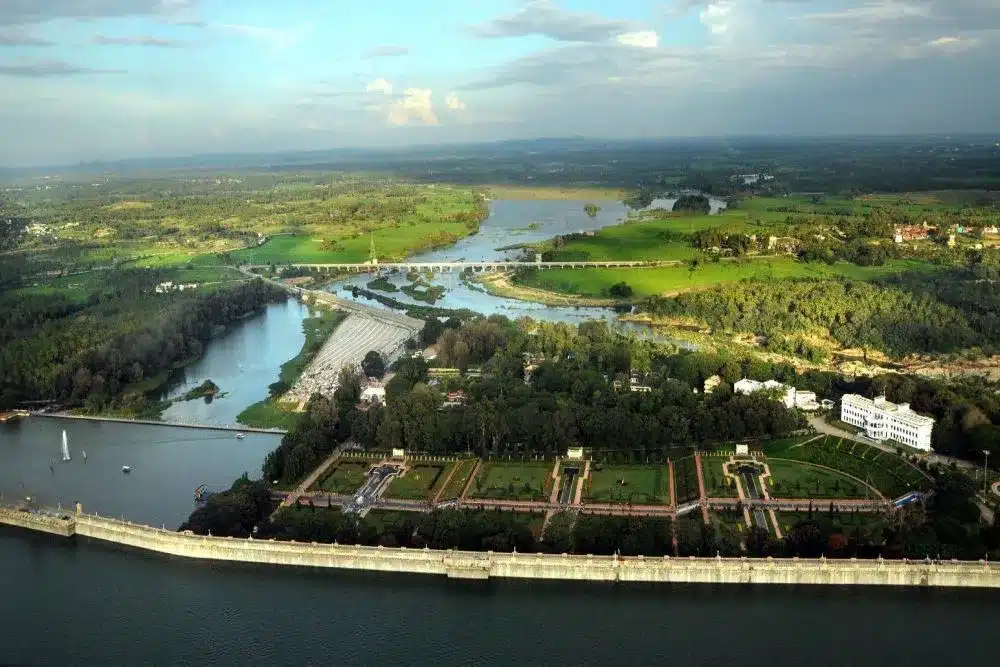
About Krishnaraja Sagar (KRS) Dam:
- It is a type of gravity dam built on the river Kaveri and its tributaries, Hemavathi and Lakshmana Theertha, in the district of Mandya in Karnataka.
- Construction:
- The dam was named after Maharaja Krishna Raja Wadiyar IV, the then ruler of the princely state of Mysore, who played a significant role in initiating and funding the construction.
- The dam’s primary objectives were to provide water for irrigation, generate hydroelectric power, and mitigate the impact of droughts in the region.
- The construction began in 1911 and was completed in 1931.
- The dam was designed by Sir M. Visvesvaraya, a famous Indian engineer (often referred to as the ‘architect of modern Mysore’ or ‘father of planning in India’).
- The reservoir is spread over an area of 130 Sq. Kms.
- Features:
- It is 2,621 meters (8,600 feet) long and 40 meters (130 feet) high.
- The dam has arch-type 177 iron sluices, and some of them have automatic doors.
- The dam was among the first in the world to have automatic sluice gates.
- It was constructed using traditional stone masonry and a lime-pozzolan mortarcalled surki, which acted as the binder.
- Brindavan Gardens, an ornamental garden, is attached to the dam.
- Usage:
- Apart from being the main source of water for irrigation in the most fertile Mysore and Mandya, the reservoir is the main source of drinking water for all of Mysore city and almost the whole of Bangalore city.
- It also ensures power supply to the Shivanasamudra hydroelectric power station.
- The water released from this dam flows into the state of Tamil Nadu and is stored in the Mettur dam in the Salem district.
Q1. What is a Gravity Dam?
A gravity dam is a type of dam structure designed to withstand the force of water pressure solely through its weight. It relies on its massive weight and resistance to sliding to hold back the force of the water and maintain stability. Gravity dams are commonly built in locations where there is a solid foundation of bedrock or rock formations that can support their weight effectively.
Source: Monsoon in Karnataka: KRS dam breaches 100 feet mark, Kabini almost full following rain in Kerala


 Last updated on Oct, 2026
→ UPSC 2027 Notification will be released on 13 January 2027 at upsconline.nic.in.
→ Check Nobel Prize 2026 Winners List here.
→ Download PIB PRiSM Monthly Magazine 2026 here.
→ Check UPSC Monthly Current Affairs Magazine The Recitals here.
→ Check out the latest UPSC Syllabus here.
→ Download UPSC Model Answers for Mains 2026
→ UPSC Mains Question Paper 2026 is out now for Essay & GS Paper 1, 2, 3 & 4.
→ UPSC Calendar 2027 has been released.
→ Enroll in Vajiram & Ravi’s UPSC Mains Test Series 2027 for structured answer writing practice, expert evaluation, and exam-oriented feedback.
→ Join Vajiram & Ravi’s UPSC Mentorship Program 2027 for personalized guidance, strategy planning, and one-to-one support from experienced mentors.
→ Go through the UPSC Mains Previous Year Papers to enhance your preparation.
→ UPSC has released UPSC Toppers List 2025 with the Civil Services final result on its official website.
→ Also check Best UPSC Coaching in India