Bluetongue Virus Latest News
More suspected cases of bluetongue virus (BTV) have been recently detected in Northern Ireland.
About Bluetongue Virus
- It is responsible for causing the severe haemorrhagic disease, bluetongue (BT).
- It is an infectious, non-contagious, vector-borne disease.
- It can infect domestic ruminants, including cattle, sheep, and goats, along with wild animals such as buffalo, deer, antelope, and camels.
- Of the domestic species, sheep are the most severely affected.
- BTV is present in all continents except Antarctica.
- Transmission:
- BTV is predominantly spread between ruminants through the bites of infected Culicoides midges, tiny blood-feeding insects that can be found in large numbers on most farms.
- Some BTV strains can be transferred from a ruminant mother to her fetus during pregnancy.
- Can the BTV Spread to Humans?
- No, BTV cannot infect people.
- There are no food safety issues, and meat and dairy products are safe to consume.
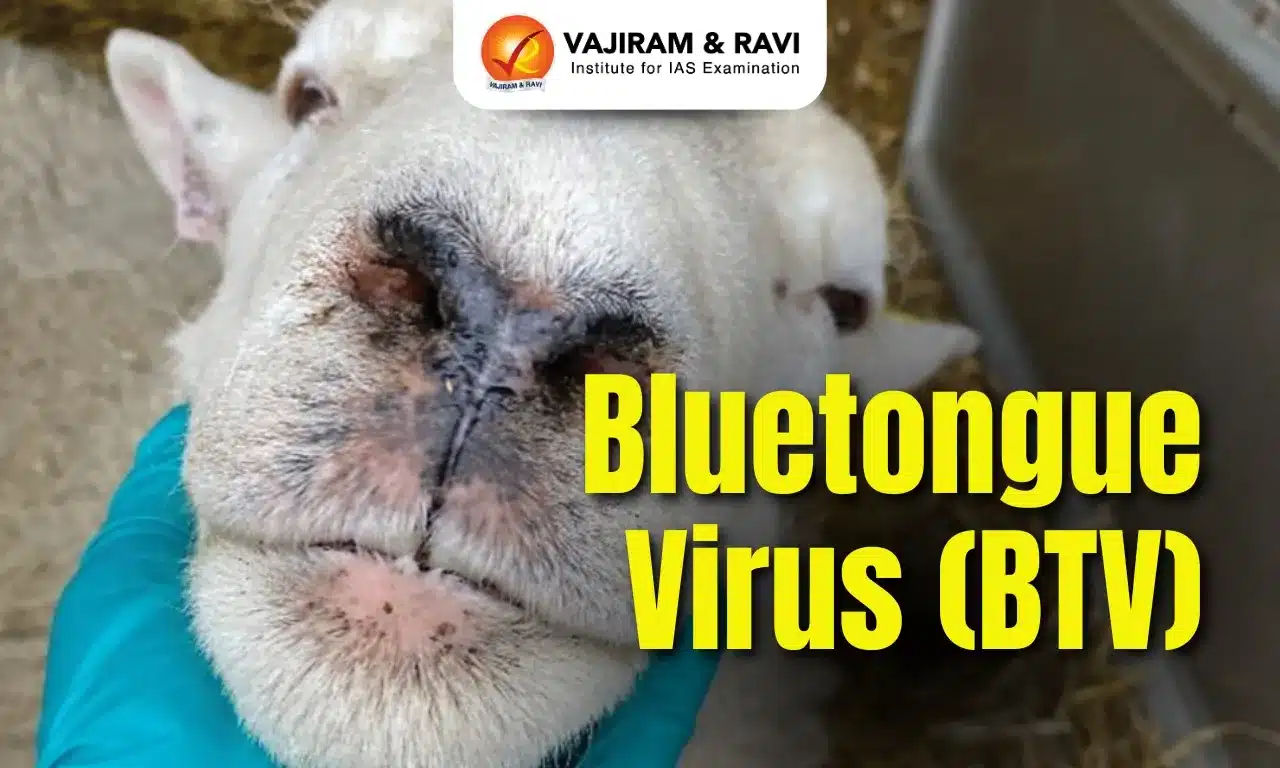
- Clinical signs associated with bluetongue disease are usually only seen in sheep (and sometimes deer), and it can be fatal. Clinical Signs Include:
- Fever (40°C to 42°C)
- Swelling of the lips, tongue, and head
- Nasal discharge
- Lameness
- Reddening around the coronary band (top of the hoof).
- Some animals may show signs of a swollen, bluish-coloured tongue (hence the name ‘bluetongue’).
- This will not always be seen and should not be relied upon to diagnose bluetongue disease.
- BT can result in high rates of morbidity and even mortality in flocks and herds and can affect production (e.g. milk yields) and trade.
- Treatment:
- There is no effective treatment for bluetongue.
- Vaccines are available for certain types of the disease and are used in Africa, Asia, and parts of Europe.
Source: BBC


 Last updated on Sep, 2026
→ UPSC 2027 Notification will be released on 13 January 2027 at upsconline.nic.in.
→ Check out the latest UPSC Syllabus here.
→ Download UPSC Model Answers for Mains 2026
→ UPSC Mains Question Paper 2026 is out now for Essay & GS Paper 1, 2, 3 & 4.
→ UPSC Calendar 2027 has been released.
→ Enroll in Vajiram & Ravi’s UPSC Mains Test Series 2027 for structured answer writing practice, expert evaluation, and exam-oriented feedback.
→ Join Vajiram & Ravi’s UPSC Mentorship Program 2027 for personalized guidance, strategy planning, and one-to-one support from experienced mentors.
→ Go through the UPSC Mains Previous Year Papers to enhance your preparation.
→ UPSC has released UPSC Toppers List 2025 with the Civil Services final result on its official website.
→ Also check Best UPSC Coaching in India
Bluetongue Virus FAQs
Q1. Bluetongue Virus (BTV) causes which type of disease in animals?+
Q2. Which domestic species is most severely affected by Bluetongue Virus?+
Q3. What is the primary vector responsible for transmitting Bluetongue Virus?+
Q4. Can Bluetongue Virus infect humans?+
Q5. What is the current treatment for Bluetongue Virus in animals?+
Tags: bluetongue virus prelims pointers upsc current affairs upsc prelims current affairs