About Chalukya dynasty
- The Chalukyas ruled over the central Indian plateau of the Deccan between the sixth and twelfth centuries.
- During that period, they ruled as three closely related but individual dynasties.
- The Chalukyas of Badami, who ruled between the sixth and the eighth centuries, and the two sibling dynasties of the Chalukyas of Kalyani, or the Western Chalukyas, and the Chalukyas of Vengi, or the Eastern Chalukyas.
Key Facts about Badami Chalukyas
- Origin:
- Pulakesi I established the Chalukya dynasty in 550.
- Pulakesi I took Vatapi (Badami in Bagalkot district, Karnataka) under his control and made it his capital.
- Historians refer to Pulakesi I and his descendants as the Chalukyas of Badami.
- They ruled over an empire that comprised the entire state of Karnataka and most of Andhra Pradesh in the Deccan.
- Pulakesi II had been perhaps the greatest emperor of the Badami Chalukyas.
- Pulakesi II extended the Chalukya Empire up to the northern extents of the Pallava kingdom and halted the southward march of Harsha by defeating him on the banks of the river Narmada.
- He then defeated the Vishnukundins in the southeastern Deccan.
- Pallava Narasimhavarman reversed that victory by attacking and occupying the Chalukya capital, Vatapi (Badami).
- Hiuen-Tsiang, a Chinese traveller, had visited the court of Pulakesi II.
- Later, Persian emperor Khosrau II exchanged ambassadors with Pulakesi II.
- The Badami Chalukya dynasty went into a brief decline following the death of Pulakesi II due to internal feuds.
- It recovered during the reign of Vikramaditya I, who succeeded in pushing the Pallavas out of Badami and restoring order to the empire.
- The empire reached its peak during the rule of the illustrious Vikramaditya II, who defeated Pallava Nandivarman II and captured Kanchipuram.
- The Rashtrakuta Dantidurga overthrew the last Badami Chalukya king, Kirtivarman I, in 753.
- At their peak, they ruled a vast empire stretching from the Kaveri to the Narmada.
- Art and Architecture:
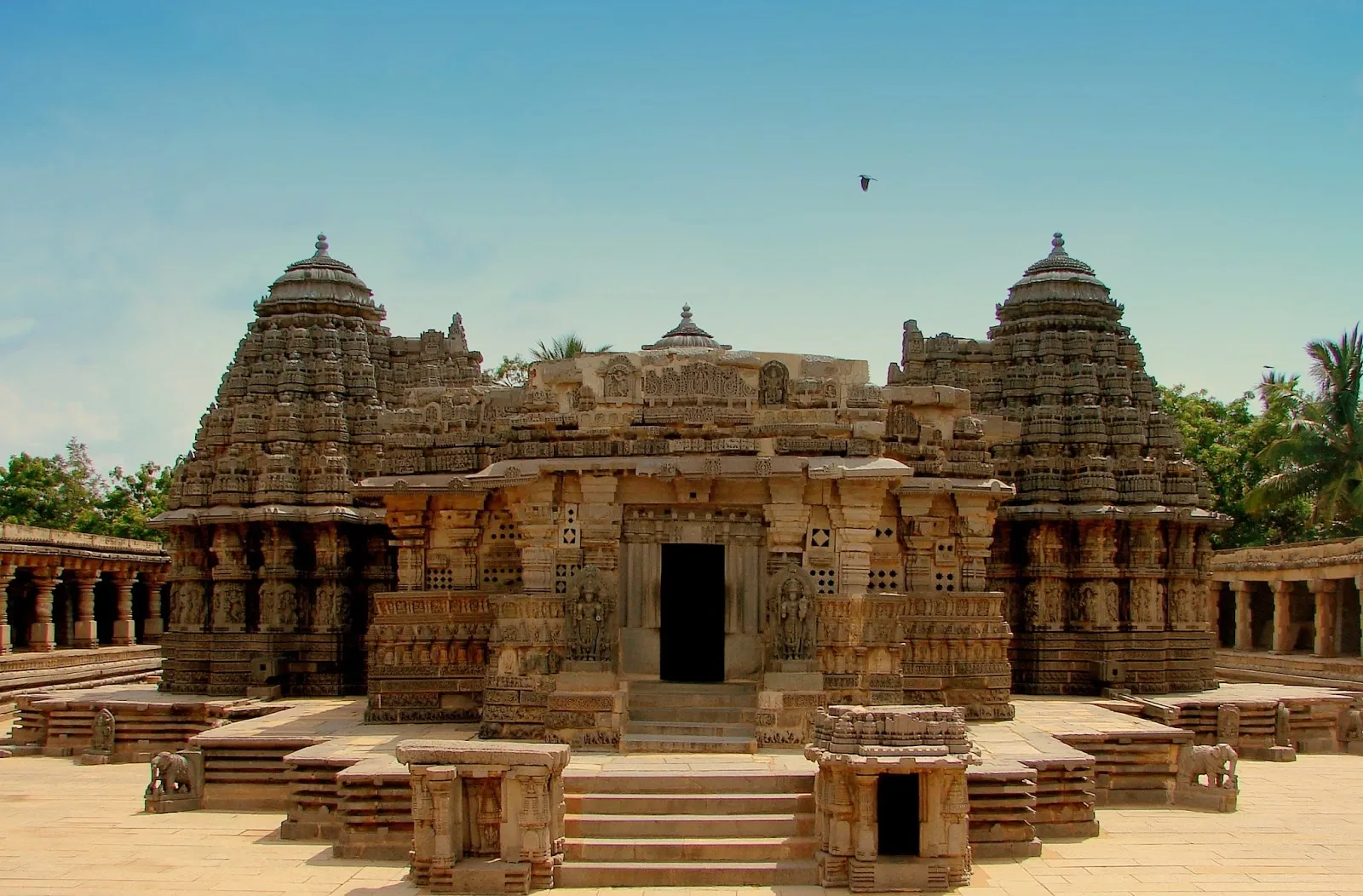
- It saw the evolution and proliferation of a new style of architecture known as Vesara, a combination of the South Indian and the North Indian building styles.
- The rock-cut temples of Pattadakal, a UNESCO World Heritage Site, Badami, and Aihole constitute their most celebrated monuments.
- Government:
- The army consisted of infantry, cavalry, elephant corps, and a powerful navy.
- Hiuen-Tsiang mentions that the Chalukya army had hundreds of elephants intoxicated with liquor prior to the battle.
- Rashtrakuta inscriptions use the term Karnatabala to refer to their powerful armies.
- The government levied taxes called Herjunka, Kirukula, Bilkode, and Pannaya.
- The empire was divided into Maharashtrakas (provinces), then into smaller Rashtrakas (Mandala), Vishaya (district), Bhoga (group of ten villages).
- Many autonomous regions existed, ruled by feudatories like Alupas, Gangas, Banas, and Sendrakas.
- Local assemblies looked after local issues.
- Groups of mahajanas (learned brahmins) looked after agraharas (like Ghatika, a place of higher learning), like the ones at Badami (2000 mahajans) and Aihole (500 mahajanas).
- Coinage:
- The Badami Chalukyas minted coins of a different standard compared to the northern kingdoms.
- The coins had Nagari and Kannada legends. They minted coins with symbols of temples, lion or boar facing right, and the lotus.
- Religion:
- They initially followed Vedic Hinduism.
- Later, from the time of Vikramaditya I, the people took an inclination towards Shaivism, and sects like Pashupata, Kapalikas, and Kalamukhas existed.
- They actively encouraged Jainism, as attested to by one of the Badami cave temples and other Jain temples in the Aihole complex.
Q1) What is Pallava Dynasty?
The Pallava Dynasty was a famous power in South India that existed between the 3rd and 9th Centuries. They ruled the northern parts of Tamil Nadu, parts of Karnataka, Andhra Pradesh, and Telangana, with Kanchipuram as their capital.The Pallavas supported Buddhism, Jainism, and the Brahmanical faith and were patrons of music, painting, and literature.
Source: Badami Chalukya temples, writing found in Nalgonda


 Last updated on Sep, 2026
→ UPSC 2027 Notification will be released on 13 January 2027 at upsconline.nic.in.
→ Asian Games 2026 are being held in Aichi-Nagoya, Japan, from 19 September to 4 October.
→ Check out the latest UPSC Syllabus here.
→ Download UPSC Model Answers for Mains 2026
→ UPSC Mains Question Paper 2026 is out now for Essay & GS Paper 1, 2, 3 & 4.
→ UPSC Calendar 2027 has been released.
→ Enroll in Vajiram & Ravi’s UPSC Mains Test Series 2027 for structured answer writing practice, expert evaluation, and exam-oriented feedback.
→ Join Vajiram & Ravi’s UPSC Mentorship Program 2027 for personalized guidance, strategy planning, and one-to-one support from experienced mentors.
→ Go through the UPSC Mains Previous Year Papers to enhance your preparation.
→ UPSC has released UPSC Toppers List 2025 with the Civil Services final result on its official website.
→ Also check Best UPSC Coaching in India