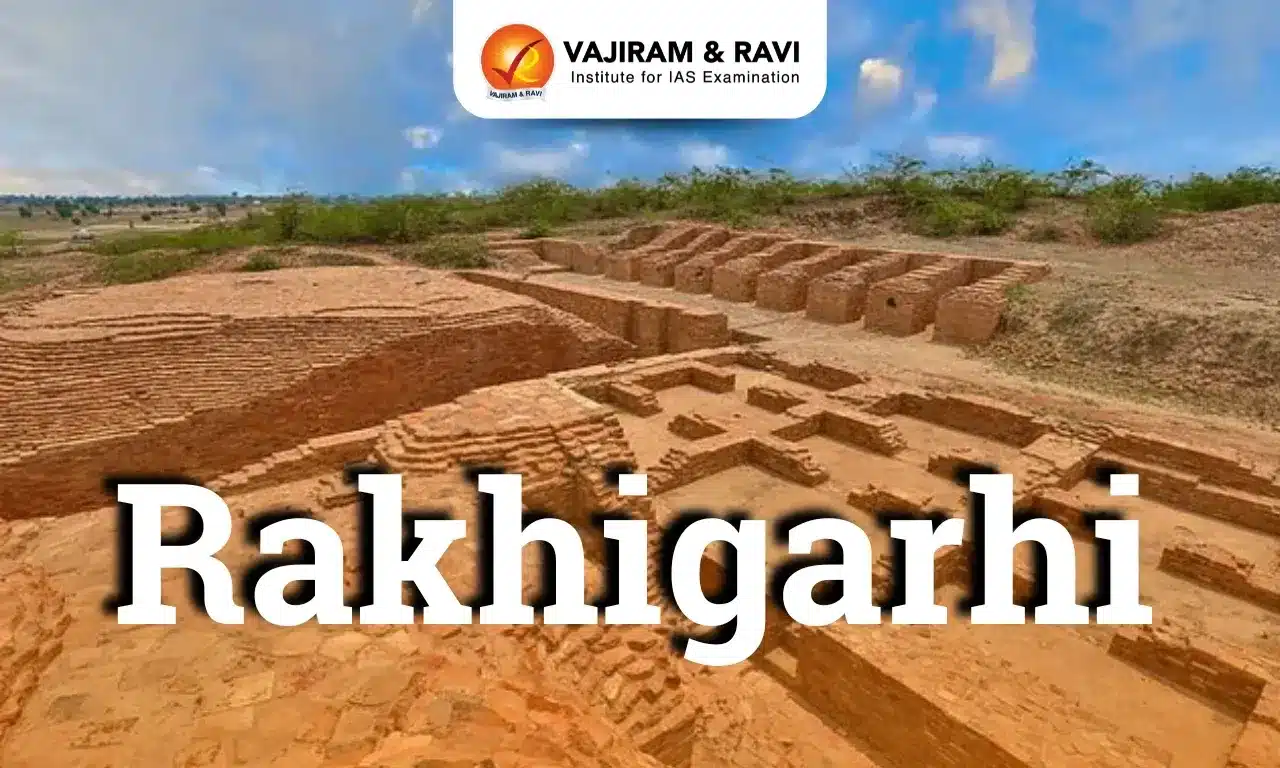
About Rakhigarhi
- Rakhigarhi is an archaeological site located in Hisar district, Haryana, in the Ghaggar-Hakra river plain.
- It is one of the oldest and largest cities of the subcontinent’s earliest known Bronze Age urban culture, the Indus Valley or Harappan Civilization, going back to about 6500 BCE.
- Rakhigarhi constitutes one of the only two cities of the Harappan Era (6th millennium–1900 BC) situated within India’s current political boundary, the other being Dholavira in Gujarat.
- The site was first discovered in the 1960s by the Archeological Survey of India.
- Findings:
- The exploration around this site has clearly identified seven archaeological mounds spread over an area of approximately 350 ha.
- Rakhigarhi primarily yields evidence of occupation during the Early and Mature Harappan periods, with the site being completely abandoned during the Late Harappan period.
- The archaeological excavations revealed the mature Harappan phase, represented by a planned township with mud-brick as well as burnt-brick houses with a proper drainage system.
- The ceramic industry is represented by red ware, which included dish-on-stand, vase, jar, bowl, beaker, perforated jar, goblet, and handis.
- Animal sacrificial pits lined with mud bricks and triangular and circular fire alters on the mud floor have also been excavated, that signifies the ritual system of the Harappans.
- A cylindrical seal with five Harappan characters on one side and a symbol of an alligator on the other is an important find from this site.
- Other antiquities include blades; terracotta and shell bangles; beads of semi-precious stones, terracotta, shell and copper objects; animal figurines, toy cart frame and wheel of terracotta; bone points; inscribed steatite seals, and sealings.
- The excavations have yielded a few extended burials, which certainly belong to a very late stage, maybe the medieval times.
- Rakhigarhi is also well-known as the site which has yielded the only DNA evidence from the Harappan era.
Source :TP
Rakhigarhi Latest FAQs
Q1. On which river is Rakhigarhi civilization?
Ans. Rakhigarhi is situated on the bank of the now dry, Saraswati river
Q2. Who excavated Rakhigarhi first?
Ans. The excavation of Rakhigarhi was first conducted by Dr. V. N. Misra, an Indian archaeologist, in the early 1990s.
Q3. How old is Rakhigarhi?
Ans. Researchers have established that human remains discovered at an ancient site of Rakhigarhi – a village in the Hisar district of Haryana – date back around 8,000 years.
Q4. What is the city of the dead in Harappan civilization?
Ans. Mohenjo-daro! Mohenjo Daro, or “Mound of the Dead” is an ancient Indus Valley Civilization city that flourished between 2600 and 1900 BCE


 Last updated on Oct, 2026
→ UPSC 2027 Notification will be released on 13 January 2027 at upsconline.nic.in.
→ Asian Games 2026 are being held in Aichi-Nagoya, Japan, from 19 September to 4 October.
→ Check Nobel Prize 2026 Winners List here.
→ Download PIB PRiSM Monthly Magazine 2026 here.
→ Check UPSC Monthly Current Affairs Magazine The Recitals here.
→ Check out the latest UPSC Syllabus here.
→ Download UPSC Model Answers for Mains 2026
→ UPSC Mains Question Paper 2026 is out now for Essay & GS Paper 1, 2, 3 & 4.
→ UPSC Calendar 2027 has been released.
→ Enroll in Vajiram & Ravi’s UPSC Mains Test Series 2027 for structured answer writing practice, expert evaluation, and exam-oriented feedback.
→ Join Vajiram & Ravi’s UPSC Mentorship Program 2027 for personalized guidance, strategy planning, and one-to-one support from experienced mentors.
→ Go through the UPSC Mains Previous Year Papers to enhance your preparation.
→ UPSC has released UPSC Toppers List 2025 with the Civil Services final result on its official website.
→ Also check Best UPSC Coaching in India