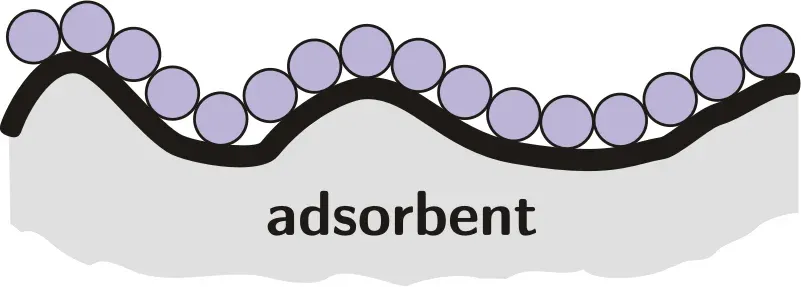
About Adsorption
- It refers to the adhesion of atoms, ions, or molecules from a gas, liquid, or dissolved solid to the surface of a material.
- It is considered a surface phenomenon that creates a film of the adsorbateon the surface of theadsorbent (a solid material, for instance).
- Materials that are used to adsorb gases or dissolved substances arecalled adsorbents; the adsorbed molecules are usually referred to collectively as the adsorbate.
- How Adsorption Works?
- Adsorption depends on surface energy.
- The surface atomsof the adsorbent are partially exposed, so they can attract the adsorbate molecules.
- Adsorption may result from electrostatic attraction, chemisorption, or physisorption.
- Characteristics of Adsorbents:
- Typically, adsorbents have small pore diameters so that there is a high surface area to facilitate adsorption.
- The pore size usually ranges between 0.25 and 5 mm.
- Industrial adsorbents have high thermal stability and resistance to abrasion.
- Depending on the application, the surface may be hydrophobic or hydrophilic.
- The adsorbents come in many shapes, including rods, pellets, and molded shapes.
- Examples of adsorbents include Silica gel, Alumina,Activated carbon or charcoal, Zeolites, Adsorption chillers used with refrigerants, Biomaterials that adsorb proteins, etc.
- Adsorption is a different process from absorption, in which a substance diffuses into a liquid or solid to form a solution.
- Adsorption phenomena are operative in most natural physical, biological, and chemical systems, and adsorption operations employing solids such as activated carbon and synthetic resins are widely used in industrial applications and for the purification of waters and waste waters.
Q1: What is electrostatic attraction?
Electrostatic Attractions are interactions between opposite charges. The attraction wants to pull the opposite charges together. Ionic bonds are formed by the electrostatic attractions between ions. Covalent bonds are formed by electrostatic attraction between the nuclei’s protons and the shared electron pair. Electrostatic attraction also happens between molecules or atoms. But, it doesn’t form a bond. Instead, they interact with each other via partial charges or dipoles.


 Last updated on Oct, 2026
→ UPSC 2027 Notification will be released on 13 January 2027 at upsconline.nic.in.
→ Asian Games 2026 are being held in Aichi-Nagoya, Japan, from 19 September to 4 October.
→ Check Nobel Prize 2026 Winners List here.
→ Download PIB PRiSM Monthly Magazine 2026 here.
→ Check UPSC Monthly Current Affairs Magazine The Recitals here.
→ Check out the latest UPSC Syllabus here.
→ Download UPSC Model Answers for Mains 2026
→ UPSC Mains Question Paper 2026 is out now for Essay & GS Paper 1, 2, 3 & 4.
→ UPSC Calendar 2027 has been released.
→ Enroll in Vajiram & Ravi’s UPSC Mains Test Series 2027 for structured answer writing practice, expert evaluation, and exam-oriented feedback.
→ Join Vajiram & Ravi’s UPSC Mentorship Program 2027 for personalized guidance, strategy planning, and one-to-one support from experienced mentors.
→ Go through the UPSC Mains Previous Year Papers to enhance your preparation.
→ UPSC has released UPSC Toppers List 2025 with the Civil Services final result on its official website.
→ Also check Best UPSC Coaching in India