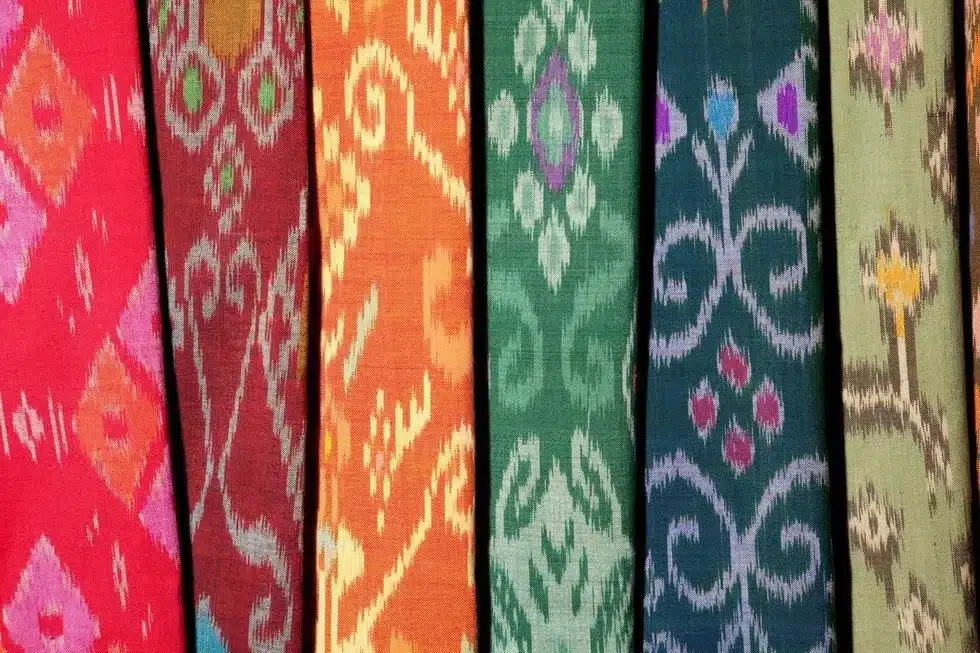
About Ikat design:
- Origin & Technique:
- Ikat originates from the Indonesian/Malay word ‘mengikat’, meaning to bind.
- It features a resist dyeing process where threads are dyed before weaving.
- The fabrics exhibit unique ‘blurred’ effects due to slight misalignments of threads.
- Historical references:
- Ancient references to ikat include the Buddhist ‘Lalitavistara Sutra’ and the Ajanta caves murals.
- These references mention ‘Vichitra Patolaka’, associated with the double ikat or patola of Gujarat.
- Types of Ikat:
- Single Ikat: Dyeing involves either the warp or the weft threads, simpler and quicker to produce.
- Double Ikat: Both warp and weft threads are intricately resist-dyed for precise alignment, known for their complexity.
- Key regions and GI tags:
- Patan’s Patola from Gujarat is known for its double ikat and received a GI tag in 2013.
- Rajkot Patola, a simpler single ikat variant from Gujarat, also received a GI tag in 2013.
- Odisha’s Bandha specialises in single ikat with GI-tagged styles like Sambalpuri Ikat (2010) and Bomkai (2009).
- Telangana’s Telia Rumal is famous for its oil-treated threads that enhance colour depth and received a GI tag in 2020 and Pochampally Ikat is known for its geometric patterns and received a GI tag in 2005.
Q1: What is the National Bank for Agriculture and Rural Development (NABARD)?
It is a financial institution that was set up by the Indian government to promote sustainable agriculture and rural development in the country. It is the main regulatory body in the country’s rural banking system. It was established in 1982 as a central regulating body for agriculture financing and the rural section. The government of India established NABARD under the outlines of the National Bank for Agriculture and Rural Development Act 1981.
Source: Weaving A Story Of Traditional Art, Ikat


 Last updated on Oct, 2026
→ UPSC 2027 Notification will be released on 13 January 2027 at upsconline.nic.in.
→ Asian Games 2026 are being held in Aichi-Nagoya, Japan, from 19 September to 4 October.
→ Check Nobel Prize 2026 Winners List here.
→ Download PIB PRiSM Monthly Magazine 2026 here.
→ Check UPSC Monthly Current Affairs Magazine The Recitals here.
→ Check out the latest UPSC Syllabus here.
→ Download UPSC Model Answers for Mains 2026
→ UPSC Mains Question Paper 2026 is out now for Essay & GS Paper 1, 2, 3 & 4.
→ UPSC Calendar 2027 has been released.
→ Enroll in Vajiram & Ravi’s UPSC Mains Test Series 2027 for structured answer writing practice, expert evaluation, and exam-oriented feedback.
→ Join Vajiram & Ravi’s UPSC Mentorship Program 2027 for personalized guidance, strategy planning, and one-to-one support from experienced mentors.
→ Go through the UPSC Mains Previous Year Papers to enhance your preparation.
→ UPSC has released UPSC Toppers List 2025 with the Civil Services final result on its official website.
→ Also check Best UPSC Coaching in India