About Mikania micrantha:
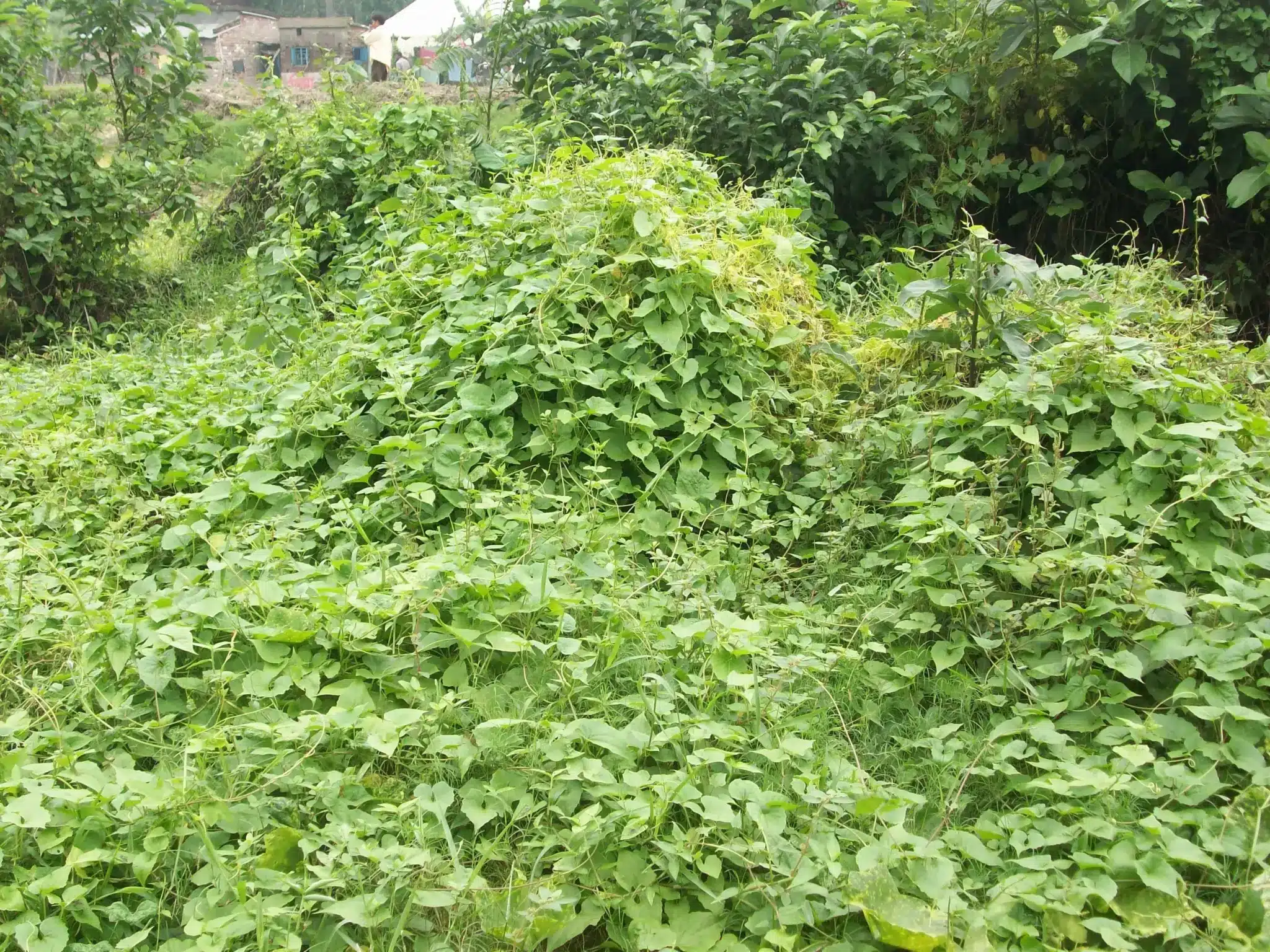
- It is a perennial creeping climber known for its vigorous and rampant growth.
- It is a native of Central and South America.
- It is a major invasive species in several parts of southeast Asia, India, and the Pacific Islands.
- It was introduced in India in the 1940s as ground cover in tea plantations and is now a serious threat to several plantation crops as well as forest areas all over the country.
- It grows best where fertility, organic matter, soil moisture, and humidity are all high.
- It damages or kills other plants by cutting out the light and smothering them.
- It climbs up other plants to reach the canopy for better sunlight.
- Mikania is known to have allelopathic potential by producing biochemicals that can inhibit seed germination and seedling growth of other plants.
- It produces thousands of lightweight seeds that are wind-dispersed and also has the ability to reproduce vegetatively through its roots, resulting in rapid and widespread invasion by this weed in any disturbed area.
Key Facts about Bhadra Tiger Reserve (BTR):
- It is situated in the midst of the Western Ghats region of Karnataka.
- The reserve is unique as it is nestled within several hill ranges. The habitat has a good population of elephants and is also an Elephant Reserve.
- It boasts of a substantial tiger population, and as such, the sanctuary was declared the 25th Project Tiger Reserve of India in 1998.
- Rivers: It is well drained by the river Bhadra and its tributaries.
- Vegetation: It has dry deciduous, moist deciduous, shola, and semi-evergreen patches.
- Flora: Teak, Rosewood, Mathi, Honne, Nandi, and many medicinal plants.
- Fauna: Tiger, Leopard, Leopard cat, Dholes, Indian Civet, ungulates like Gaur, Sambar, and Barking Deer are common.
Q1: What are invasive alien species?
These are the species whose introduction and/or spread outside their natural past or present distribution threatens biological diversity. These include animals, plants, fungi, and even microorganisms, and can influence all kinds of ecosystems. These species need an introduction either through natural or human intervention, survive on native food resources, reproduce at a fast rate, and edge out native species in the competition over resources. Invasive species act as disruptors in the food chain and disturb the balance of the ecosystem.
Source: Alarm in Bhadra Tiger Reserve as weed runs rampant


 Last updated on Sep, 2026
→ UPSC 2027 Notification will be released on 13 January 2027 at upsconline.nic.in.
→ Asian Games 2026 are being held in Aichi-Nagoya, Japan, from 19 September to 4 October.
→ Check out the latest UPSC Syllabus here.
→ Download UPSC Model Answers for Mains 2026
→ UPSC Mains Question Paper 2026 is out now for Essay & GS Paper 1, 2, 3 & 4.
→ UPSC Calendar 2027 has been released.
→ Enroll in Vajiram & Ravi’s UPSC Mains Test Series 2027 for structured answer writing practice, expert evaluation, and exam-oriented feedback.
→ Join Vajiram & Ravi’s UPSC Mentorship Program 2027 for personalized guidance, strategy planning, and one-to-one support from experienced mentors.
→ Go through the UPSC Mains Previous Year Papers to enhance your preparation.
→ UPSC has released UPSC Toppers List 2025 with the Civil Services final result on its official website.
→ Also check Best UPSC Coaching in India