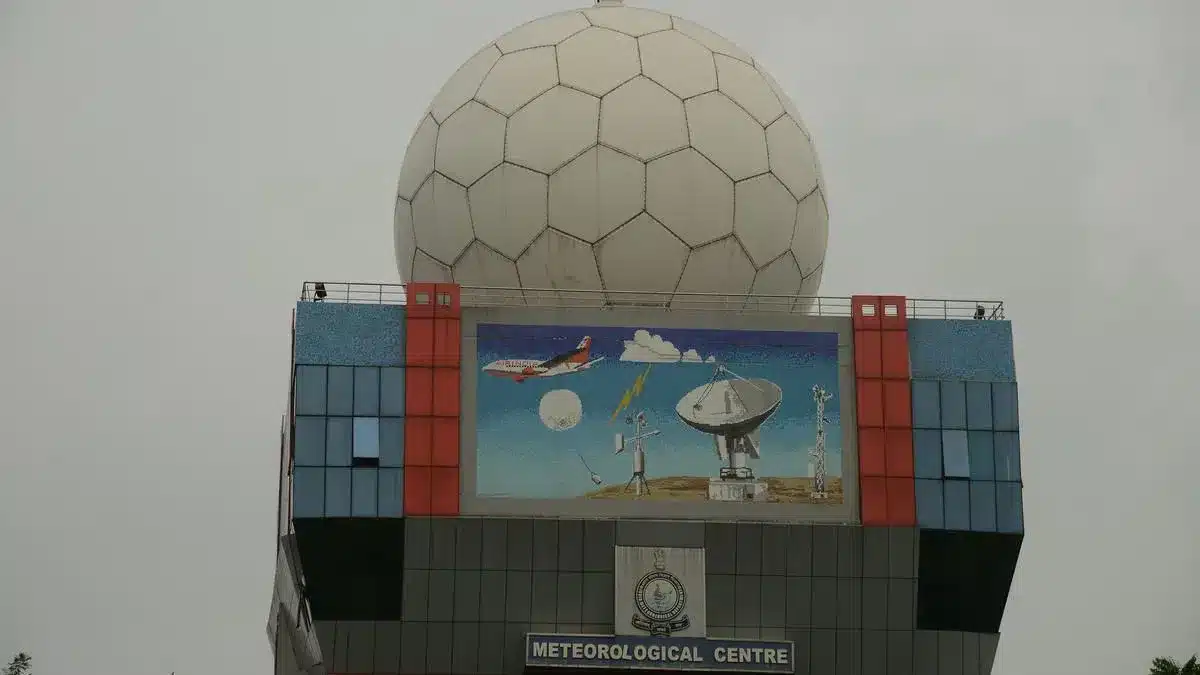
About X-band radar:
- An X-band radar is radar that emits radiation in the X-band of the electromagnetic spectrum: 8-12 GHz, corresponding to wavelengths of around 2-4 cm
- The smaller wavelengths allow the radar to produce images of higher resolution.
- However, the greater the frequency of some radiation, the faster it will be attenuated.
- Applications
- The new radar is expected to be able to monitor the movements of particles, such as soil, to inform landslide warnings.
- The device will also perform high temporal sampling, that is, rapidly sample its environs, allowing it to spot particle movements happening in shorter spans of time.
- These radars are typically used for studies about cloud development and light precipitation due to their abilities to detect tiny water particles and snow.
What is Radar?
- Radar is short for ‘radio detection and ranging’.
- The device uses radio waves to determine the distance, velocity, and physical characteristics of objects around the device.
- A transmitter emits a signal aimed at an object whose characteristics are to be ascertained (in meteorology, this could be a cloud). A part of the emitted signal is echoed by the object back to the device, where a receiver tracks and analyses it.
- Weather radar, also known as a Doppler radar, is a common application of this device. The Doppler effect is the change in frequency of sound waves as their source moves towards and away from a listener.
- In meteorology, Doppler radars can reveal how fast a cloud is moving and in which direction based on how the cloud’s relative motion changes the frequency of the radiation striking it.
- A pulse-Doppler radar can measure the intensity of, say, rainfall by emitting radiation in pulses and tracking how often they’re reflected to the receiver.
- This way, modern Doppler radars can monitor weather conditions and anticipate new wind patterns, the formation of storms, etc.
Q1:What Does Transmitter Mean?
A transmitter is an electronic device used in telecommunications to produce radio waves in order to transmit or send data with the aid of an antenna. The transmitter is able to generate a radio frequency alternating current that is then applied to the antenna, which, in turn, radiates this as radio waves.
Source: What is Wayanad’s new X-band radar? | Explained


 Last updated on Sep, 2026
→ UPSC 2027 Notification will be released on 13 January 2027 at upsconline.nic.in.
→ Asian Games 2026 are being held in Aichi-Nagoya, Japan, from 19 September to 4 October.
→ Check out the latest UPSC Syllabus here.
→ Download UPSC Model Answers for Mains 2026
→ UPSC Mains Question Paper 2026 is out now for Essay & GS Paper 1, 2, 3 & 4.
→ UPSC Calendar 2027 has been released.
→ Enroll in Vajiram & Ravi’s UPSC Mains Test Series 2027 for structured answer writing practice, expert evaluation, and exam-oriented feedback.
→ Join Vajiram & Ravi’s UPSC Mentorship Program 2027 for personalized guidance, strategy planning, and one-to-one support from experienced mentors.
→ Go through the UPSC Mains Previous Year Papers to enhance your preparation.
→ UPSC has released UPSC Toppers List 2025 with the Civil Services final result on its official website.
→ Also check Best UPSC Coaching in India