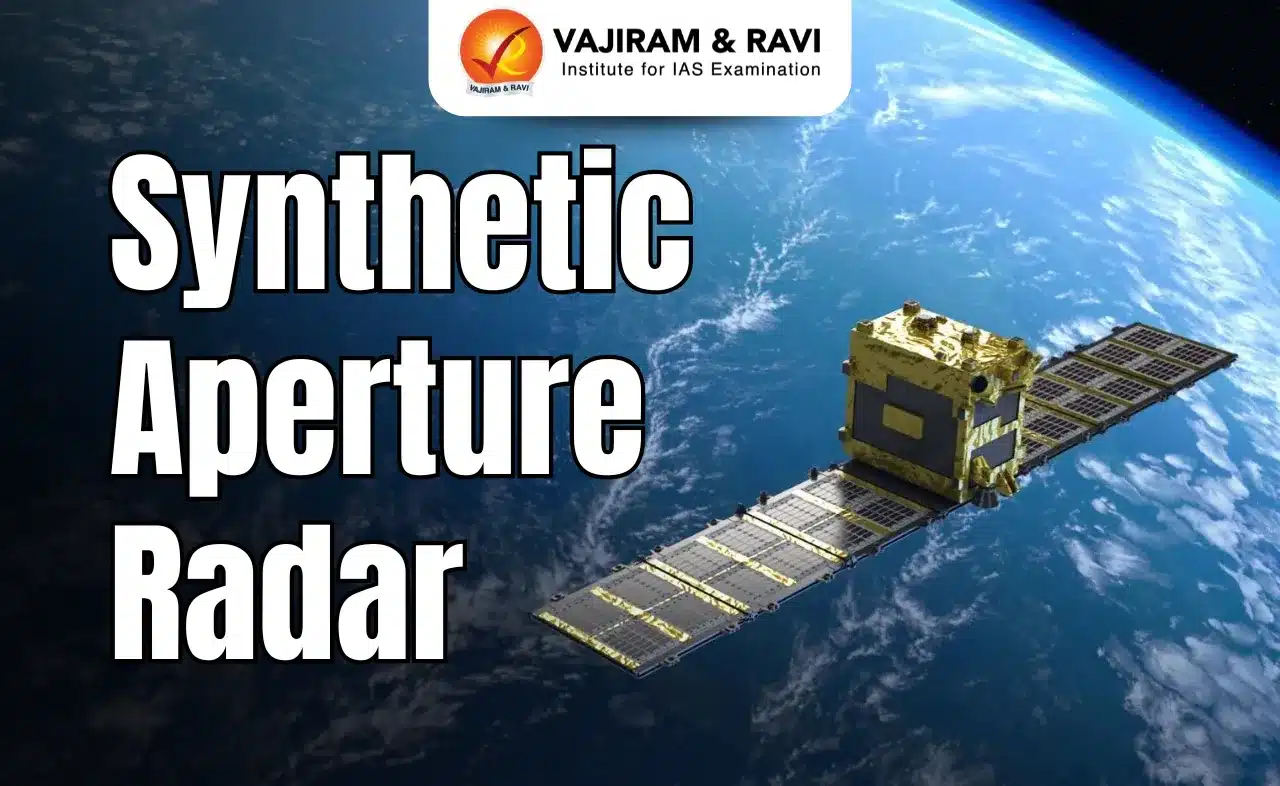
Synthetic Aperture Radar Latest News
Recently, NASA said the NASA-ISRO SAR mission had arrived at ISRO’s spaceport in Sriharikota.
About Synthetic Aperture Radar
- It is a type of active data collection where an instrument sends out a pulse of energy and then records the amount of that energy reflected back after it interacts with Earth.
- SAR imagery is created from the reaction of an emitted pulse of energy with physical structures (like mountains, forests, and sea ice) and conditions like soil moisture.
- It is a way to make sharp pictures even when it’s dark or cloudy.


Working of Synthetic Aperture Radar
- SAR systems send out microwave pulses and record the echoes that bounce back from the ground, ocean, ice or buildings.
- Then, clever signal processing turns those echoes into detailed images.
- The key element is the antenna that receives the echoes. Usually, the longer a physical antenna, the better the resolution — but a large antenna is hard to build and maintain.
- On a SAR, a small antenna is carried on a moving platform like a satellite. As a result each echo is recorded at a slightly different position.
- By stitching them together with precise timing and phase information, software can help mimic a single antenna hundreds of metres long.
- Since microwaves penetrate clouds, smoke, and even light rainfall, SAR can collect data 24/7. If a SAR unit is mounted on an orbiting satellite, it can map swaths of land hundreds of kilometres wide in a single overpass.
- Different materials like soil, vegetation, water, and metals reflect microwaves differently, allowing SAR to detect changes invisible to optical sensors.
Source: TH

 Last updated on Oct, 2026
→ UPSC 2027 Notification will be released on 13 January 2027 at upsconline.nic.in.
→ Check Nobel Prize 2026 Winners List here.
→ Download PIB PRiSM Monthly Magazine 2026 here.
→ Check UPSC Monthly Current Affairs Magazine The Recitals here.
→ Check out the latest UPSC Syllabus here.
→ Download UPSC Model Answers for Mains 2026
→ UPSC Mains Question Paper 2026 is out now for Essay & GS Paper 1, 2, 3 & 4.
→ UPSC Calendar 2027 has been released.
→ Enroll in Vajiram & Ravi’s UPSC Mains Test Series 2027 for structured answer writing practice, expert evaluation, and exam-oriented feedback.
→ Join Vajiram & Ravi’s UPSC Mentorship Program 2027 for personalized guidance, strategy planning, and one-to-one support from experienced mentors.
→ Go through the UPSC Mains Previous Year Papers to enhance your preparation.
→ UPSC has released UPSC Toppers List 2025 with the Civil Services final result on its official website.
→ Also check Best UPSC Coaching in India
Synthetic Aperture Radar FAQs
Q1. What is the use of SAR image?+
Q2. What is LiDAR full form?+
Tags: prelims pointers synthetic aperture radar upsc current affairs upsc prelims current affairs