What’s in today’s article?
- About the mission
- The India-Bhutan Satellite
- Future missions ISRO is planning
Why In News ?
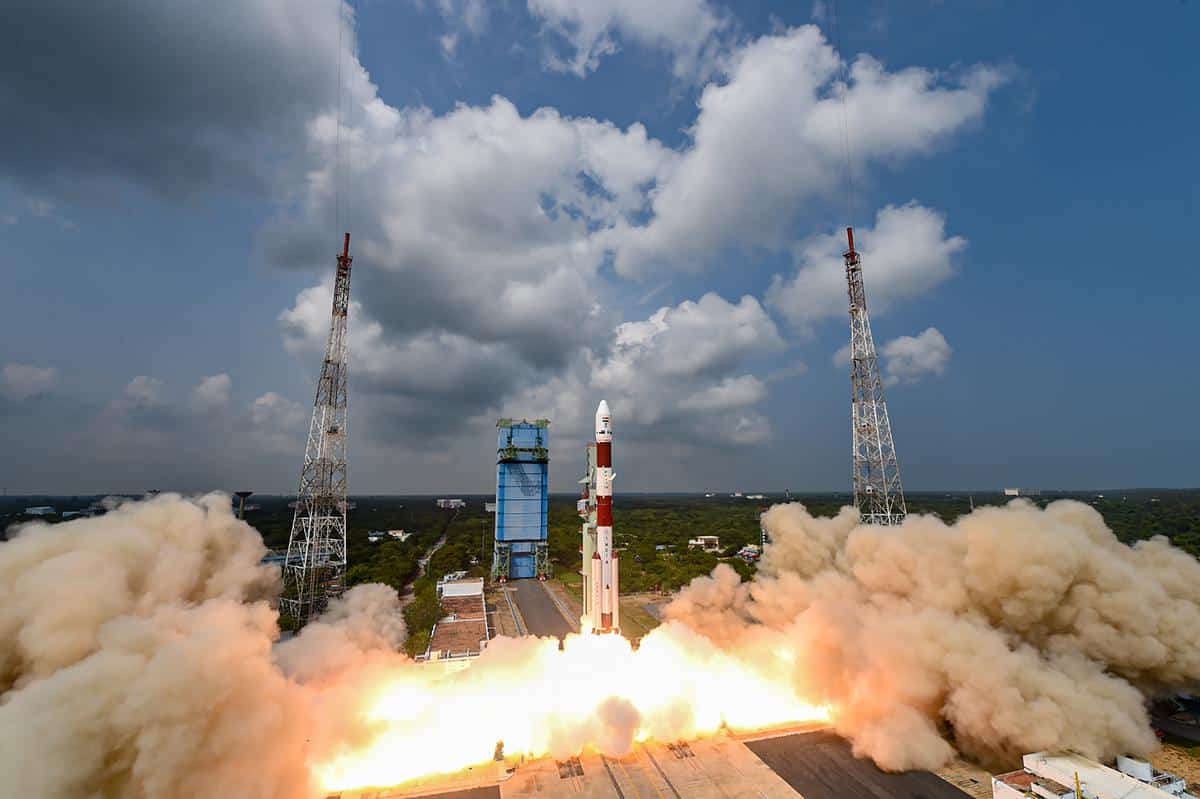
- The Indian Space Research Organisation (ISRO) successfully launched 9 satellites, including an Earth Observation Satellite (EOS-06), into multiple orbits using the space agency’s Polar Satellite Launch Vehicle (PSLV-C54) in one of its longest missions.
About the mission:

- Launch vehicle: PSLV: This is the 56th flight of the PSLV and the 24th flight of the PSLV-XL version that took off from the Satish Dhawan Space Centre (SDSC), SHAR, Sriharikota.
- The PSLV is an expendable medium-lift launch vehicle designed and operated by the ISRO.
- It was developed in 1993 to allow India to launch its Indian Remote Sensing (IRS) satellites into sun-synchronous orbits.
- PSLV can also launch small size satellites into Geostationary Transfer Orbit (GTO).
- Some notable payloads launched by PSLV include India’s first lunar probe Chandrayaan-1, India’s first interplanetary mission – Mars Orbiter Mission (Mangalyaan) and India’s first space observatory – Astrosat.
- PSLV-XL is the upgraded version of PSLV which uses larger strap-on motors (PSOM-XL or S12) to achieve higher payload capability up to 1,800 kg (4,000 lb) to Sun-synchronous orbit.
- Satellites:
- The 8 nano satellites:
- It includes ISRO Nano Satellite-2 for Bhutan (INS-2B), Anand, Astrocast (four satellites) and two Thybolt satellites.
- EOS-6:
- It is the Oceansat series’ 3rd-generation satellite envisaged to observe ocean colour data, sea surface temperature and wind vector data to use in oceanography, climatic and meteorological applications.
- The 8 nano satellites:
- Separation of the satellites:
- The primary satellite (EOS-06) was separated in Orbit-1 and subsequently, orbit was changed by using two Orbit Change Thrusters (OCTs) introduced in the Propulsion Bay Ring of the PSLV-C54.
- Later, all the 7 commercial satellites from NewSpace India Limited (NSIL) were deployed successfully.
- Astrocast, a 3U spacecraft from Spaceflight Inc, US, was separated.
- The Thybolt, a 0.5U spacecraft bus with a communication payload to enable rapid technology demonstration and constellation development from Dhruva Space, was then placed in the intended orbit.
- The Anand three axis stabilised nano satellite, a technology demonstrator from Pixxel, India was also placed in the orbit.


The India-Bhutan Satellite:
- The INS-2B satellite, a joint mission between India and Bhutan, contains two payloads –
- NanoMx, a multispectral optical imaging payload developed by Space Applications Centre (SAC), and
- APRS-Digipeater, built collaboratively by DITT-Bhutan and URSC.
- The India-Bhutan satellite achieved a historic milestone in India’s bi-lateral cooperation with Bhutan.
- Also, the ISRO is working with Bhutan in establishing a ground station in Thimphu, which will be commissioned shortly.
Future missions ISRO is planning:
- ISRO is planning to have its mission to the sun with its satellite Aditya-L1, a coronagraphy spacecraft to study the solar atmosphere, with a PSLV rocket next year.
- The space agency will also launch 4 navigation satellites for the country’s NavIC constellation, with the first one going up in 2023.

 Last updated on Sep, 2026
→ UPSC 2027 Notification will be released on 13 January 2027 at upsconline.nic.in.
→ Check out the latest UPSC Syllabus here.
→ Download UPSC Model Answers for Mains 2026
→ UPSC Mains Question Paper 2026 is out now for Essay & GS Paper 1, 2, 3 & 4.
→ UPSC Calendar 2027 has been released.
→ Enroll in Vajiram & Ravi’s UPSC Mains Test Series 2027 for structured answer writing practice, expert evaluation, and exam-oriented feedback.
→ Join Vajiram & Ravi’s UPSC Mentorship Program 2027 for personalized guidance, strategy planning, and one-to-one support from experienced mentors.
→ Go through the UPSC Mains Previous Year Papers to enhance your preparation.
→ UPSC has released UPSC Toppers List 2025 with the Civil Services final result on its official website.
→ Also check Best UPSC Coaching in India