What’s in today’s article?
- Why in News?
- Background in which the 13th Amendment came up
- What is the 13th Amendment to Sri Lanka’s Constitution?
- Other Clauses of the Indo-Sri Lanka Accord
- Implementation of the 13th Amendment
- Implementation in the Tamil-dominated North and Eastern provinces
Why in News?
- Sri Lanka President is set to hold an all-party meeting to discuss the issue of Tamil reconciliation and welfare.
- This comes days after his visit to India, during which the Indian PM expressed the hope to implement the 13th Amendment to Sri Lanka’s constitution.
Background in which the 13th Amendment came up:
- Under the 1978 constitution, Sri Lanka had a unitary government, with all powers in the hands of the Centre.
- The Tamil minority in Sri Lanka was concentrated in the Northern and Eastern provinces.
- The struggle for rights and greater autonomy here had led to a civil war between the Liberation Tigers of Tamil Eelam (LTTE) and the Sri Lankan government.


What is the 13th Amendment to Sri Lanka’s Constitution?
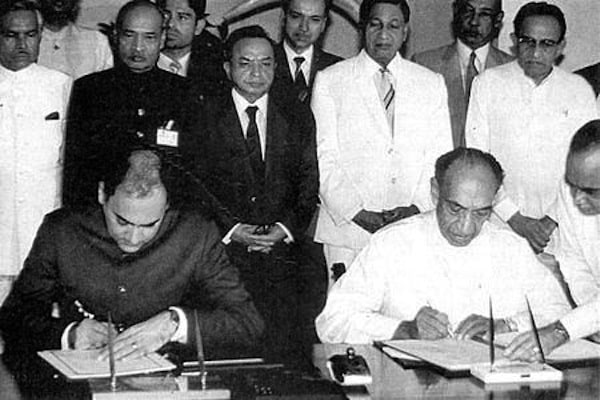
- It was made after the signing of the Indo-Sri Lanka Accord between Prime Minister Rajiv Gandhi and President J R Jayewardene in 1987 in Colombo, Sri Lanka.
- The Accord aimed at amending the constitution to transfer some powers, such as on agriculture, health, etc., to the governments of the country’s nine provinces, and find a constitutional solution to the civil war.
- For this, the 13th Amendment was made to allow devolution of power through the Sri Lankan constitution.
●
Other Clauses of the Indo-Sri Lanka Accord:
- Apart from the devolution of power, the Accord had other clauses, such as –
- Tamil and English being adopted as official languages along with Sinhala,
- Lifting of emergency on the “Eastern and Northern Provinces by August 15, 1987”,
- Surrender of arms by militant groups, and
- General amnesty to political and other prisoners now held in custody under the emergency laws.
- The Accord also says that the Government of India will underwrite and guarantee the resolutions and co-operate in the implementation of these proposals.
- Thus, Tamil groups in Sri Lanka have appealed to India multiple times (including recently) to make sure the Accord is implemented fully.
Implementation of the 13th Amendment:
- Provinces across Sri Lanka were given greater autonomy after the amendment.
- The Central government retains land and police powers, while the elected provincial councils (similar to state Assemblies in India) can legislate on subjects like agriculture, housing, road transport, education, health, etc.
- While some are unhappy over too little devolution, the hardline nationalists raise alarms over the weakening of the Central government’s authority.
- The Sinhala nationalists oppose the 13th Amendment as they see it as imposed by India.
Implementation in the Tamil-dominated North and Eastern provinces:
- The regions for whom devolution was largely intended never really benefited from it.
- While the Sinhala provinces saw regular elections and the political parties here benefited from the experience of grassroots politics, the North and Eastern regions stayed under the central government’s control for long.
- Since 2014, provincial elections are pending across Sri Lanka.
- This is because Parliament is yet to amend a 2017 Act for reforming the election process by introducing a hybrid system of first past the post and proportional representation from the current system of proportional representation.
Q) What is the water body that separates India and Sri Lanka?
Palk Strait is a strait between the Tamil Nadu state of India and the Mannar district of the Northern Province of Sri Lanka. It connects the Bay of Bengal in the northeast with the Palk Bay and then with the Gulf of Mannar in the southwest.
Q) When was Buddhism introduced in Sri Lanka?
According to traditional Sri Lankan chronicles (such as the Dipavamsa) Buddhism was introduced into Sri Lanka in the 4th century BCE by Venerable Mahinda, the son of Indian Emperor Ashoka, during the reign of Sri Lanka’s King Devanampiya Tissa.
Source: PM Modi urges Sri Lanka President to implement 13th Amendment: What is it, why India cares

 Last updated on Sep, 2026
→ UPSC 2027 Notification will be released on 13 January 2027 at upsconline.nic.in.
→ Check out the latest UPSC Syllabus here.
→ Download UPSC Model Answers for Mains 2026
→ UPSC Mains Question Paper 2026 is out now for Essay & GS Paper 1, 2, 3 & 4.
→ UPSC Calendar 2027 has been released.
→ Enroll in Vajiram & Ravi’s UPSC Mains Test Series 2027 for structured answer writing practice, expert evaluation, and exam-oriented feedback.
→ Join Vajiram & Ravi’s UPSC Mentorship Program 2027 for personalized guidance, strategy planning, and one-to-one support from experienced mentors.
→ Go through the UPSC Mains Previous Year Papers to enhance your preparation.
→ UPSC has released UPSC Toppers List 2025 with the Civil Services final result on its official website.
→ Also check Best UPSC Coaching in India