What’s in today’s article?
- Why in news?
- What is Chandrayaan-3?
- What is ISRO Telemetry, Tracking and Command Network (ISTRAC)?
- News Summary: Chandrayaan-3’s landing spot on Moon to be known as Shiv Shakti point
- Key highlights of the speech delivered by PM Modi
Why in news?
- PM Modi announced that the point where the Chandrayaan-3 lander touched down on the lunar surface would be named Shiv Shakti.
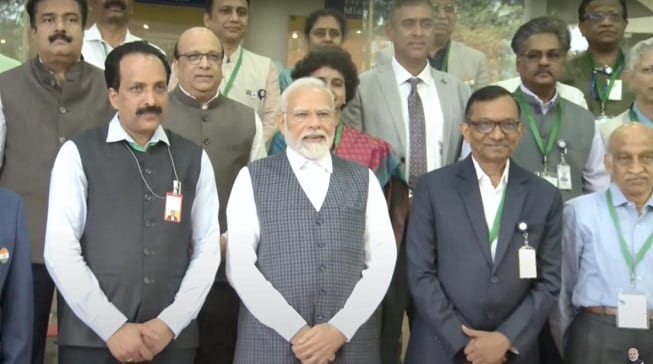
- He was addressing the ISRO scientists at the ISRO Telemetry Tracking and Command Network (ISTRAC) in Bengaluru after his arrival from Greece.


Chandrayaan-3
- About
- The Chandrayaan-3 is India’s third lunar mission.
- It consists of an indigenous lander module (LM), propulsion module (PM), and a rover.
- Its objective is to develop and demonstrate new technologies required for inter-planetary missions.
- Objectives
- The mission had 3 objectives:
- Demonstration of a Safe and Soft Landing on the Lunar Surface is accomplished☑️
- Demonstration of Rover roving on the moon is accomplished☑️
- Conducting in-situ scientific experiments – This step is going on. All payloads are performing normally.
- The mission had 3 objectives:
- Modules
- The propulsion module is the one that will take the lander and the rover to the moon.
- The lander module contains the rover. After the touchdown, the lander will remain stationary at the landing site, while the rover will explore the moon.
- Payloads
- The Chandrayaan-3 carries six payloads that would help ISRO understand the lunar soil and also get the blue planet’s photographs from the lunar orbit.
- Radio Anatomy of Moon Bound Hypersensitive ionosphere and Atmosphere (RAMBHA) will measure the near-surface plasma density and its changes with time.
- Instrument for Lunar Seismic Activity (ILSA) will measure seismicity around the landing site and delineate the structure of the lunar crust and mantle.
- The Laser-Induced Breakdown Spectroscope (LIBS) will determine the elemental composition of lunar soil and rocks around the landing site.
- Alpha Particle X-Ray Spectrometer (APXS) will derive the chemical composition and infer the mineralogical composition of the moon’s surface.
- Spectro-polarimetry of HAbitable Planet Earth (SHAPE) will study the spectro-polarimetric signatures of the earth in the near-infrared wavelength range.
- This could be used in the search for life on exo-planets beyond the solar system.
- Lunar lander Vikram will click photos of the rover Pragyaan as it studies the seismic activity on the moon.
- Using laser beams, it would try to melt a piece of the lunar surface — the regolith — to study the gases emitted during the process.
- The Chandrayaan-3 carries six payloads that would help ISRO understand the lunar soil and also get the blue planet’s photographs from the lunar orbit.
- ISRO’s previous moon missions
- Chandrayaan-3 is largely a replica of its predecessor, Chandrayaan-2, that was launched in July 2019 in the form of an orbiter and a lander (‘Vikram’) bearing a rover (‘Pragyan’).
- Chandrayaan-1 was launched by ISRO in October, 2008.
- The ISRO lost communication with Chandrayaan-1 on August 29, 2009, almost a year after it was launched.
ISRO Telemetry, Tracking and Command Network (ISTRAC)
- ISTRAC is located in Bengaluru.
- It is entrusted with the major responsibility to provide tracking support for all the satellite and launch vehicle missions of ISRO.
- The major objectives of the centre are:
- carrying out mission operations of all operational remote sensing and scientific satellites;
- providing Telemetry, Tracking and Command (TTC) services from launch vehicle lift-off till injection of satellite into orbit;
- to estimate its preliminary orbit in space; and
- hardware and software developmental activities that enhance the capabilities of ISTRAC for providing flawless TTC and Mission Operations services.
- Towards, these objectives, ISTRAC has established a network of ground stations at Bengaluru, Lucknow, Mauritius, Sriharikota, Port Blair, Thiruvananthapuram, Brunei, Biak (Indonesia) and the Deep Space Network Stations.
News Summary: Chandrayaan-3’s landing spot on Moon to be known as Shiv Shakti point
Key highlights of the speech delivered by PM Modi
- Naming of landing spots of Chandrayaan-3 and Chandrayaan-2
- PM Modi announced that the point where the Moon lander of Chandrayaan-3 touched down will now be known as Shiv Shakti.
- In Shiv, there is resolution for the welfare of humanity and Shakti gives us strength to fulfil those resolutions.
- This Shiv Shakti point of the moon also gives a sense of connection with Himalaya to Kanyakumari.
- Also, the point where the Chandrayaan-2 left its footprints will now be called
- It will serve as an inspiration for every effort that India makes and remind us that failure is not the end.
- PM Modi announced that the point where the Moon lander of Chandrayaan-3 touched down will now be known as Shiv Shakti.
- National Space Day
- He announced that August 23, the day the Chandrayaan-3’s lander made a historic soft-landing on the Moon will be commemorated as National Space Day.
- National Space Day will celebrate the spirit of Science, Technology and Innovation, and inspire us for an eternity.
- He asked ISRO to organise national hackathons on space technology in governance in collaboration with various departments of the Centre and the State governments.
- He also called upon students across the country to take part in a huge quiz competition on the Chandrayaan mission organised by MyGov from September 1.
- India now among first-world countries
- India has become the fifth-largest economy in the world and it is now among the first-world countries.
- In the journey from third row to first row, institutions like our ISRO have played a huge role.
- Scientifically prove the astronomical formulas in the scriptures of India
- He urged the younger generation of the country to come forward to scientifically prove the astronomical formulas in the scriptures of India.
Q1) What is rover?
A rover is a type of vehicle designed for exploration and research on the surface of planets, moons, or other celestial bodies. Rovers are typically used in space exploration missions to gather data, capture images, and conduct scientific experiments in environments where it’s not feasible for humans to be present.
Q2) What is Chandrayaan-1?
Chandrayaan-1 is India’s first lunar exploration mission, which was launched by the Indian Space Research Organisation (ISRO). The mission was named “Chandrayaan” which means “Moon Craft” in Sanskrit. Chandrayaan-1 was launched on October 22, 2008, and it marked a significant milestone in India’s space exploration program.
Source: Chandrayaan-3’s landing spot on Moon to be known as Shiv Shakti point: PM Modi in Bengaluru | ISRO | Indian Express | Times of India

 Last updated on Oct, 2026
→ UPSC 2027 Notification will be released on 13 January 2027 at upsconline.nic.in.
→ Check Nobel Prize 2026 Winners List here.
→ Download PIB PRiSM Monthly Magazine 2026 here.
→ Check UPSC Monthly Current Affairs Magazine The Recitals here.
→ Check out the latest UPSC Syllabus here.
→ Download UPSC Model Answers for Mains 2026
→ UPSC Mains Question Paper 2026 is out now for Essay & GS Paper 1, 2, 3 & 4.
→ UPSC Calendar 2027 has been released.
→ Enroll in Vajiram & Ravi’s UPSC Mains Test Series 2027 for structured answer writing practice, expert evaluation, and exam-oriented feedback.
→ Join Vajiram & Ravi’s UPSC Mentorship Program 2027 for personalized guidance, strategy planning, and one-to-one support from experienced mentors.
→ Go through the UPSC Mains Previous Year Papers to enhance your preparation.
→ UPSC has released UPSC Toppers List 2025 with the Civil Services final result on its official website.
→ Also check Best UPSC Coaching in India