What’s in today’s article?
- Why in news?
- What is GPS tracker?
- What is the legal position on the use of this technology in this way?
Why in news?
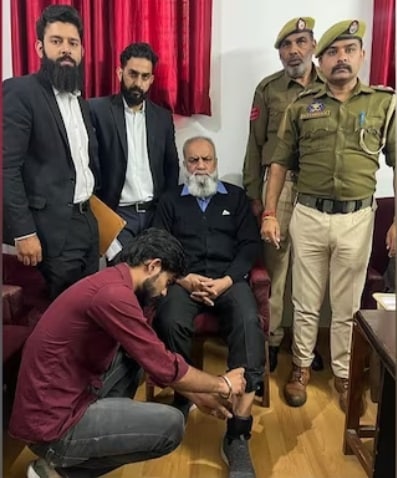
- The Jammu and Kashmir Police has introduced GPS tracker anklets for monitoring the terror accused out on bail.
- Ghulam Mohammad Bhat, who is accused of offences under the Unlawful Activities (Prevention) Act (UAPA), was let out of jail.
- This was after a special National Investigation Agency (NIA) court in Jammu upheld the prosecution’s plea and ordered police to affix a GPS tracker anklet on his foot.
- With this, the J&K police department became the first in India to be using GPS tracker anklets.


What is GPS tracker?
- About
- A GPS tracker is a small, wearable device like the GPS collars that have long been used to monitor the movements of animals.
- The device provides the exact location of the wearer at all times, and allows law enforcement and security agencies to monitor his/ her movement in real time.
- The use of GPS trackers make it a little easier to get bail under the stringent UAPA, and give police the confidence to not oppose bail.
- Features
- The device is tamper-proof, and any attempt at tampering with it sets off an alarm.
- It can also not be removed by the wearer or any unauthorised person without damaging it.
- The tracker can be put on the ankle or arm of a person. Thus, there are GPS anklets and GPS bracelets.
- Applications
- The movements of wild animals such as rogue elephants in Kerala or the cheetahs in Kuno are monitored using these devices.
- Many new automobiles are equipped with trackers to ensure they can be traced if stolen; owners can also have them installed separately.
- Criticism
- Many experts have pointed to the absence of specific legal provisions allowing the use of GPS tracker anklets.
- Also, the security establishment has not yet developed any standards and ethics in electronic monitoring.
- Rights activists say tracking a human being is a violation of their fundamental right to privacy.
- They claim that the Supreme Court in ‘Maneka Gandhi vs Union of India’ (1978) ruled that the right to life includes the right to human dignity.
- Since surveillance raises concerns of over-regulation and infringement of human rights, it is necessary to have a system of informed consent and procedures to deal with unethical and illegal practices.
What is the legal position on the use of this technology in this way?
- In India
- The use of the GPS anklet on Bhat was sanctioned by a court.
- Human rights activists have, however, pointed to the absence of specific legal provisions allowing this.
- In other countries
- GPS trackers are a precondition for bail in several countries including the United States, the United Kingdom, and Malaysia.
- In the UK, electronic monitoring may be under the Terrorism Prevention and Investigation Measures Act, 2011.
- In Malaysia, the legal frameworks on electronic monitoring have been developed by amending existing legislation and enacting new laws such as:
- Prevention of Crime Act, 1959, Security Offences Act, 2012,
- Dangerous Drugs (Special Prevention Measures) Act, and
- the Criminal Procedure Code.
Q1) What is GPS?
GPS stands for Global Positioning System. It is a satellite-based radio navigation system that provides location and time information in all weather conditions. GPS is used on land, sea, and air to determine the exact location, time, and velocity.
Q2) What is right to life?
The right to life is a moral principle that states that a human being or animal has the right to live and should not be killed by another entity. The right to life is considered the most basic of all other rights. It seeks to protect the unjust deprivation of human life by the state.
Source: On bail, tracked by satellite: How GPS anklets work | Wionews | India Today

 Last updated on Sep, 2026
→ UPSC 2027 Notification will be released on 13 January 2027 at upsconline.nic.in.
→ Asian Games 2026 are being held in Aichi-Nagoya, Japan, from 19 September to 4 October.
→ Check out the latest UPSC Syllabus here.
→ Download UPSC Model Answers for Mains 2026
→ UPSC Mains Question Paper 2026 is out now for Essay & GS Paper 1, 2, 3 & 4.
→ UPSC Calendar 2027 has been released.
→ Enroll in Vajiram & Ravi’s UPSC Mains Test Series 2027 for structured answer writing practice, expert evaluation, and exam-oriented feedback.
→ Join Vajiram & Ravi’s UPSC Mentorship Program 2027 for personalized guidance, strategy planning, and one-to-one support from experienced mentors.
→ Go through the UPSC Mains Previous Year Papers to enhance your preparation.
→ UPSC has released UPSC Toppers List 2025 with the Civil Services final result on its official website.
→ Also check Best UPSC Coaching in India