What’s in today’s article?
- Why in news?
- Volcano
- What is a volcano?
- Volcanoes particularly active in Pacific Ring of Fire
- Can scientists predict volcanic eruptions?
- What is Mount Etna?
Why in news?
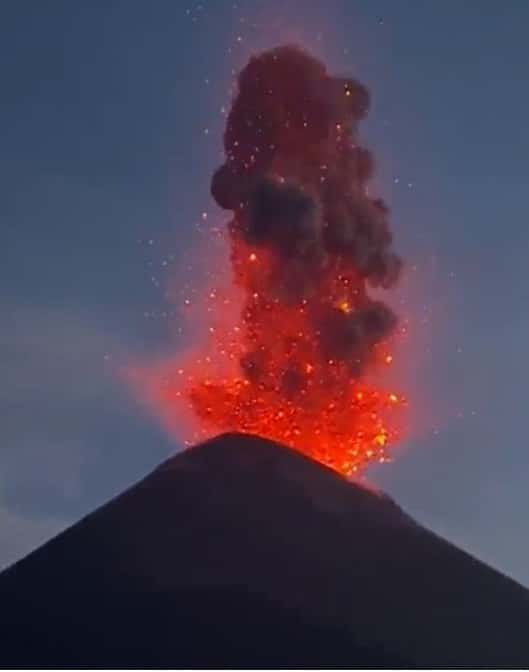
- The Mount Etna volcano began erupting again on the island of Sicily, sending ash miles into the sky.
- The eruptive column is estimated to be more than 14,700 feet above sea level.
- It should be noted that of volcanic eruptions only reaches the headlines when the big ones erupt — Etna, Kilauea, Mauna Loa, Merapi, Eyjafjallajökull or Fagradalsfjall.
- However, at any time during a given year, there may be as many as 50 to 80 fresh eruptions around the world.
- E.g., Data from the Smithsonian Institution’s Global Volcanism Program suggests that 56 volcanoes erupted in the first six months of 2023.


What is a volcano?
- About
- Volcanoes are openings, or vents where lava, tephra (small rocks), and steam erupt onto the Earth’s surface.
- Volcanoes can be on land and in the ocean.
- They are, in part, a result of their own eruptions but also the general formation of our planet, as tectonic plates move.
- Types
- There are four main types of volcanoes: cinder cones, composite or strato volcanoes, shield volcanoes and lava domes.
- Their type is determined by how the lava from an eruption flows and how that flow affects the volcano, and, as a result, how it affects its surrounding environment.
- Eruption
- Essentially, it is a case of magma, or molten rock, below the surface of the Earth, bubbling up, rising and overflowing,.
- The magma finds its way to vents in the volcano and gets spewed across the land and into the atmosphere.
- When magma erupts from a volcano, it is called lava.
Volcanoes particularly active in Pacific Ring of Fire
- Pacific Ring of Fire includes New Zealand, Southeast Asia, Japan and the western coast of the Americas.
- About 90% of all earthquakes worldwide strike within this region.
Can scientists predict volcanic eruptions?
- Scientists are capable of predicting volcanic eruptions hours, or sometimes several days, in advance.
- This is not the case with earthquakes, which are much harder to predict.
- Scientists use seismographic data from earthquakes and other tremors, because those can be a precursor to volcanic eruptions.
- They monitor the ground for signs of deformation, which may be caused by the movement of magma.
- They also take readings of volcanic gas emissions, and changes in gravity and magnetic fields.
Mount Etna
- About
- Mount Etna is an active stratovolcano on the east coast of Sicily, Italy.
- It is Europe’s most active volcano and one of the largest in the world. Its recorded volcanic activity dates back to 1500 B.C.
- Since then, it has erupted more than 200 times.
- Etna has displayed a variety of eruption styles, including violent explosions and voluminous lava flows.
- Other volcanoes erupt for much longer than Etna
- One of the most famous long-term eruptions was Kilauea volcano on Hawaii.
- Its spewing spree in 1983 continued — almost nonstop — for 35 years until 2018, only to start again in 2021. The eruption is still ongoing.
- Dukono in Indonesia started erupting in August 1933 and is still continuing.
- Santa Maria in Guatemala began erupting in June 1922 and continues to this day.
- Yasur in Vanuatu first rumbled to life in about 1270 (± 110 years) and as of June 2023, was still erupting.
- One of the most famous long-term eruptions was Kilauea volcano on Hawaii.
Q1) What is stratovolcano?
Stratovolcanoes have relatively steep sides and are more cone-shaped than shield volcanoes. They are formed from viscous, sticky lava that does not flow easily. The lava therefore builds up around the vent forming a volcano with steep sides.
Q2) What is Pacific Ring of Fire?
The Pacific Ring of Fire is a tectonic belt that encircles the Pacific Ocean. It is also known as the Circum-Pacific Belt or the Pacific Rim.
Source: Mount Etna erupts: Why some volcanoes just keep spewing lava | Foxweather | Geology.com

 Last updated on Sep, 2026
→ UPSC 2027 Notification will be released on 13 January 2027 at upsconline.nic.in.
→ Asian Games 2026 are being held in Aichi-Nagoya, Japan, from 19 September to 4 October.
→ Check out the latest UPSC Syllabus here.
→ Download UPSC Model Answers for Mains 2026
→ UPSC Mains Question Paper 2026 is out now for Essay & GS Paper 1, 2, 3 & 4.
→ UPSC Calendar 2027 has been released.
→ Enroll in Vajiram & Ravi’s UPSC Mains Test Series 2027 for structured answer writing practice, expert evaluation, and exam-oriented feedback.
→ Join Vajiram & Ravi’s UPSC Mentorship Program 2027 for personalized guidance, strategy planning, and one-to-one support from experienced mentors.
→ Go through the UPSC Mains Previous Year Papers to enhance your preparation.
→ UPSC has released UPSC Toppers List 2025 with the Civil Services final result on its official website.
→ Also check Best UPSC Coaching in India