What’s in today’s article?
- Background
- History of Swiss Mediation
- What are the Goals of the Summit?
- Russia’s Response to the Summit
- India’s Participation in the Summit
Background
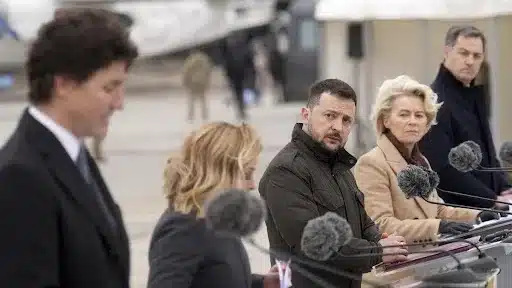
- With the Russia-Ukraine war in its third year, Switzerland will host a peace conference on June 15-16, immediately after the G7 Summit in Italy.
- Switzerland has taken this initiative at the request of Ukraine’s President Volodymyr Zelenskyy, who visited Bern (Switzerland’s capital) earlier in January this year.


History of Swiss Mediation
- Neutrality is a foundational principle of Switzerland’s foreign policy.
- It has had a tradition of being the protecting power since the 19th century when it looked after the interests of both the Kingdom of Bavaria and the Grand Duchy of Baden during the Franco-Prussian War of 1870-71.
- It acted as the protecting power during the two World Wars, and held nearly 200 protective power mandates during World War II.
- Switzerland represented India’s interests in Pakistan and Pakistan’s in India between 1971 and 1976.
- Over the last two decades, Switzerland has been the protecting power between Saudi Arabia and Iran, the US and Iran, Russia and Georgian, and other pairs of mutually hostile governments.
- The country also has a history of hosting negotiations or mediating in conflicts. It hosted talks between the government in Colombo and the Liberation Tigers of Tamil Eelam in 2006.
- During the Russia-Ukraine war, however, Switzerland has leaned towards Ukraine, and has joined the Western sanctions regime against Russia.
What are the Goals of the Summit?
- During President Zelenskyy’s visit to Bern in January, 2024, Switzerland and Ukraine discussed the next steps towards a comprehensive, just and lasting peace in Ukraine.
- At Ukraine’s request, Switzerland agreed to host a high-level conference.
- The objective of the Summit is to “provide a platform for a high-level dialogue on ways to achieve a comprehensive, just and lasting peace for Ukraine based on international law and the UN Charter”.
- The conference will aim to “create a common understanding of the framework conductive to this goal and a concrete roadmap for the peace process”.
- Switzerland has invited 120 countries, including India, to participate in the conference.
Russia’s Response to the Summit
- Surprisingly, Russia has not been invited by Switzerland for the Ukraine-Russia Peace Summit.
- Russian President Vladimir Putin has said there will be no peace in Ukraine until Russia’s goals are met.
- He declared that Russia was not invited, and also stated that nothing could be decided without Moscow.
- He suggested that because there would be no Russian delegation at the conference, it could be claimed that Russia is refusing to negotiate.
- According to the Swiss foreign ministry, invitations to the June peace summit will be sent to around 120 countries in the coming weeks.
- Ignazio Cassis, head of the Swiss foreign ministry, had already stated that Russia would not be taking part.
India’s Participation in the Summit
- Prime Minister Narendra Modi’s schedule will be clear after the Lok Sabha results come in June 4.
- Once the election results are declared, the Prime Minister will be ready to travel, after the formation of the government.
- This would be the Indian Prime Minister’s first trip overseas after elections.
- Also, there are expectations that Italy will invite the PM for the G7 leaders’ summit as a guest — as has been the practice in the last five years since France invited New Delhi in 2019 and Japan in 2023.
- After the G7 leaders’ summit, the stop at the peace conference will be a “natural event” to go to for the Prime Minister.
- Zelenskyy had sought India’s support on his 10-point peace formula, which calls for withdrawal of Russian troops from Ukraine, release of prisoners, restoration of Ukraine’s territorial integrity, and guarantees on nuclear safety, food and energy security.
India has sought to maintain a diplomatic balancing act between Russia and Ukraine, and it will have to calibrate its response over attendance at the peace conference.

 Last updated on Oct, 2026
→ UPSC 2027 Notification will be released on 13 January 2027 at upsconline.nic.in.
→ Asian Games 2026 are being held in Aichi-Nagoya, Japan, from 19 September to 4 October.
→ Check Nobel Prize 2026 Winners List here.
→ Download PIB PRiSM Monthly Magazine 2026 here.
→ Check UPSC Monthly Current Affairs Magazine The Recitals here.
→ Check out the latest UPSC Syllabus here.
→ Download UPSC Model Answers for Mains 2026
→ UPSC Mains Question Paper 2026 is out now for Essay & GS Paper 1, 2, 3 & 4.
→ UPSC Calendar 2027 has been released.
→ Enroll in Vajiram & Ravi’s UPSC Mains Test Series 2027 for structured answer writing practice, expert evaluation, and exam-oriented feedback.
→ Join Vajiram & Ravi’s UPSC Mentorship Program 2027 for personalized guidance, strategy planning, and one-to-one support from experienced mentors.
→ Go through the UPSC Mains Previous Year Papers to enhance your preparation.
→ UPSC has released UPSC Toppers List 2025 with the Civil Services final result on its official website.
→ Also check Best UPSC Coaching in India