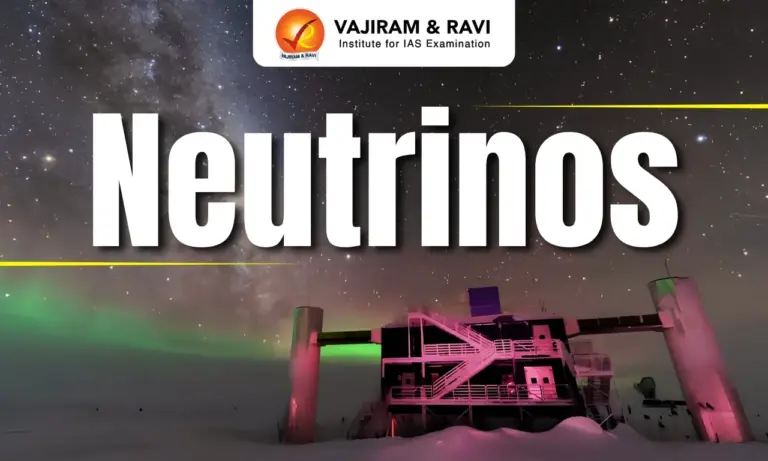
Neutrinos Latest News
- The 2026 Nobel Prize in Physics has been awarded to Francis Halzen, a Belgian-American scientist, for designing an elaborate detection system beneath the Antarctic ice sheets to capture neutrinos — tiny, elusive subatomic particles often called “ghost particles.”
- His facility, IceCube, achieved something unique: detecting high-energy neutrinos arriving from far outside our galaxy.
What Are Neutrinos?
- Neutrinos are very small subatomic particles, produced mainly in nuclear reactions inside stars.
- They are among the most abundant particles in the universe, second only to photons (light particles).
- Despite their abundance, they reveal enormous amounts of information about the cosmos precisely because of a frustrating property: they are extremely difficult to detect.
Why Detection Is So Hard
- Neutrinos have an extremely low propensity to interact with matter. The Nobel Prize committee itself described them as the “shyest particle.”
- They are also electrically neutral, so they don’t respond to electromagnetic fields the way charged particles do.
- Nearly 65 billion neutrinos pass through a human fingernail every second, completely unnoticed.
- Detection happens only on the rare occasions they do interact with matter — perhaps one in billions or trillions.
- This is why neutrino observatories worldwide are very large facilities, built in extremely isolated, often underground locations, designed to maximise interaction chances and minimise background noise.


Why Their Elusiveness Is Also Their Strength
- The very quality that makes neutrinos hard to detect makes them scientifically invaluable. They pass through regions of cosmic space that no other signal can cross.
- Very dense regions in space can absorb or scatter electromagnetic radiation entirely.
- Neutrinos, however, simply flow through such regions undisturbed.
- This lets them reveal processes happening within or beyond dense cosmic regions that are otherwise inaccessible to scientists.
What Made IceCube Special
- IceCube was not the first neutrino observatory — neutrinos were first theoretically proposed in the 1930s and first detected in the 1950s, with several dedicated observatories operating worldwide since.
- IceCube’s Breakthrough: It successfully detected a special variety of high-energy neutrinos originating far outside our galaxy — extra-galactic neutrinos.
- Previously, scientists could only detect neutrinos originating close to Earth, primarily produced by nuclear processes inside the Sun.
How IceCube Actually Works
- Halzen conducted most of the theoretical design work for an observatory built deep beneath the ice sheets of Antarctica.
- South Pole location worked because: it was isolated; and at significant depths, there was extensive darkness with no disturbance from other radiation or signals.
- The Setup: One cubic kilometre of ice, equipped with over 5,000 light sensors mounted on long cables; An overground facility collects and processes the signals.
- The Physics: On the rare occasion a neutrino interacts with an ice atom’s nucleus, it produces a charged particle. If that particle travels faster than the speed of light in ice, it produces a faint glow (a phenomenon related to Cherenkov radiation).
- By analysing this glow’s characteristics, scientists can reconstruct the energy and direction of the original neutrino.
Timeline of Results
- 2011: The facility became fully operational, having already recorded a couple of events suggesting extra-galactic neutrino involvement.
- 2013: IceCube presented the first evidence of detecting very high-energy neutrinos.
- Since then: Several such detections have been recorded and independently verified.
Why This Matters: Multi-Messenger Astronomy
- The detection of extra-galactic neutrinos has opened an entirely new source of information about the universe, adding to the tools scientists already use.
Evolution of Cosmic Observation Tools
- Visible light — the original and only tool for a long time.
- Full electromagnetic spectrum detectors (and cosmic ray detectors) — developed subsequently.
- Gravitational waves (detected in 2015) — opened an entirely new observational window.
- Extra-galactic neutrinos — adds yet another dimension of possibility.
- Together, these different signal types enable “multi-messenger astronomy” — the ability to study the same cosmic event using multiple independent types of signals.
Indian Context: The Stalled INO Project
- The India-based Neutrino Observatory (INO) project was initially planned for Kerala, then relocated to Tamil Nadu.
- Howver, the project ran into opposition from local and political groups over land acquisition and environmental concerns. A new location has yet to be finalised.
Conclusion
- Halzen turned a cubic kilometre of Antarctic ice into humanity’s most unlikely telescope — one built not to capture light, but its opposite: particles that refuse to interact with anything at all.
- By finally catching neutrinos from beyond our galaxy, IceCube has added a new, nearly unblockable channel for reading the universe.
- India’s own stalled neutrino project is a reminder that even in fundamental science, the hardest obstacles aren’t always physics — sometimes they’re land and politics.
Source: IE

 Last updated on Oct, 2026
→ UPSC 2027 Notification will be released on 13 January 2027 at upsconline.nic.in.
→ Asian Games 2026 are being held in Aichi-Nagoya, Japan, from 19 September to 4 October.
→ Check Nobel Prize 2026 Winners List here.
→ Download PIB PRiSM Monthly Magazine 2026 here.
→ Check UPSC Monthly Current Affairs Magazine The Recitals here.
→ Check out the latest UPSC Syllabus here.
→ Download UPSC Model Answers for Mains 2026
→ UPSC Mains Question Paper 2026 is out now for Essay & GS Paper 1, 2, 3 & 4.
→ UPSC Calendar 2027 has been released.
→ Enroll in Vajiram & Ravi’s UPSC Mains Test Series 2027 for structured answer writing practice, expert evaluation, and exam-oriented feedback.
→ Join Vajiram & Ravi’s UPSC Mentorship Program 2027 for personalized guidance, strategy planning, and one-to-one support from experienced mentors.
→ Go through the UPSC Mains Previous Year Papers to enhance your preparation.
→ UPSC has released UPSC Toppers List 2025 with the Civil Services final result on its official website.
→ Also check Best UPSC Coaching in India
Neutrinos FAQs
Q1. What are neutrinos? +
Q2. Why are neutrinos difficult to detect?+
Q3. What made IceCube significant in neutrino research?+
Q4. How does IceCube detect neutrinos?+
Q5. What is the significance of neutrinos for multi-messenger astronomy?+
Tags: mains articles Neutrinos upsc current affairs upsc mains current affairs