Russian and Chinese Revolutions Latest News
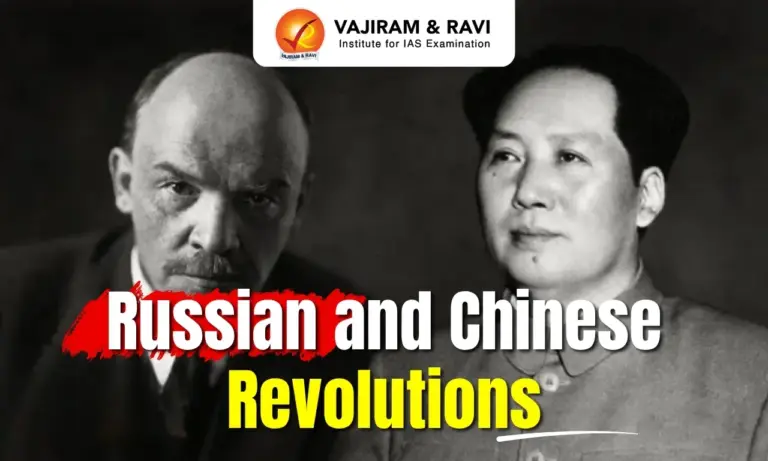
- October occupies a singular place in modern history, associated with two revolutions that transformed not just governments but the very language of politics.
- On October 1, 1949, Mao Zedong stood at Tiananmen in Beijing and proclaimed the People’s Republic of China.
- Thirty-two years earlier, in October 1917, the Bolsheviks under Vladimir Ilyich Lenin had seized power in Petrograd.
- The Bolshevik seizure on October 25–26 (Julian calendar) corresponds to November 7–8 on the Gregorian calendar now used worldwide.
- Russia later adopted the Gregorian calendar, but the name “October Revolution” endured.
A Connected but Distinct Legacy
- The two revolutions arose from very different circumstances and should not be seen as repetitions of one another. Yet a crucial thread connects them:
- Russia established the first durable state founded on Marxist socialism.
- China demonstrated how Marxism could be reshaped for a predominantly agrarian Asian society.
- Together, they challenged the assumption that Western Europe alone would determine the direction of modern history.


Russia, 1917: Revolution and a New Political Imagination
- The Russian Revolution cannot be separated from the catastrophe of World War I.
- Imperial Russia entered the war burdened by social inequality, agrarian tensions, a restless industrial working class, and an autocracy that had survived the 1905 revolution without resolving its underlying problems.
- Military defeats, casualties, shortages and inflation steadily eroded Tsar Nicholas II’s authority.
The Sequence of Events
- The February Revolution of 1917 toppled the Romanov dynasty, but the Provisional Government continued the war and postponed land reform.
- Soviets (councils) of workers and soldiers emerged as alternative centres of authority.
- Lenin returned from exile in April, demanding peace and “all power to the soviets.”
- By September, Bolsheviks held majorities in the Petrograd and Moscow Soviets, with Leon Trotsky heading the Petrograd Soviet.
- In October, Bolshevik-led soldiers, sailors and Red Guards occupied strategic points in Petrograd and seized the Winter Palace. New decrees on peace and land followed.
Contested Legacy
- To supporters, October represented power transferring to workers and peasants.
- To critics, it was a disciplined minority’s seizure of power that eventually produced one-party rule.
- The dissolution of the Constituent Assembly, civil war, and later Soviet coercive institutions ensured this debate would never disappear.
1917’s Global Impact
- Land redistribution, workers’ rights, public ownership, mass education, and social welfare appeared not merely as ideas but as programmes a state might actually realise.
- Even anti-communist societies had to respond — the expansion of labour rights, social insurance, and welfare states occurred in a world where organised labour and socialist alternatives could no longer be easily ignored.
- The Bolsheviks denounced imperialism, while the Communist International sought to link socialist revolution with anti-colonial struggles.
- Across Asia, Africa, and Latin America, socialism became intertwined with movements for national liberation.
China, 1949: Revolution Moves East
- China followed a different road. The Qing dynasty fell in 1911, but political fragmentation, warlordism, unequal treaties, and foreign intervention continued.
- Key stages:
- The May Fourth Movement (1919) radicalised a generation of Chinese intellectuals, some turning toward Marxism.
- The Communist Party of China was founded in 1921, partly under the intellectual impact of the Russian Revolution.
- After Chiang Kai-shek turned against the communists in 1927, the movement was driven into the countryside.
- China’s Great Innovation: In a predominantly agrarian society, Mao placed the peasantry at the centre of revolutionary strategy — rural organisation, land reform, and guerrilla warfare became instruments of mobilisation.
- The Long March (1934–35) ensured the movement’s survival and strengthened Mao’s leadership.
- Resistance to Japanese invasion enhanced the communists’ nationalist credentials.
- Renewed civil war after 1945 ended with the defeat of the Kuomintang, which retreated to Taiwan.
- On October 1, 1949, Mao proclaimed the People’s Republic — a revolutionary transformation for roughly one-fifth of humanity.
- China’s significance extended beyond the emerging Cold War balance: it demonstrated that an agrarian Asian society could chart its own revolutionary path, and that the peasant could be as central a revolutionary figure as the industrial worker.
Achievement, Tragedy, and the Colonial World
- Commemorating these revolutions does not require romanticising them.
The Soviet record
- Achievements: Remarkable advances in literacy, education, science, and industrialisation; an enormous role in defeating Nazi Germany.
- Tragedies: Forced collectivisation, famine, the Great Terror, and the Gulag produced immense suffering.
The Chinese record
- Achievements: Transformed landholding, education, public health, and the legal position of women; striking later improvements in literacy and life expectancy.
- Tragedies: Violence during land reform, the disastrous Great Leap Forward (rapid industrialisation and agricultural collectivisation), and the upheavals of the Cultural Revolution.
Impact on Colonised Societies
- European imperialism had long presented itself as nearly permanent. Russia’s revolution challenged imperialism ideologically, while China showed an Asian civilisation reclaiming political sovereignty after foreign encroachment.
India’s Engagement with Both Revolutions
- India responded closely to both experiences:
- M N Roy debated colonial strategy with Lenin.
- Bhagat Singh read socialist literature.
- Rabindranath Tagore reflected on Soviet education.
- Jawaharlal Nehru’s 1927 visit to the Soviet Union shaped his thinking on planning and development.
- India recognised the People’s Republic of China soon after its establishment, and both countries later articulated the Panchsheel principles — optimism later shattered by the 1962 conflict.
- India followed neither the Soviet nor Chinese political model, choosing parliamentary democracy and a mixed economy instead.
- But its debates over planning, land reform, public-sector industry, labour, and education unfolded within a world transformed by 1917 and 1949.
The Continuing Meaning of October
- Russia and China represented two different revolutionary paths:
- Russia centred the industrial worker, soldier, and soviet.
- China added the peasant, rural mobilisation, and protracted struggle.
- Their differences culminated in the Sino-Soviet split, proving that communist politics itself contained competing visions.
What endured, What Didn’t
- The Soviet Union disappeared in 1991; the People’s Republic survives, profoundly altered by Deng Xiaoping’s economic reforms.
- But the significance of both revolutions extends beyond the states they created — they forced the modern world to confront questions of land, labour, poverty, inequality, education, welfare, imperialism, and national sovereignty.
Source: IE

 Last updated on Oct, 2026
→ UPSC 2027 Notification will be released on 13 January 2027 at upsconline.nic.in.
→ Asian Games 2026 are being held in Aichi-Nagoya, Japan, from 19 September to 4 October.
→ Check Nobel Prize 2026 Winners List here.
→ Download PIB PRiSM Monthly Magazine 2026 here.
→ Check UPSC Monthly Current Affairs Magazine The Recitals here.
→ Check out the latest UPSC Syllabus here.
→ Download UPSC Model Answers for Mains 2026
→ UPSC Mains Question Paper 2026 is out now for Essay & GS Paper 1, 2, 3 & 4.
→ UPSC Calendar 2027 has been released.
→ Enroll in Vajiram & Ravi’s UPSC Mains Test Series 2027 for structured answer writing practice, expert evaluation, and exam-oriented feedback.
→ Join Vajiram & Ravi’s UPSC Mentorship Program 2027 for personalized guidance, strategy planning, and one-to-one support from experienced mentors.
→ Go through the UPSC Mains Previous Year Papers to enhance your preparation.
→ UPSC has released UPSC Toppers List 2025 with the Civil Services final result on its official website.
→ Also check Best UPSC Coaching in India
Russian and Chinese Revolutions FAQ
Q1. Why are the Russian and Chinese Revolutions historically connected?+
Q2. What caused the Russian Revolution of 1917? +
Q3. How did China develop a different revolutionary strategy? +
Q4. How did these revolutions influence the colonial world?+
Q5. How did India respond to the Russian and Chinese Revolutions? +
Tags: mains articles Russian and Chinese Revolutions upsc current affairs upsc mains current affairs