What’s in today’s article?
- Why in News?
- Comments Made by the Karnataka HC Judge
- Watchdog of the Judges of Constitutional Courts
- Previous Instances of Impeachment Proceedings Against the Judges
- Judicial Interventions to Discipline Judges
Why in News?
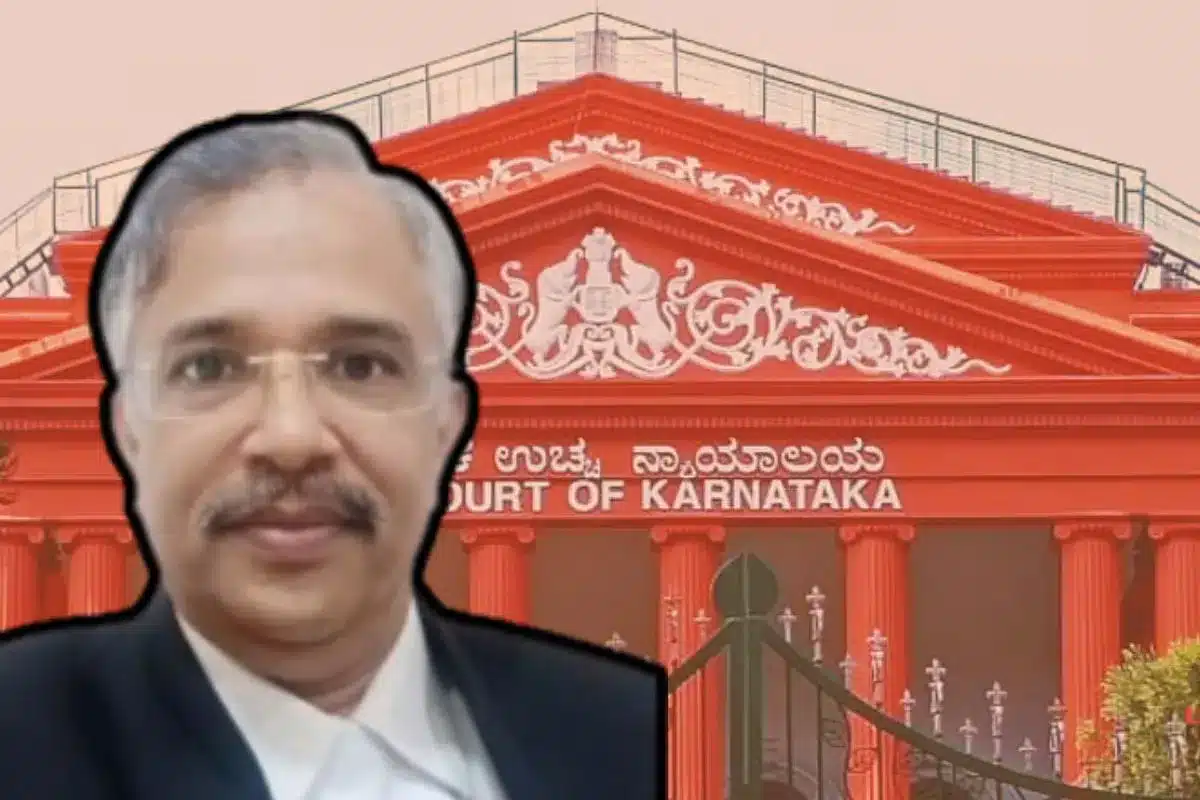
A Bench of the five senior-most Supreme Court judges headed by Chief Justice of India (CJI) expressed serious concern about objectionable comments made by a Karnataka High Court Justice (V Srishananda).


Comments Made by the Karnataka HC Judge:
- During a hearing, he had referred to a particular locality of Bengaluru as being “in Pakistan”. In another hearing, he had made an “objectionable” comment against a female lawyer.
- Though the SC withdrew its intervention after the judge submitted an apology, even a slight reprimand from the apex court to a judge of a constitutional court is uncommon and conveys a powerful message.
- The situation also highlights the constitutional limitations on how the judiciary can discipline judges.
Watchdog of the Judges of Constitutional Courts:
- The Constitution of India [Article 124(4)]:
- A judge of the SC (or any HC) can be removed from office only by an order of the President passed after an address by each House of Parliament supported –
- By a majority of the total membership of that House and
- By a majority of not less than two-third of the members of the House present and voting
- And has been presented to the President in the same session for such removal on the ground of proved misbehaviour or incapacity.
- A judge of the SC (or any HC) can be removed from office only by an order of the President passed after an address by each House of Parliament supported –
- Significance of the above provision: It gives a great degree of protection to the judges to ensure that they can exercise their powers without fear of interference from the executive.
- Issues with the above provision – Impeachment or nothing:
- The impeachment, which is a political process, is the only recourse to dealing with errant judges.
- “Proved misbehaviour” or “incapacity” are the only two grounds for removal of a judge of the constitutional court.
- The level of political consensus required to pass an impeachment motion, makes the standard for impeachment very high.
Previous Instances of Impeachment Proceedings Against the Judges:
- Only five instances of impeachment proceedings in history:
- Against Justice V Ramaswami (SC, 1993),
- Justice Soumitra Sen (Calcutta HC, 2011),
- Justice J B Pardiwala (Gujarat HC, 2015),
- Justice C V Nagarjuna (HC of Andhra Pradesh and Telangana, 2017), and
- Then CJI Justice Dipak Misra (2018).
- Results of these proceedings: These proceedings were never successful. Justice Sen was impeached by Rajya Sabha and subsequently resigned.
- Alternatives to impeachment: Over the years, the SC has created substitute methods of disciplining judges because, under the current legal framework, the alternative to impeachment is to just turn a blind eye.
Judicial Interventions to Discipline Judges:
- Judicial actions:
- As the court of last resort, the SC’s word is final and binding. This means that through judicial action, it can send a message to errant judges, even if such a power is not defined in the letter of the law.
- For example, a five-judge Bench of the SC headed by then CJI Jagdish Khehar held Calcutta HC’s C S Karnan guilty of contempt of court, and sentenced him to six months’ imprisonment in 2017.
- Karnan retired less than a month after the SC verdict, and was taken into custody to serve his sentence.
- This resulted in an uneasy precedent, with many voicing concerns about one constitutional court disciplining the judges of another.
- Transfer policy:
- The SC Collegium, comprising five senior-most judges of the apex court including the CJI, recommends the transfer of HC judges.
- Given that the decisions of the Collegium are opaque, this transfer policy can be deployed as a tool to discipline judges as well.
- In 2010, the then Karnataka HC judge (P D Dinakaran was facing allegations of land grabbing and corruption) was transferred to the Sikkim HC.
- The move was criticised as only “transferring corruption” rather than dealing with it. However, Justice Dinakaran resigned in 2011.
Q.1. What is the Collegium System?
The Collegium System is a mechanism for appointing and transferring judges in India’s higher judiciary. It is headed by the CJI and four other senior judges of the SC. The system is not mentioned in the Constitution, but evolved through three SC judgements, known as the Three Judges Cases, in 1981, 1993, and 1998.
Q.2. How does the hierarchy in the Indian judiciary system work?
The Indian judicial system is divided into three verticals: Supreme Court, High Courts and District Courts. The Supreme Court is the apex court, followed by 25 High Courts, and District Courts are at the bottom tier.
Source: How Supreme Court deals with errant judges, works around constitutional limitations

 Last updated on Sep, 2026
→ UPSC 2027 Notification will be released on 13 January 2027 at upsconline.nic.in.
→ Check out the latest UPSC Syllabus here.
→ Download UPSC Model Answers for Mains 2026
→ UPSC Mains Question Paper 2026 is out now for Essay & GS Paper 1, 2, 3 & 4.
→ UPSC Calendar 2027 has been released.
→ Enroll in Vajiram & Ravi’s UPSC Mains Test Series 2027 for structured answer writing practice, expert evaluation, and exam-oriented feedback.
→ Join Vajiram & Ravi’s UPSC Mentorship Program 2027 for personalized guidance, strategy planning, and one-to-one support from experienced mentors.
→ Go through the UPSC Mains Previous Year Papers to enhance your preparation.
→ UPSC has released UPSC Toppers List 2025 with the Civil Services final result on its official website.
→ Also check Best UPSC Coaching in India