


What’s in today’s article?
- Why in News?
- What are CAFE Norms?
- Penalty on Automakers for Violating CAFE Norms
- Conclusion
Why in News?
- The Centre has identified eight automakers, including Hyundai, Kia, Mahindra, and Honda, for exceeding mandated fleet emission levels during the financial year 2022-23.
- Non-compliance with Corporate Average Fuel Efficiency (CAFE) norms has led to an estimated penalty of ₹7,300 crore, with Hyundai alone facing over ₹2,800 crore in fines.


What are CAFE Norms?
- Introduced by: The Bureau of Energy Efficiency (BEE) in 2017 under the Energy Conservation Act, 2001, to regulate fuel consumption and carbon emissions for passenger vehicles.
- Objective: Reduce oil dependency and curb air pollution.
- Scope: Vehicles under 3,500 kg, including those powered by petrol, diesel, LPG, CNG, hybrids, and EVs.
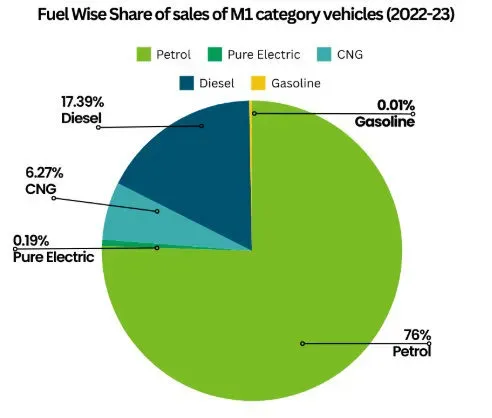
- Implementation: These standards were introduced in two phases – the first CAFÉ norms stage I fuel consumption standards were introduced effective 2017-18, and the CAFÉ norms stage II standards came into force in 2022-23.
- Compliance Criteria for FY23:
- Fuel consumption: ≤ 4.78 litres per 100 km.
- Carbon emissions: ≤ 113 grams of CO2 per km.
- Penalties for non-compliance: The financial year 2022-23 saw tighter CAFE norms come into effect, resulting in significant penalties for non-compliance.
- Significance of CAFE norms:
- The CAFE framework incentivises automakers to produce EVs, hybrids, and CNG vehicles while penalising reliance on fossil fuel-driven cars.
- Stricter norms align with India’s broader goals to reduce emissions and promote sustainable transportation.
Penalty on Automakers for Violating CAFE Norms:
- Breakdown of penalty: The penalties represent a substantial proportion of some automakers’ profits, with Hyundai’s fine equating to nearly 60% of its FY23 earnings.
- Stricter penalty norms:
- In December 2022, the Energy Conservation Act was amended to enforce stricter penalties:
- ₹25,000 per vehicle for a shortfall below 0.2 litres per 100 km.
- ₹50,000 per vehicle for exceeding the threshold.
- Base penalty: ₹10 lakh.
- Carmakers’ contentions: Automakers argue that the stricter penalty norms took effect only from January 1, 2023, making it unfair to apply them retroactively to cars sold throughout FY23.
- In December 2022, the Energy Conservation Act was amended to enforce stricter penalties:
- Government’s counter:
- In FY23, 18 manufacturers’ models were tested in accredited laboratories to simulate real-world driving conditions.
- While all 19 automakers complied in FY22, data for FY23 indicates non-compliance for eight carmakers.
Conclusion:
- The penalties for non-compliance with CAFE norms underscore the government’s commitment to enforcing stricter emission standards.
- However, ongoing discussions and delayed compliance reports highlight the challenges in balancing regulatory enforcement with industry concerns.
Q.1. What is the Bureau of Energy Efficiency (BEE)?
The BEE is a statutory body under the Government of India’s Ministry of Power that promotes energy conservation and efficient use of energy. The BEE was established on March 1, 2002, under the Energy Conservation Act of 2001.
Q.2. What is the Energy Conservation Act?
The Energy Conservation Act was enacted in 2001 with the goal of reducing energy intensity of the Indian economy.
News: Hyundai, Mahindra, 6 others likely to face emission penalties of Rs 7,300 crore | BEE

 Last updated on Oct, 2026
→ UPSC 2027 Notification will be released on 13 January 2027 at upsconline.nic.in.
→ Check Nobel Prize 2026 Winners List here.
→ Download PIB PRiSM Monthly Magazine 2026 here.
→ Check UPSC Monthly Current Affairs Magazine The Recitals here.
→ Check out the latest UPSC Syllabus here.
→ Download UPSC Model Answers for Mains 2026
→ UPSC Mains Question Paper 2026 is out now for Essay & GS Paper 1, 2, 3 & 4.
→ UPSC Calendar 2027 has been released.
→ Enroll in Vajiram & Ravi’s UPSC Mains Test Series 2027 for structured answer writing practice, expert evaluation, and exam-oriented feedback.
→ Join Vajiram & Ravi’s UPSC Mentorship Program 2027 for personalized guidance, strategy planning, and one-to-one support from experienced mentors.
→ Go through the UPSC Mains Previous Year Papers to enhance your preparation.
→ UPSC has released UPSC Toppers List 2025 with the Civil Services final result on its official website.
→ Also check Best UPSC Coaching in India








