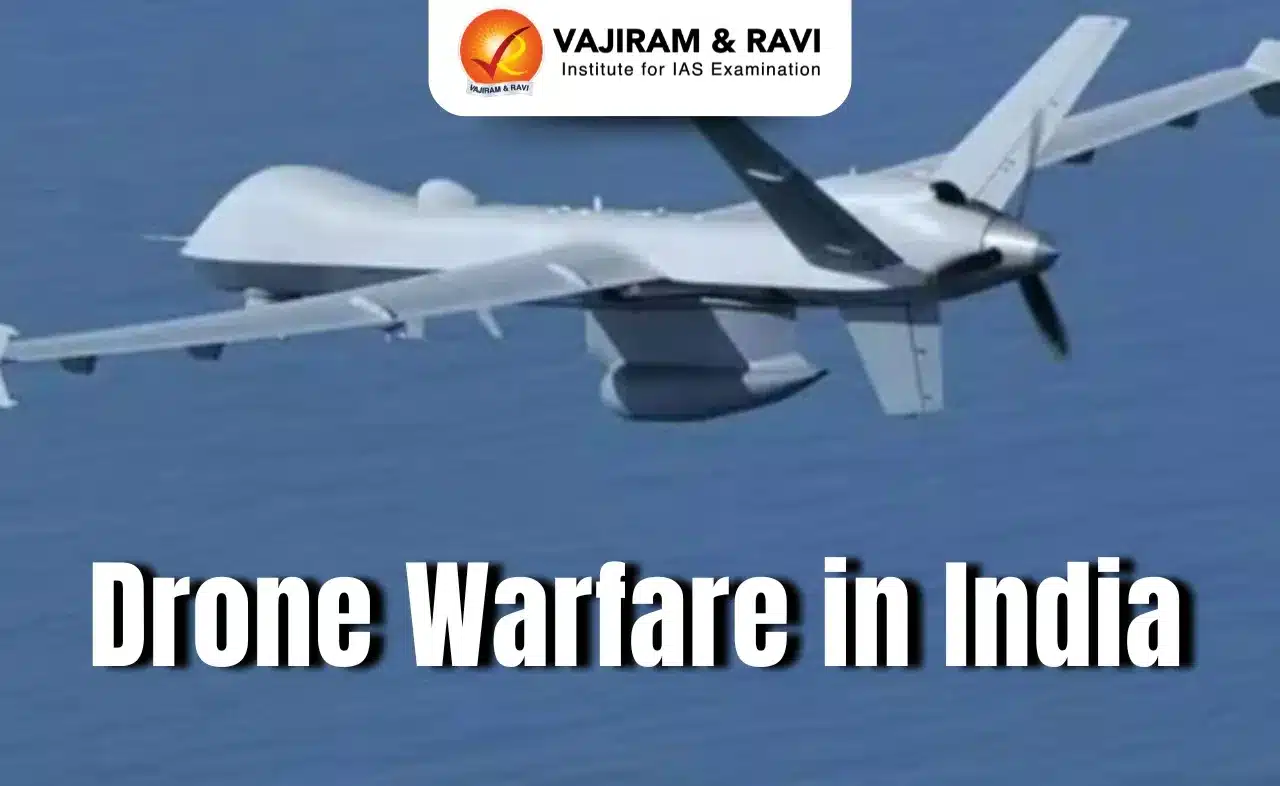
Drone Warfare in India Latest News
- Former Army Chief General M M Naravane’s 2021 warning about the dangers of low-tech warfare remains highly relevant today.
- Two recent incidents highlight this:
- Recently, Ukraine used cheap First Person View (FPV) drones to bomb five Russian airbases, showcasing how low-cost drones can bypass traditional air defences.
- In May, during the post-Operation Sindoor hostilities, Pakistan launched relentless drone swarm attacks across India’s western front.
- These events underscore the urgent need to rethink air defence strategies in an era of asymmetric and low-cost drone warfare.
The Rise of Drone Warfare: A Strategic Shift
- Drones, or Unmanned Aerial Vehicles (UAVs), trace back to World War II and the Korean War, mainly used for training and limited offensives.
Drone Swarms: The Future of Combat
- Swarms are groups of drones that operate together, adapt in real time, and continue missions despite losses.
- Their advantages include saturation attacks, real-time intel gathering, and coordinated strikes on high-value targets.
- Future drone swarms, powered by artificial intelligence, will make autonomous decisions, adapt tactics, and integrate with ground and cyber warfare units.
Market Outlook
- The global military drone market is booming — from $14.14 billion in 2023 to a projected $47.16 billion by 2032 — reflecting their growing role in modern warfare.


The Growing Threat of Drone Swarms
- Chief of Defence Staff General Anil Chauhan warned about the increasing use of small, swarm-capable drones that are nearly undetectable and untargetable, posing a serious security challenge.
Asymmetric Advantage and Strategic Challenge
- Swarm drones are cheap but deadly — capable of inflicting massive damage on high-value targets.
- For example, a $1,000 drone can potentially destroy a $200 million aircraft.
- Launching them from mobile platforms near sensitive sites makes defence difficult.
India’s Unique Vulnerabilities
- With porous borders and diverse populations, India faces a high risk of such surprise attacks.
- The ability to move drones covertly, as Ukraine did across Russian territory, illustrates the scale of the threat.
Need for Comprehensive Security Integration
- Defending against swarm drones requires coordination across military, intelligence, and civil policing — even a local traffic constable could play a role in early detection.
Countering Drone Threats: Multi-Layered Defence Strategies
- Detection is the First Line of Defence
- Modern anti-drone systems begin with detection using: AESA radars; Electro-optical & infrared sensors; Acoustic detectors; AI-powered sensor fusion systems.
- Kinetic Neutralisation: Traditional but Costly
- Drones can be destroyed by missiles or anti-aircraft guns, but this method is expensive and inefficient against swarms.
- Automated systems like – C-RAM; Phalanx gun systems – are more effective for rapid engagement.
- Emerging Cost-Effective Technologies
- To reduce defence costs, militaries are shifting toward:
- Directed Energy Weapons (DEWs): Lasers & microwaves disable drones electronically.
- Electronic Warfare (EW): Jams GPS/communication signals.
- Spoofing: Misdirects drone navigation and commands.
- Cyber Attacks: Hacks drones and crashes them remotely.
- Interceptor Drones & Nets: Physically capture or disable hostile drones at close range.
- To reduce defence costs, militaries are shifting toward:
- The Challenge of Cost Asymmetry
- A drone swarm costing $100,000 may require millions to neutralise with missiles — making low-cost defensive options a priority.
- The Layered Defence Model
- Optimal protection combines multiple technologies in layers for redundancy and cost-efficiency.
- Examples: Israel’s Iron Dome; US’s DE M-SHORAD
- India is also developing such integrated systems.
India’s Capabilities Against Drone Threats
- Akashteer Air Defence Control System
- Developed by Bharat Electronics Ltd, it links with the Indian Air Force’s integrated command network for real-time airspace tracking and threat response.
- Bhargavastra
- Created by Solar Defence and Aerospace Ltd, this system launches 64 micro-rockets in rapid salvos to destroy incoming drone swarms.
- DRDO’s Anti-Drone System: Offers 360-degree radar coverage and dual-action neutralisation:
- Soft kill: Jamming communication and GPS signals
- Hard kill: Laser targeting
- Detects drones up to 4 km away and neutralises threats within a 1 km radius.
- Indrajaal
- Developed by a Hyderabad-based startup, this AI-powered defensive grid uses a combination of jammers, spoofers, and real-time intelligence to secure up to 4,000 sq km.
- It is operational at Indian naval installations in Gujarat and Karnataka.
Looking Ahead: The Future of Drone Warfare and India’s Preparedness
- Global Drone Arms Race
- There is an ongoing global race to enhance both drone and anti-drone technologies. For example:
- Iran is producing 20+ Shahed drones daily, showcasing rapid scalability.
- India has established a growing drone ecosystem, supported by 550+ startups, combining indigenous development and acquired technologies.
- There is an ongoing global race to enhance both drone and anti-drone technologies. For example:
- The New Face of War
- Future conflicts are expected to be:
- Unmanned: With drones taking over many battlefield roles
- AI-Driven: Enabling autonomous decision-making
- Asymmetric: Where low-cost tech can target high-value assets
- CDS General Anil Chauhan emphasizes a paradigm shift:
- “We are at a cusp where war may be between humans and machines — and tomorrow, between machines themselves.”
- This underscores the urgent need for resilient, AI-integrated defence systems to counter increasingly sophisticated threats.
- Future conflicts are expected to be:
Source: IE

 Last updated on August, 2026
→ UPSC Mains 2026 commenced on 21st August 2026 and will continue through 30th August 2026, as per the official examination schedule.
→ UPSC Mains Question Paper 2026 is out now for Essay & GS Paper 1, 2, 3 & 4.
→ UPSC Mains GS Paper 1 2026 is out now.
→ UPSC Mains GS Paper 2 2026 is out now.
→ UPSC Mains GS Paper 3 2026 is out now.
→ UPSC Mains GS Paper 4 2026 is out now.
→ Check out the latest UPSC Syllabus 2026 here.
→ UPSC Mains Admit Card 2026 is now out.
→ Enroll in Vajiram & Ravi’s UPSC Mains Test Series 2027 for structured answer writing practice, expert evaluation, and exam-oriented feedback.
→ Join Vajiram & Ravi’s UPSC Mentorship Program 2027 for personalized guidance, strategy planning, and one-to-one support from experienced mentors.
→ Go through the UPSC Mains Previous Year Papers to enhance your preparation.
→ Download UPSC Mains Essay Paper 2025, UPSC Mains GS Paper-I 2025, UPSC Mains GS Paper-II 2025, UPSC Mains GS Paper-III 2025, UPSC Mains GS Paper-IV 2025, UPSC Mains English (Compulsory) Paper 2025, UPSC Mains Hindi (Qualifying) Paper 2025 here.
→ UPSC has released UPSC Toppers List 2025 with the Civil Services final result on its official website.
→ UPSC Calendar 2027 has been released.
→ Also check Best UPSC Coaching in India
Drone Warfare in India FAQs
Q1. What is drone warfare?+
Q2. Why are drone swarms dangerous?+
Q3. How is India countering drone threats?+
Q4. What is Operation Spider’s Web?+
Q5. What’s the future of drone warfare?+
Tags: drone warfare in india mains articles upsc current affairs upsc mains current affairs