State Legislative Councils Latest News
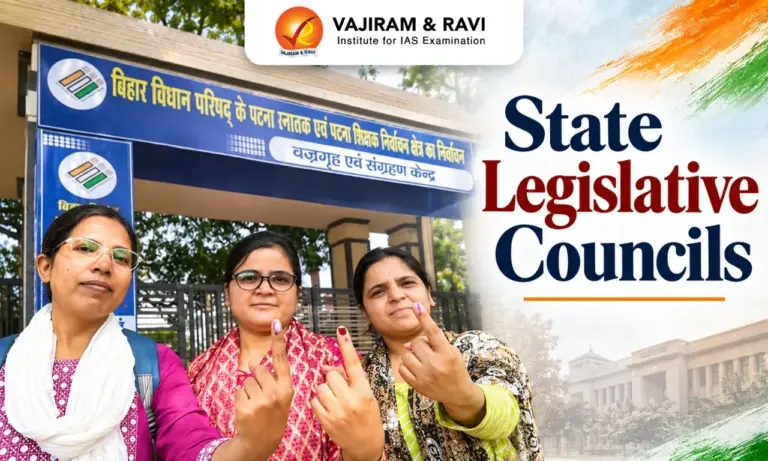
- Recently, elections were held for 28 Legislative Council seats in four states. These polls have drawn attention to the unusual and complex system used to elect Members of Legislative Councils (MLCs). Unlike Assembly elections, not every adult citizen can vote in them.
A Second Chamber for States
- India has two types of legislatures. Unicameral legislatures have one House. Bicameral legislatures have two Houses.
- The Constitution makes Parliament bicameral, with the Lok Sabha and Rajya Sabha.
- For states, however, a second chamber is optional. This chamber is called the Legislative Council (Vidhan Parishad).


Debate in the Constituent Assembly
- The framers disagreed on whether states needed a second chamber.
- Arguments in favour:
- It would bring diverse viewpoints into lawmaking.
- It would act as a voice of reason.
- It would check hasty decisions of the directly elected House.
- Arguments against:
- It would be expensive.
- It would slow down government action.
- Parties could use its seats to reward loyalists.
- The framers reached a middle path. They let states decide whether they want a Council.
- They also capped its size and limited its powers. This created a unique institution.
Present Status
- Currently, six states have Legislative Councils: Andhra Pradesh, Bihar, Maharashtra, Karnataka, Uttar Pradesh and Telangana.
- Uttar Pradesh has the largest Council (100 seats). Telangana has the smallest (40 seats).
- The Representation of the People Act, 1950 also provides seats for Madhya Pradesh and Tamil Nadu, but their Councils are not operational.
Composition of the Council
- Article 171 governs the size and structure of Councils.
- Minimum size: 40 members.
- Maximum size: One-third of the total strength of the Legislative Assembly.
- Members are chosen as follows:
- One-third elected by MLAs.
- One-third elected by members of local bodies.
- One-twelfth elected by graduates.
- One-twelfth elected by teachers.
- The remaining nominated by the Governor.
- The Representation of the People Act, 1950 lays down the exact seat break-up for each Council.
Key Features of MLC Membership
- Term: Six years.
- Continuity: One-third of members retire every two years.
- Eligibility: A candidate must be at least 30 years old and a voter in the state.
- Nominations: The Governor nominates residents with expertise in literature, science, art, the co-operative movement and social service.
Who Votes in MLC Elections?
- MLA Constituency – This is the simplest category. Only sitting MLAs vote.
- Territorial Constituencies – The other three categories are territorial. Eligible voters within a specific area elect their representative.
- Local authorities: Only sitting members of local bodies can vote.
- Graduates: The voter must be a citizen, ordinarily resident in the constituency, and must have held a graduate degree from any Indian university for at least three years.
- Teachers: The voter must have taught for at least three years in the last six years in an institution not lower than secondary school.
- Special Electoral Rolls – Rolls for graduate and teacher constituencies are prepared afresh before every election. Even existing voters must re-apply. Eligibility is counted from the qualifying date of November 1 each year.
Rationale for Graduate and Teacher Seats
- Representation of specific groups began before Independence. The Government of India Act, 1935 provided seats on religious, economic and social grounds.
- In the Constituent Assembly, arguments were made that the Council should represent a province’s intelligentsia.
- It suggested that subsets of voters, such as graduates, trade unions, local body members and professionals, should elect some members. This idea was adopted in the Constitution.
How Voting Works
- Single Transferable Vote: General elections are simple: one voter, one vote, one candidate. This allows the use of EVMs. MLC elections, however, use proportional representation through the Single Transferable Vote (STV), as in Rajya Sabha elections.
- That is why they still use ballot papers.
- The ballot lists all candidates, along with NOTA.
- Voters rank candidates by writing 1, 2, 3 and so on.
- A candidate needs a fixed quota of votes to win.
- Quota formula: (Total valid votes ÷ (Seats + 1)) + 1.
- Surplus votes of winners pass to the next preferences. The lowest-ranked candidate is eliminated, and their votes are transferred. This continues until all seats are filled.
Secret Ballot vs Open Ballot
- In Rajya Sabha elections, MLAs must show their ballot to their party’s agent. Parliament introduced this open ballot system in 2003 to curb cross-voting.
- In MLC elections, the MLAs’ vote remains secret. They need not show it to anyone.
How Councils Differ from Rajya Sabha
- Legislative Councils are much weaker than the Rajya Sabha.
- Permanence: Rajya Sabha is a continuous body. A Council’s existence depends on the Assembly. Under Article 169, Parliament can create or abolish a Council if the Assembly passes a resolution by a special majority.
- Legislative power: Councils cannot shape laws passed by the Assembly. They can only delay ordinary bills; the Assembly has the final say.
Concern over Stability
- In 2013, a Parliamentary Committee examining a proposed Council for Rajasthan called for a national policy on creating and abolishing Councils.
- It warned that a second chamber should not depend on the mood of the government of the day.
Conclusion
- Legislative Councils give a voice to the educated, teachers and local governments in state lawmaking. Yet their limited powers and dependence on ruling majorities weaken their role.
- A clear national policy on their creation and abolition can make Councils stable, credible and truly deliberative institutions.
Source: IE

 Last updated on Oct, 2026
→ UPSC 2027 Notification will be released on 13 January 2027 at upsconline.nic.in.
→ Check Nobel Prize 2026 Winners List here.
→ Download PIB PRiSM Monthly Magazine 2026 here.
→ Check UPSC Monthly Current Affairs Magazine The Recitals here.
→ Check out the latest UPSC Syllabus here.
→ Download UPSC Model Answers for Mains 2026
→ UPSC Mains Question Paper 2026 is out now for Essay & GS Paper 1, 2, 3 & 4.
→ UPSC Calendar 2027 has been released.
→ Enroll in Vajiram & Ravi’s UPSC Mains Test Series 2027 for structured answer writing practice, expert evaluation, and exam-oriented feedback.
→ Join Vajiram & Ravi’s UPSC Mentorship Program 2027 for personalized guidance, strategy planning, and one-to-one support from experienced mentors.
→ Go through the UPSC Mains Previous Year Papers to enhance your preparation.
→ UPSC has released UPSC Toppers List 2025 with the Civil Services final result on its official website.
→ Also check Best UPSC Coaching in India
State Legislative Councils FAQs
Q1. What are State Legislative Councils? +
Q2. Which states in India currently have Legislative Councils? +
Q3. How are members of State Legislative Councils elected? +
Q4. What is the minimum and maximum strength of a Legislative Council? +
Q5. Can a State Legislative Council be abolished? +
Tags: mains articles State Legislative Councils upsc current affairs upsc mains current affairs