Ballot Papers in Indian Elections Latest News
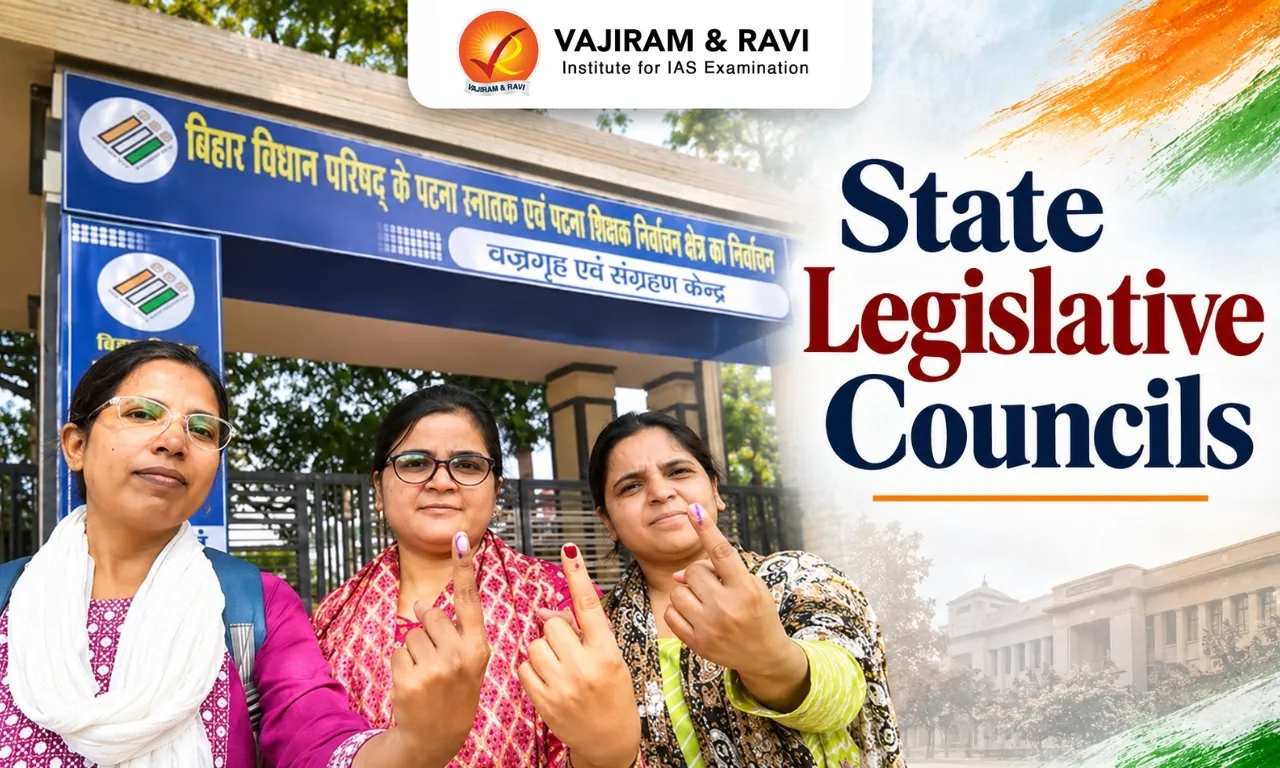
- Recently, elections were held for 28 Legislative Council (MLC) seats across the country. PM Modi took a swipe at the opposition party, noting that MLC elections use ballot papers, not EVMs. The Opposition Party has blamed EVMs for its past electoral losses.
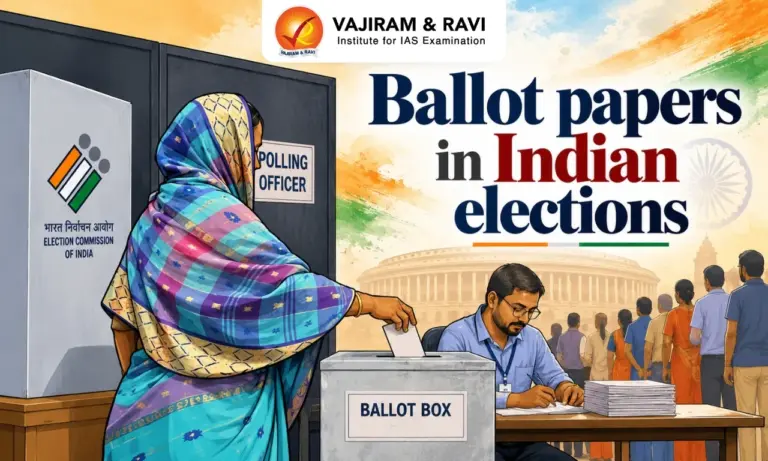
- The remarks have revived the EVM vs ballot paper debate. This raises a key question: which elections in India still use ballot papers, and why?
Ballot Papers in Panchayat Elections
- Most elections to Gram Panchayats, Panchayat Samitis and Zilla Parishads still use ballot papers.
- A 2023 study by the Indian Institute of Public Administration (IIPA), sponsored by the Ministry of Panchayati Raj, found:
- 53% of states use ballot papers for Gram Panchayat elections.
- Only three States/UTs (Kerala, Sikkim, and Dadra & Nagar Haveli and Daman & Diu) use EVMs in all Gram Panchayat constituencies.
- 22% of states are in transition. They use EVMs in some constituencies and ballot papers in others.
- EVM use rises at higher tiers. In Zilla Panchayat elections, 17% of states use EVMs in all constituencies.


Reasons Given by States
- States using ballot papers cited two main hurdles:
- Lack of funds.
- Lack of voter awareness about EVMs.
- The IIPA report found the awareness argument weak. The same voters use EVMs in Assembly and Lok Sabha elections.
Drawbacks of Ballot Papers
- The report highlighted several problems:
- Counting is slow and cumbersome.
- It requires huge manpower.
- It is not environment-friendly.
Ground Realities
- Local practices also explain the continued use of ballot papers.
- Non-party symbols: In rural local body polls, tehsildars allot symbols days before the election. Candidates give three choices and get one. These are not regular party symbols.
- Personal connect matters: A former sarpanch from Maharashtra noted that a candidate’s closeness to voters and help with daily work matter more than ideology in these polls.
- Simultaneous polls: A Bihar official said elections for multiple tiers happen at the same time. Using so many machines would be difficult, so ballot papers are more practical.
- Can EVMs Handle Local Symbols?
- Yes. Former Election Commissioner Ashok Lavasa explained that a process called “symbol loading” allows the required local symbols to be loaded onto EVMs.
Municipal and Student Union Elections
- Municipal Bodies
- Municipal elections fall under the State Election Commissions (SECs). SECs can choose between EVMs and ballot papers.
- Municipal Corporation of Delhi: Uses EVMs.
- Punjab: Shifted to ballot papers in 2026.
- The Punjab and Haryana High Court upheld this choice. It noted that the Punjab Municipal Election Rules, 1994 permit both methods, leaving the decision to the SEC.
- Municipal elections fall under the State Election Commissions (SECs). SECs can choose between EVMs and ballot papers.
- Student Unions
- Student union polls also use both methods.
- Delhi University Students’ Union (DUSU): Uses EVMs. Candidate names appear in alphabetical order, so names and ballot numbers matter.
- Jawaharlal Nehru University Students’ Union (JNUSU): Uses ballot papers.
Single Transferable Vote: Where Ballot Papers Are Necessary
- Some elections must use ballot papers. These are elections held through the Single Transferable Vote (STV) system.
- Legislative Councils – Under Article 171, MLC elections follow proportional representation through STV. Voters mark their first, second, third and further preferences. This ranking makes the vote transferable. It can only be done on paper, not on an EVM.
- Rajya Sabha – Rajya Sabha elections also use STV and ballot papers. Here, voting MLAs follow an open ballot; they must show their vote to their party’s agent.
How the STV Quota Works
- A formula decides the votes needed to win.
- Quota = [Total votes ÷ (Number of seats + 1)] + 1
- Example:
- 200 MLAs vote for 4 seats.
- 200 ÷ (4 + 1) = 40.
- Quota = 40 + 1 = 41 votes.
- Any candidate with 41 first-preference votes is elected.
- If seats remain vacant, surplus votes of winners are transferred. For instance, a winner with 45 votes has 4 surplus votes. These go to the second-preference candidates.
- If several winners have surpluses, the largest surplus is transferred first.
- If seats still remain, the candidate with the fewest first-preference votes is eliminated. Their votes move to the next preference. This continues until all seats are filled.
Conclusion
- Ballot papers remain vital where STV voting, local symbols or simultaneous multi-tier polls make EVMs impractical. However, slow counting, high costs and environmental concerns persist.
- Gradual, well-funded adoption of EVMs in local polls, with strong voter trust, can balance efficiency and credibility.
Source: IE

 Last updated on Oct, 2026
→ UPSC 2027 Notification will be released on 13 January 2027 at upsconline.nic.in.
→ Check Nobel Prize 2026 Winners List here.
→ Download PIB PRiSM Monthly Magazine 2026 here.
→ Check UPSC Monthly Current Affairs Magazine The Recitals here.
→ Check out the latest UPSC Syllabus here.
→ Download UPSC Model Answers for Mains 2026
→ UPSC Mains Question Paper 2026 is out now for Essay & GS Paper 1, 2, 3 & 4.
→ UPSC Calendar 2027 has been released.
→ Enroll in Vajiram & Ravi’s UPSC Mains Test Series 2027 for structured answer writing practice, expert evaluation, and exam-oriented feedback.
→ Join Vajiram & Ravi’s UPSC Mentorship Program 2027 for personalized guidance, strategy planning, and one-to-one support from experienced mentors.
→ Go through the UPSC Mains Previous Year Papers to enhance your preparation.
→ UPSC has released UPSC Toppers List 2025 with the Civil Services final result on its official website.
→ Also check Best UPSC Coaching in India
Ballot papers in Indian elections FAQs
Q1. Which elections in India still use ballot papers? +
Q2. Why do states continue using ballot papers in Panchayat elections? +
Q3. What are the major disadvantages of using ballot papers? +
Q4. Why are ballot papers necessary in Legislative Council elections? +
Q5. How does the Single Transferable Vote system work? +
Tags: Ballot papers in Indian elections mains articles upsc current affairs upsc mains current affairs