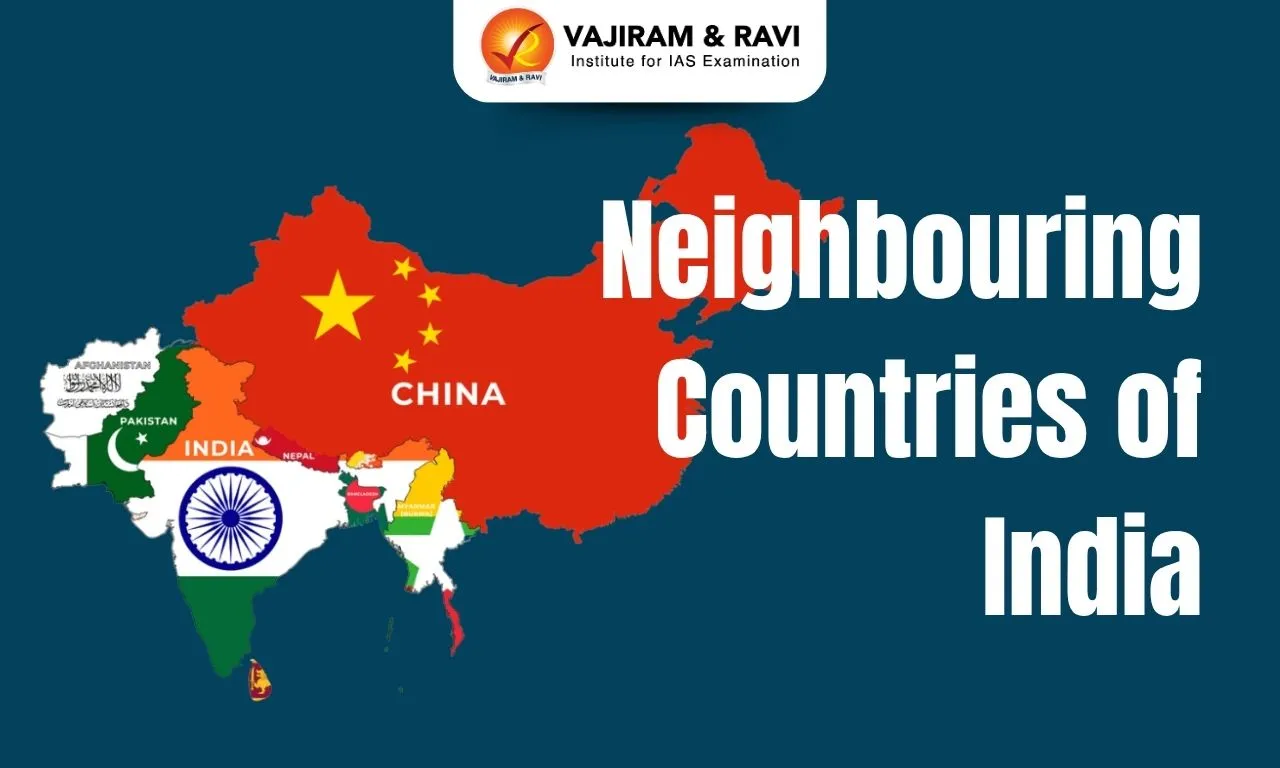
India, a prominent South Asian nation, stands out as one of the largest countries in the world. Positioned in both the Northern and Eastern Hemispheres, India ranks as the seventh-largest globally by land area. India’s land boundaries extend to approximately 15,106.7 kilometers, encompassing a coastline of around 7,516.6 kilometers. This extensive border area offers unique access to neighboring countries, connecting India with cultures, economies, and ecosystems that enhance its regional significance. This article delves into details for Neighbouring Countries of India as of 2026.
What are Neighbouring Countries of India?
India shares over 15,106.7 kilometers of land borders with 7 countries: Pakistan to the west, China and Nepal to the north, Bhutan to the northeast, and Bangladesh and Myanmar to the east, and maritime border with 2 countries: Sri Lanka separated by the Gulf of Mannar & the Palk Strait and Maldives located southwest of the Indian mainland. This geographical spread makes India a central player in South Asian geopolitics.
In addition to its land borders, India has a coastline stretching 7,516.6 kilometers, providing it with direct access to the Arabian Sea, the Bay of Bengal, and the Indian Ocean. This coastal expanse connects India to international waters, giving it a strategic marine position that supports trade routes linking the Middle East, Africa, and Southeast Asia. Important ports like Mumbai, Chennai, and Kolkata facilitate extensive trade and cultural exchange, solidifying India’s role in the global economy.
Neighbouring Countries of India 2026
India shares its borders with nine countries: seven land borders (Pakistan, China, Nepal, Bhutan, Bangladesh, Myanmar, Afghanistan) and two maritime borders (Sri Lanka and the Maldives). This geographical knowledge is vital for competitive exams, especially in the General Awareness section.
| Neighbouring Countries of India 2026 | |
| Aspect | Description |
|
Total Neighbouring Countries Of India |
9 |
|
Neighbouring Countries Of India |
Afghanistan, Pakistan, China, Nepal, Bhutan, Bangladesh, Sri Lanka, Maldives and MyanmarTotal |
|
Total Land Border Of India |
15,106.7 k.m. |
|
Total Length Of Indian Coastline |
7516.6 km |


Neighbouring Countries of India With Capital 2026 List
India shares its borders with 9 countries, each with distinct geographical, cultural, and economic ties. The List of Neighbouring Countries of India With Capital the capital, border length, and bordering states has been tabulated below:
| List of Neighbouring Countries of India 2026 With Capital | |||||
| Country | Capital | Flag | Currency | Border Length | Bordering States |
|
Afghanistan |
Kabul |
 |
Afghani (AFN) |
106 Km |
Ladakh (PoK) |
|
Bangladesh |
Dhaka |
 |
Bangladeshi Taka (BDT) |
4096.7 Km |
West Bengal, Meghalaya, Mizoram, Tripura and Assam |
|
Bhutan |
Thimphu |
 |
Bhutanese Ngultrum (BTN) |
699 Km |
West Bengal, Sikkim, Arunachal Pradesh & Assam |
|
China |
Beijing |
 |
Renminbi (CNY) |
3488 Km |
Ladakh, Himachal Pradesh, Uttarakhand, Sikkim and Arunachal Pradesh |
|
Myanmar |
Naypyidaw, Yangon |
 |
Myanmar Kyat (MMK) |
1643 Km |
Arunachal Pradesh, Nagaland, Mizoram and Manipur |
|
Nepal |
Kathmandu |
 |
Nepalese Rupee (NPR) |
1751 Km |
Bihar, Uttarakhand, UP, Sikkim and West Bengal |
|
Pakistan |
Islamabad |
 |
Pakistani Rupee (PKR) |
3323 Km |
Jammu and Kashmir, Ladakh, Punjab, Rajasthan and Gujarat |
|
Sri Lanka |
Colombo (Commercial), Sri Jayawardenepura Kotte (Legislative) |
 |
Sri Lankan Rupee (LKR) |
Sea Border |
It is separated to India by Gulf of Mannar |
|
Maldives |
Male |
 |
Maldivian Rufiyaa (MVR) |
Sea Border |
It lies in the south-west part of India Ocean below the Lakshadweep Island |
Neighbouring Countries of India Physical Features
India shares its land and maritime boundaries with several countries, each having distinct physical features that influence geopolitics, trade, and regional cooperation. India shares land borders with seven countries and maritime boundaries with two. The Neighbouring Countries of India Physical Features has been discussed in the table below:
| Neighbouring Countries of India Physical Features | |||
|
Country |
Geographical & Climatic Features |
Energy & Natural Resources |
India’s Strategic Interests |
|
Afghanistan |
Mountainous terrain influences cold winters and seismic activity due to tectonic plate location. |
Rich in minerals and water but lacks infrastructure in remote regions. |
Acts as a corridor for India to Central Asia, enhancing connectivity and economic cooperation. |
|
Bangladesh |
Dense river network vital for agriculture, but vulnerable to monsoons and floods; seismic risk exists. |
Investing in solar energy to meet growing demands; high population strains resources. |
Important trade partner in textiles and agriculture; collaboration on river management is crucial. |
|
Bhutan |
High-altitude mountainous country; experiences cold winters and occasional earthquakes. |
Major hydropower potential; rivers are tapped for electricity generation. |
India imports hydropower from Bhutan, vital for energy supply in northeastern states. |
|
China |
Geographically diverse, with deserts, tropical zones, and the Tibetan Plateau, earthquake-prone zones. |
Global leader in renewable and nuclear energy production. |
Trade ties benefit India in goods and tech, though geopolitical relations are complex and sensitive. |
|
Myanmar |
Tropical climate with intense monsoons; situated near earthquake fault lines. |
Exploring geothermal and wind energy, rich in river-based water resources. |
Strategic for India’s Act East policy; access to ports strengthens trade and regional integration. |
|
Nepal |
Dominated by the Himalayas; experiences altitude-driven cold weather and frequent quakes. |
Excellent hydropower potential; solar energy initiatives are rising in remote areas. |
Access to Nepal’s rivers for electricity benefits India’s northern power grid and water-sharing cooperation. |
|
Pakistan |
Diverse terrain with deserts and fertile plains; northern areas face high seismic activity. |
Water-stressed despite major rivers; exploring wind and solar solutions. |
Cooperation essential for managing shared rivers like the Indus; has energy and climate impact implications. |
|
Sri Lanka |
Island nation with tropical monsoons; affected by Indian Ocean climate and tsunami risk. |
Expanding use of solar energy; coastal ecosystems critical for livelihood. |
Strategic location aids India in maritime security, trade routes, and regional diplomacy. |
|
Maldives |
The low-lying island nation, highly threatened by sea-level rise, has a tropical marine climate. |
Depends largely on solar energy; rich marine biodiversity in coral reefs. |
Important for India’s maritime diplomacy and security in the Indian Ocean; enhances regional influence. |
9 Neighbouring Countries of India 2026
India shares its borders with nine neighbouring countries, including Pakistan, China, Nepal, Bhutan, Bangladesh, Myanmar, Afghanistan, Sri Lanka, and the Maldives. Among them, seven share land borders: Pakistan, China, Nepal, Bhutan, Bangladesh, Myanmar, and Afghanistan, while Sri Lanka and the Maldives are India’s maritime neighbours. These countries together reflect India’s vast geopolitical landscape, cultural diversity, and regional influence.
7 Neighbouring Countries of India By Land 2026
The seven Neighbouring Countries of India 2026 separated by Land Border are:
1. Pakistan
Pakistan lies to the northwest of India, sharing a 3,323 km long border. The two countries were part of undivided British India until 1947. Key border crossings include Wagah (Punjab) and Attari (Amritsar). While relations have been politically strained, they share strong cultural and linguistic links.
2. China
China borders India to the north and northeast with a border length of 3,488 km. The boundary passes through Ladakh, Himachal Pradesh, Uttarakhand, Sikkim, and Arunachal Pradesh. Both countries are ancient civilizations and major Asian powers. However, the border areas like Aksai Chin and Arunachal Pradesh remain disputed.
3. Nepal
Nepal lies to the north of India, bordered by Bihar, Sikkim, Uttar Pradesh, and West Bengal, sharing an open border of 1,770 km. Citizens of both countries can travel and work freely across borders. The two nations share deep cultural, linguistic, and religious ties. Mount Everest and the Himalayas further connect their geography and tourism.
4. Bhutan
Bhutan is a landlocked Himalayan kingdom situated to the northeast of India, sharing a 699 km border. It touches Indian states like Sikkim, Arunachal Pradesh, Assam, and West Bengal. Relations between India and Bhutan are marked by friendship, trust, and cooperation. India assists Bhutan in defense, trade, and hydropower development.
5. Bangladesh
Bangladesh lies to the east of India and shares the longest international border with India, about 4,096 km. It borders West Bengal, Assam, Meghalaya, Tripura, and Mizoram. The two countries share strong historical and cultural bonds, with Bengali as a common language. India supported Bangladesh’s independence movement in 1971.
6. Myanmar (Burma)
Myanmar shares a 1,643 km border with India, touching Arunachal Pradesh, Nagaland, Manipur, and Mizoram. It acts as India’s gateway to Southeast Asia under the “Act East Policy.” The Moreh–Tamu border point facilitates trade and cross-border cooperation. India and Myanmar also collaborate in defense and counter-insurgency operations.
7. Afghanistan
Afghanistan shares a 106 km border with India, though it currently lies in Pakistan-occupied Kashmir (PoK). Historically, India and Afghanistan had strong trade and cultural connections through the Silk Route. India has helped rebuild Afghanistan through infrastructure and education projects. The region is strategically vital for South Asian geopolitics.
2 Neighbouring Countries of India By Water 2026
The two Neighbouring Countries of India 2026 separated by Water are:
1. Sri Lanka
Sri Lanka is India’s southern maritime neighbor, separated by the Palk Strait and the Gulf of Mannar. The shortest distance between them is around 30 km through Adam’s Bridge (Rama’s Bridge). The two nations share close historical, cultural, and religious ties, especially through Buddhism and Hinduism. Trade and tourism link both economies strongly.
2. Maldives
The Maldives lies to the southwest of India in the Indian Ocean, about 700 km from the Lakshadweep Islands. Though separated by sea, it is a key maritime neighbor of India. The two countries maintain friendly ties focused on security, trade, and tourism. India often assists the Maldives in disaster relief and defense cooperation.
Neighbouring Countries of India Facts
- India has seven land neighbours: Bangladesh, China, Pakistan, Nepal, Myanmar, Bhutan, and Afghanistan.
- India has two major maritime neighbours: Sri Lanka and Maldives.
- Bangladesh shares the longest international border with India.
- Afghanistan shares the shortest land border with India.
- China is India’s largest neighbouring country by area.
- Nepal and Bhutan are Himalayan countries located to the north of India.
- Sri Lanka is separated from India by the Palk Strait and the Gulf of Mannar.
- Maldives lies southwest of India in the Indian Ocean.
- India occupies a central position in South Asia and plays a key role in regional cooperation through organizations such as SAARC.
- Several major rivers, trade routes, and cultural links connect India with its neighbouring countries.
Direction Wise Neighbours of India 2026
- North: China, Nepal, and Bhutan
- North-West: Pakistan and Afghanistan
- East: Bangladesh and Myanmar
- South: Sri Lanka and Maldives (maritime neighbours)
India Relations with Neighbouring Countries 2026
The Bilateral Relations and disputes of India with its Neighbouring Countries has been discussed below:
India-China Relations 2026
India and China share a historical bond that spans thousands of years, marked by significant cultural and trade exchanges. In modern times, the two nations signed the Panchsheel Agreement in 1954, emphasizing mutual respect and peaceful coexistence. However, the relationship has been marred by a border conflict in 1962, which has led to long-standing disputes over territorial boundaries.
Also Read: India-China Relations 2026
India-Pakistan Relations 2026
The relationship between India and Pakistan is deeply rooted in a shared history, marked by the partition of British India in 1947. Despite cultural and historical similarities, the two nations have faced tensions, especially after conflicts such as the 1965 war and the Kargil conflict in 1999. Diplomatic channels remain open, with a focus on reducing tensions and fostering stability in the region.
Also Read: India-Pakistan Relations 2026
South Asian Association for Regional Cooperation (SAARC) 2026
Established in 1985, SAARC was formed with the goal of promoting regional cooperation and advancing economic, social, and cultural development across South Asia. Comprising eight member states, including India, Pakistan, and Bangladesh, SAARC aims to create a unified approach to addressing regional challenges such as poverty, education, and climate change. The organization has played a significant role in fostering peace and collaboration, though political disagreements have sometimes hindered its full potential.
India-Bangladesh Relations 2026
India’s support for Bangladesh’s independence in 1971 laid the foundation for a strong bilateral relationship. Since then, India and Bangladesh have developed close ties in political, economic, and cultural spheres. Both countries share a commitment to regional peace and stability, with cooperation in areas like trade, water-sharing agreements, and counterterrorism.
Also Read: India-Bangladesh Relations 2026
India-Sri Lanka Relations 2026
India and Sri Lanka have long standing historical and cultural ties that have shaped their bilateral relationship. The two nations share deep connections through religion, language, and trade. While challenges related to the Indian-origin Tamil population in Sri Lanka have occasionally strained relations, both countries continue to maintain positive political and economic ties. Cooperation in areas such as defense, trade, and infrastructure development has strengthened the partnership, with efforts focused on resolving issues diplomatically.
Also Read: India-Sri Lanka Relations 2026

 Last updated on Oct, 2026
→ UPSC 2027 Notification will be released on 13 January 2027 at upsconline.nic.in.
→ Check Nobel Prize 2026 Winners List here.
→ Download PIB PRiSM Monthly Magazine 2026 here.
→ Check UPSC Monthly Current Affairs Magazine The Recitals here.
→ Check out the latest UPSC Syllabus here.
→ Download UPSC Model Answers for Mains 2026
→ UPSC Mains Question Paper 2026 is out now for Essay & GS Paper 1, 2, 3 & 4.
→ UPSC Calendar 2027 has been released.
→ Enroll in Vajiram & Ravi’s UPSC Mains Test Series 2027 for structured answer writing practice, expert evaluation, and exam-oriented feedback.
→ Join Vajiram & Ravi’s UPSC Mentorship Program 2027 for personalized guidance, strategy planning, and one-to-one support from experienced mentors.
→ Go through the UPSC Mains Previous Year Papers to enhance your preparation.
→ UPSC has released UPSC Toppers List 2025 with the Civil Services final result on its official website.
→ Also check Best UPSC Coaching in India
Neighbouring Countries of India 2026 FAQs
Q1. How many neighbouring countries of India?+
Q2. Which country has the longest boundary with India?+
Q3. Which country has the shortest boundary with India?+
Q4. How many states share boundaries with China?+
Q5. How many states share boundary with Bangladesh?+
Tags: geography international relations neighbouring countries of india