India SCO Statement 2025 Latest News
- India refused to endorse the joint declaration at the Shanghai Cooperation Organisation (SCO) Defence Ministers’ meeting in China, objecting to the omission of references to terrorism.
- As the current SCO chair, Beijing hosted the 2025 defence ministers’ meeting in Qingdao.
- According to the MEA, India had strongly pushed for including terrorism concerns, but one country blocked the consensus, leading to the exclusion and India’s decision to withhold endorsement.
Shanghai Cooperation Organisation (SCO)
- SCO is a regional bloc of 10 countries: India, China, Russia, Pakistan, Kazakhstan, Kyrgyzstan, Tajikistan, Uzbekistan, Iran, and Belarus.
- It is the world’s largest regional organisation by area and population.
Origins and Formation
- The SCO evolved from the “Shanghai Five” (1996), formed by China, Russia, Kazakhstan, Kyrgyzstan, and Tajikistan to address post-Soviet security concerns, including religious extremism and ethnic tensions.
- It was formally established on June 15, 2001, in Shanghai.
Focus on Regional Security
Unlike most global organisations, the SCO focuses on security cooperation among Asian nations. It addresses challenges like terrorism, separatism, and extremism.
RATS – The Security Arm
- The SCO’s Regional Anti-Terrorist Structure (RATS) is its key security mechanism.
- It facilitates intelligence sharing and coordination among member states through regular meetings and exchanges.


India Refuses to Sign SCO Draft Statement
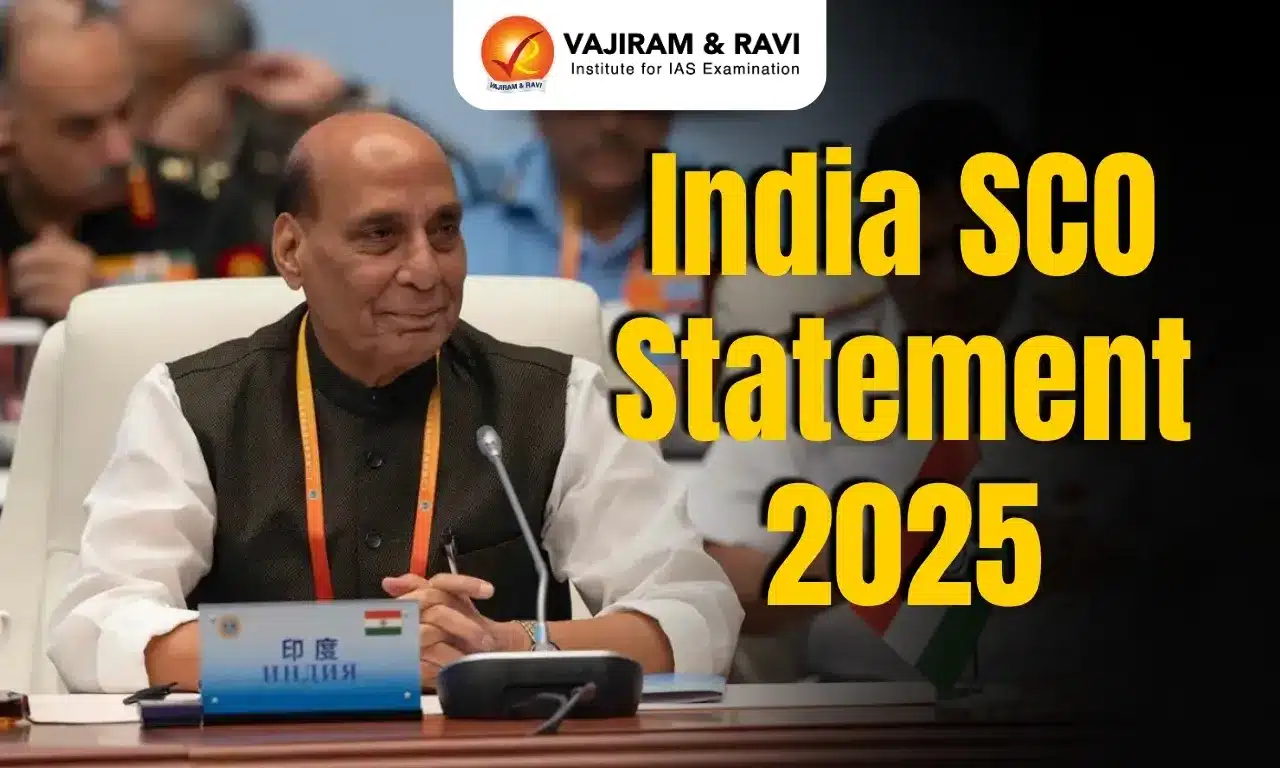
- At the 2025 SCO Defence Ministers’ meeting, Defence Minister Rajnath Singh refused to sign the joint statement.
- This was after the joint statement excluded any mention of the April 22 Pahalgam terror attack but included a reference to the Jaffar Express hijacking in Balochistan.
India’s Objection: Terrorism Omitted
- According to MEA, India had pushed to include references to terrorism, particularly Operation Sindoor and the Pahalgam attack, but “one particular country” objected—a veiled reference to Pakistan.
- As consensus was required, the statement was not adopted.
India Highlights Pahalgam Attack and Operation Sindoor
- In his speech, Indian Defence Minister strongly condemned the Pahalgam terror attack, where victims were targeted based on religious identity.
- He named The Resistance Front, a proxy of Lashkar-e-Taiba (LeT), as responsible.
- He described India’s retaliatory Operation Sindoor as a demonstration of its zero tolerance for terrorism.
No Tolerance for Double Standards
- India asserted that peace cannot coexist with terrorism or WMD proliferation. It called for:
- Decisive global action against terror sponsors
- Consequences for countries enabling cross-border terrorism
- An end to SCO’s silence on state-sponsored terror
India’s Refusal to Sign SCO Draft Statement – Analysis
SCO, traditionally dominated by Russia and China, now sees China playing a more dominant role due to Russia’s preoccupation with the Ukraine war.
China-Pakistan Nexus at Play
- China, a staunch ally of Pakistan, has extended military and diplomatic support to Islamabad following India’s Operation Sindoor.
- It has consistently shielded Pakistan in global forums from criticism over terrorism.
India’s Refusal – A Strategic Signal
- Rajnath Singh’s refusal to sign the SCO draft document, which ignored the Pahalgam terror attack but mentioned the Balochistan train hijacking, sent a strong diplomatic message.
- As a result, no joint statement was issued at this year’s meeting.
Reaffirming India’s Stance on Terrorism
- India reiterated its “no compromise on terrorism” doctrine.
- Indian Minister’s action reflects New Delhi’s consistent position that terrorism and normal diplomatic engagement cannot coexist.
What Lies Ahead
- All eyes are now on the upcoming SCO Council of Heads of State meeting in Tianjin this autumn.
- India’s stance may influence future regional discourse on terrorism and security cooperation.

 Last updated on Oct, 2026
→ UPSC 2027 Notification will be released on 13 January 2027 at upsconline.nic.in.
→ Asian Games 2026 are being held in Aichi-Nagoya, Japan, from 19 September to 4 October.
→ Check Nobel Prize 2026 Winners List here.
→ Download PIB PRiSM Monthly Magazine 2026 here.
→ Check UPSC Monthly Current Affairs Magazine The Recitals here.
→ Check out the latest UPSC Syllabus here.
→ Download UPSC Model Answers for Mains 2026
→ UPSC Mains Question Paper 2026 is out now for Essay & GS Paper 1, 2, 3 & 4.
→ UPSC Calendar 2027 has been released.
→ Enroll in Vajiram & Ravi’s UPSC Mains Test Series 2027 for structured answer writing practice, expert evaluation, and exam-oriented feedback.
→ Join Vajiram & Ravi’s UPSC Mentorship Program 2027 for personalized guidance, strategy planning, and one-to-one support from experienced mentors.
→ Go through the UPSC Mains Previous Year Papers to enhance your preparation.
→ UPSC has released UPSC Toppers List 2025 with the Civil Services final result on its official website.
→ Also check Best UPSC Coaching in India
India SCO Statement 2025 FAQs
Q1. Why did India refuse to sign the SCO statement? +
Q2. What was India’s objection at the SCO Defence Ministers’ meeting? +
Q3. Which country likely blocked terrorism references in the SCO draft? +
Q4. What is India's position on terrorism in global forums? +
Q5. What impact did Rajnath Singh’s action have at the SCO? +
Tags: india sco statement 2025 mains articles upsc current affairs upsc mains current affairs