Indus Waters Treaty Latest News
- India has rejected a Court of Arbitration ruling that issued a “supplemental award” on its competence concerning the Kishenganga and Ratle hydroelectric projects in Jammu and Kashmir.
Grievance Redressal Mechanism under the Indus Waters Treaty
- The Indus Waters Treaty (IWT), signed in 1960 between India and Pakistan with the World Bank as a guarantor, includes structured mechanisms for resolving disputes and differences over the interpretation and application of its provisions.
- These mechanisms include:
- Permanent Indus Commission (PIC):
- Comprising one commissioner from each country, the PIC serves as the first tier for resolving issues.
- It conducts annual meetings and field visits and works to resolve technical and operational matters through mutual consultation.
- Neutral Expert Mechanism:
- For technical differences that cannot be resolved at the PIC level, either party can approach the World Bank to appoint a neutral expert.
- The expert’s mandate is limited to factual and technical questions, and their decisions are binding on both parties.
- Court of Arbitration (CoA):
- For disputes involving legal interpretations or the validity of treaty provisions, a Court of Arbitration can be constituted.
- However, both countries must agree on invoking this mechanism. Any deviation from mutual consent challenges the treaty’s fundamental design.
- Permanent Indus Commission (PIC):
- India has consistently favoured the Neutral Expert route, while Pakistan has pushed for the arbitration court on issues like the design of hydropower projects.
- India maintains that parallel proceedings before both mechanisms violate the treaty’s structure and purpose.


India’s Rejection of the Court of Arbitration’s Authority
- Recently, the Hague-based Court of Arbitration issued a supplemental award asserting its jurisdiction over disputes concerning the Kishenganga and Ratle hydropower projects in Jammu and Kashmir.
- India has categorically rejected the authority of the Court of Arbitration, labelling it “illegally constituted” and devoid of legal legitimacy.
- Ministry of External Affairs (MEA) stated that the very constitution of the court violates the provisions of the IWT, and hence, any decisions or awards issued by it are “per se void.”
- India reiterated that it never recognised the court’s authority and views its functioning as lacking legal standing.
- In response to Pakistan’s request, the arbitration court examined India’s move to place the IWT in abeyance after the April 22 Pahalgam terror attack, which killed 26 Indian civilians.
- India clarified that its suspension of treaty obligations was a sovereign act justified under international law and that a tribunal formed without mutual consent has no jurisdiction over such decisions.
Pakistan’s Legal Strategy and India’s Firm Opposition
- India has accused Pakistan of manipulating international legal mechanisms to divert global attention from its support of cross-border terrorism.
- The MEA described the court’s proceedings as a “charade at Pakistan’s behest” and reiterated that Pakistan must permanently renounce terrorism before India considers resuming its treaty obligations.
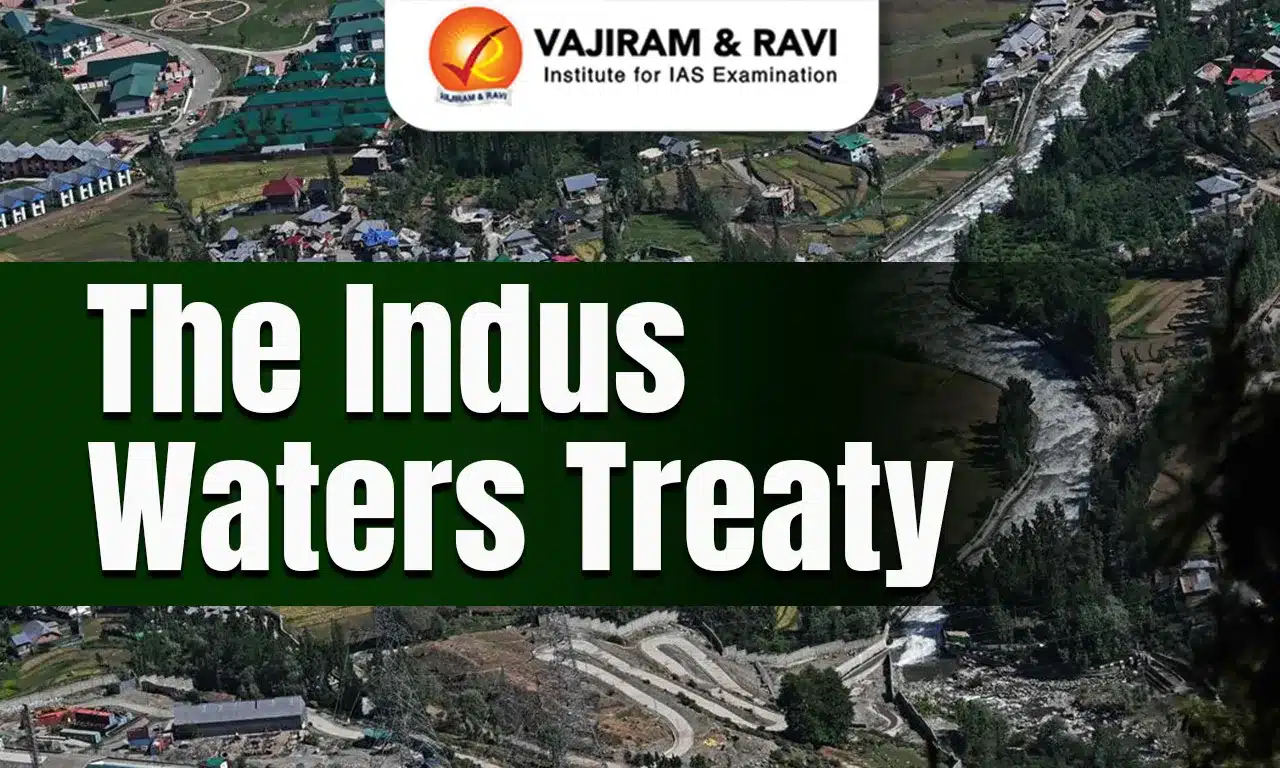
- The legal confrontation stems from longstanding differences over the design parameters of the Kishenganga (Jhelum tributary) and Ratle (Chenab) hydroelectric projects.
- In 2015, Pakistan approached the World Bank for the appointment of a Neutral Expert, but later shifted to seek arbitration in 2016.
- India, upholding the original treaty provisions, continued to insist on the Neutral Expert route, rejecting arbitration as a breach of the IWT’s sequential dispute resolution framework.
Treaty Review, Neutral Expert Engagement, and Strategic Implications
- On October 13, 2022, in an unusual move, the World Bank appointed both a Neutral Expert and constituted a Court of Arbitration simultaneously, based on separate requests by India and Pakistan.
- India objected to this parallel process, asserting it violated the treaty’s single-track mechanism for handling disputes.
- Consequently, while India has actively participated in the Neutral Expert proceedings, it has refused to recognise or engage with the arbitration court.
- This legal escalation coincides with the 65th anniversary of the Indus Waters Treaty.
- Reflecting a broader strategic posture, India issued formal notices to Pakistan in January 2023 and September 2024, calling for a comprehensive review and potential modification of the treaty, in light of evolving geopolitical and hydrological conditions.
- India’s recent decision to suspend treaty obligations is part of this larger recalibration.
- The government maintains that under international law, this action is valid until Pakistan takes verifiable steps to cease support for terrorism.
- These developments mark a significant turning point in the water-sharing relationship between the two nations, with far-reaching diplomatic and political implications for the future of the treaty.

 Last updated on Oct, 2026
→ UPSC 2027 Notification will be released on 13 January 2027 at upsconline.nic.in.
→ Asian Games 2026 are being held in Aichi-Nagoya, Japan, from 19 September to 4 October.
→ Check Nobel Prize 2026 Winners List here.
→ Download PIB PRiSM Monthly Magazine 2026 here.
→ Check UPSC Monthly Current Affairs Magazine The Recitals here.
→ Check out the latest UPSC Syllabus here.
→ Download UPSC Model Answers for Mains 2026
→ UPSC Mains Question Paper 2026 is out now for Essay & GS Paper 1, 2, 3 & 4.
→ UPSC Calendar 2027 has been released.
→ Enroll in Vajiram & Ravi’s UPSC Mains Test Series 2027 for structured answer writing practice, expert evaluation, and exam-oriented feedback.
→ Join Vajiram & Ravi’s UPSC Mentorship Program 2027 for personalized guidance, strategy planning, and one-to-one support from experienced mentors.
→ Go through the UPSC Mains Previous Year Papers to enhance your preparation.
→ UPSC has released UPSC Toppers List 2025 with the Civil Services final result on its official website.
→ Also check Best UPSC Coaching in India
Indus Waters Treaty Dispute FAQs
Q1. What is the Indus Waters Treaty?+
Q2. Why has India rejected the Court of Arbitration's authority?+
Q3. What triggered the current legal standoff?+
Q4. What does placing the treaty in abeyance mean?+
Q5. Is India participating in any dispute resolution mechanism?+
Tags: indus waters treaty mains articles upsc current affairs upsc mains current affairs