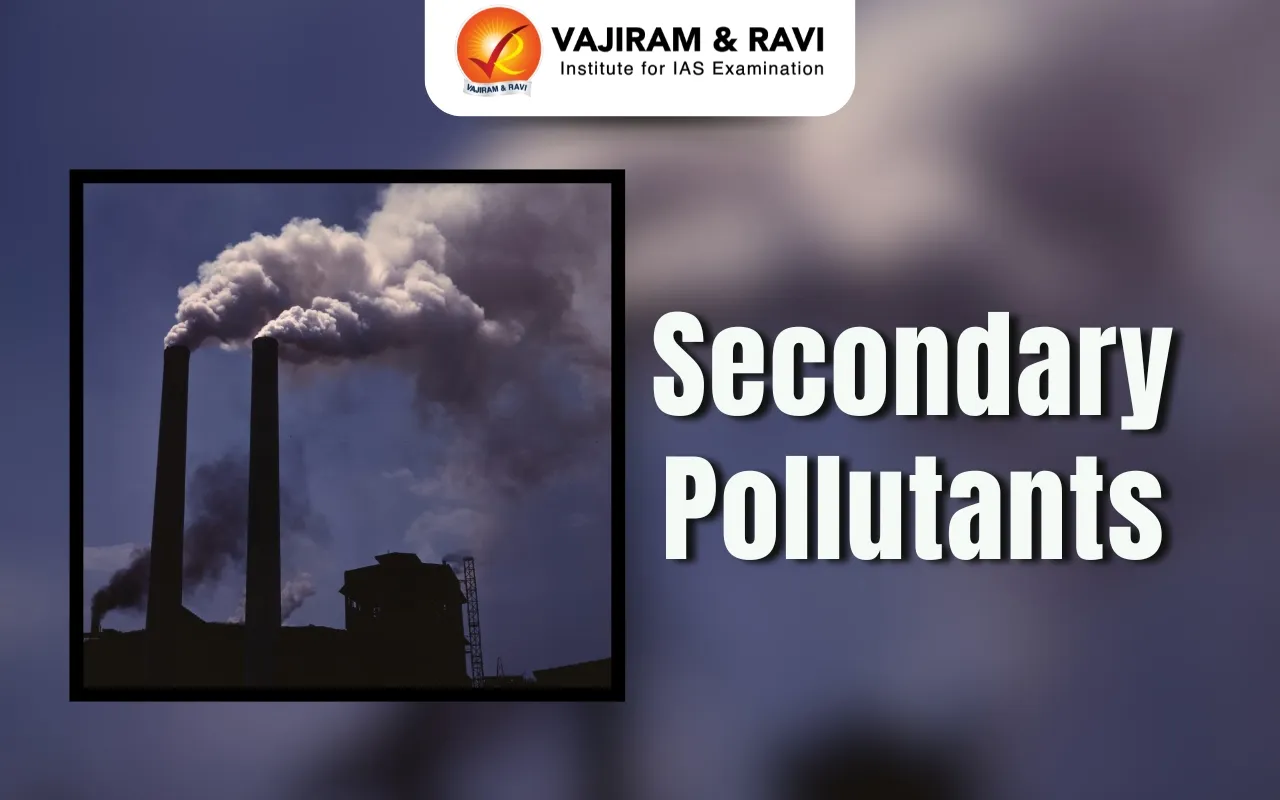
Secondary Pollutants Latest News
- A recent study has revealed that Secondary Pollutants are responsible for nearly one-third of India’s fine particulate matter (PM2.5) pollution.
Understanding Secondary PM2.5 Pollution in India
- Particulate matter smaller than 2.5 microns (PM2.5) is one of the most hazardous components of air pollution, responsible for serious respiratory and cardiovascular diseases.
- Traditionally, primary pollutants such as soot and dust from burning fossil fuels have been considered the chief contributors to PM2.5 levels.
- However, new research highlights the rising significance of secondary pollutants, especially ammonium sulphate, as key components of India’s air pollution challenge.


Primary and Secondary Pollutants: A Distinction
- Primary pollutants originate directly from emission sources such as vehicle exhaust, coal-fired power plants, and biomass burning.
- In contrast, secondary pollutants are formed when primary pollutants react with each other or with atmospheric elements like water vapour and sunlight.
- These reactions lead to the formation of complex particles like ammonium sulphate and ammonium nitrate, which can be equally or more harmful.
Key Findings of the CREA Study
- According to a study by the Centre for Research on Energy and Clean Air (CREA), secondary pollutants, especially ammonium sulphate, constitute up to 34% of India’s PM2.5 mass.
- This widespread presence was identified using satellite-based imagery and atmospheric modelling.
- Nationwide Impact:
- The average ammonium sulphate concentration across India was found to be 11.9 μg/m³.
- These concentrations are not limited to cities near pollution hotspots, but extend nationwide due to the transboundary nature of air pollution.
- Coal Plants as a Major Source:
- Over 60% of India’s sulphur dioxide (SO₂) emissions, the precursor to ammonium sulphate, are linked to coal-fired thermal power plants. These facilities become the primary driver of secondary PM2.5 formation.
- Higher Concentration near Coal Plants:
- Within 10 km of coal power plants, ammonium sulphate concentrations were 2.5 times higher (15 μg/m³) compared to areas beyond that range (6 μg/m³).
- Near these plants, it accounts for 36% of PM2.5 pollution, whereas even distant areas reported a significant 23% contribution.
Status of Emission Control Measures
- Although it is mandatory for Indian coal thermal plants to install Flue Gas Desulphurisation (FGD) systems to reduce SO₂ emissions, compliance has been poor; only about 8% of such plants have installed the required units.
- Further, reports suggest that the government is contemplating rolling back this requirement, which could severely undermine efforts to reduce secondary PM2.5.
Impact Across NCAP Cities
- The findings are particularly significant for the 130 cities identified under the National Clean Air Programme (NCAP).
- These cities are mandated to reduce pollution by 20-30% by 2025-26, but face an uphill task given the high concentration of secondary pollutants.
- Concentration Levels:
- PM2.5 levels due to ammonium sulphate in these cities ranged from 3.9 to 22.5 μg/m³.
- Widespread Presence:
- In 114 out of the 130 NCAP cities, ammonium sulphate made up more than 30% of the total PM2.5 burden.
- Combined Effect:
- Including ammonium nitrate, secondary pollutants could constitute up to 50% of PM2.5 pollution in urban areas.
Strategies for Mitigation
- To address the growing burden of secondary pollutants, a multipronged strategy is required:
- Strict Implementation of Emission Norms:
- Enforcement of FGD installation in coal power plants must be non-negotiable. Regulatory rollback would be counterproductive to public health goals.
- Agricultural and Industrial Reforms:
- Efficient fertiliser management can reduce ammonia emissions, which are a key reactant in forming secondary particles.
- Source-Specific Action:
- Pollution mitigation efforts must target both direct emission sources and precursor gases like SO₂ and NH₃.
- Transboundary Cooperation:
- Given the dispersal nature of secondary pollutants, regional coordination between states is essential for effective air quality management.
- Real-Time Monitoring and Research:
- Investments in air quality monitoring infrastructure and continuous data-driven research are needed to identify evolving patterns in pollution dynamics.
Source : TH

 Last updated on Oct, 2026
→ UPSC 2027 Notification will be released on 13 January 2027 at upsconline.nic.in.
→ Check Nobel Prize 2026 Winners List here.
→ Download PIB PRiSM Monthly Magazine 2026 here.
→ Check UPSC Monthly Current Affairs Magazine The Recitals here.
→ Check out the latest UPSC Syllabus here.
→ Download UPSC Model Answers for Mains 2026
→ UPSC Mains Question Paper 2026 is out now for Essay & GS Paper 1, 2, 3 & 4.
→ UPSC Calendar 2027 has been released.
→ Enroll in Vajiram & Ravi’s UPSC Mains Test Series 2027 for structured answer writing practice, expert evaluation, and exam-oriented feedback.
→ Join Vajiram & Ravi’s UPSC Mentorship Program 2027 for personalized guidance, strategy planning, and one-to-one support from experienced mentors.
→ Go through the UPSC Mains Previous Year Papers to enhance your preparation.
→ UPSC has released UPSC Toppers List 2025 with the Civil Services final result on its official website.
→ Also check Best UPSC Coaching in India
Secondary Pollutants FAQs
Q1. What are secondary pollutants in the context of PM2.5 pollution?+
Q2. What is the role of coal-fired power plants in India’s PM2.5 problem?+
Q3. How much of India’s PM2.5 burden is from ammonium sulphate?+
Q4. What is the compliance rate for flue gas desulphurisation systems in Indian coal plants?+
Q5. Why is ammonium sulphate pollution concerning in urban areas?+
Tags: mains articles secondary pollutants upsc current affairs upsc mains current affairs