Nuclear Sector Reforms Latest News
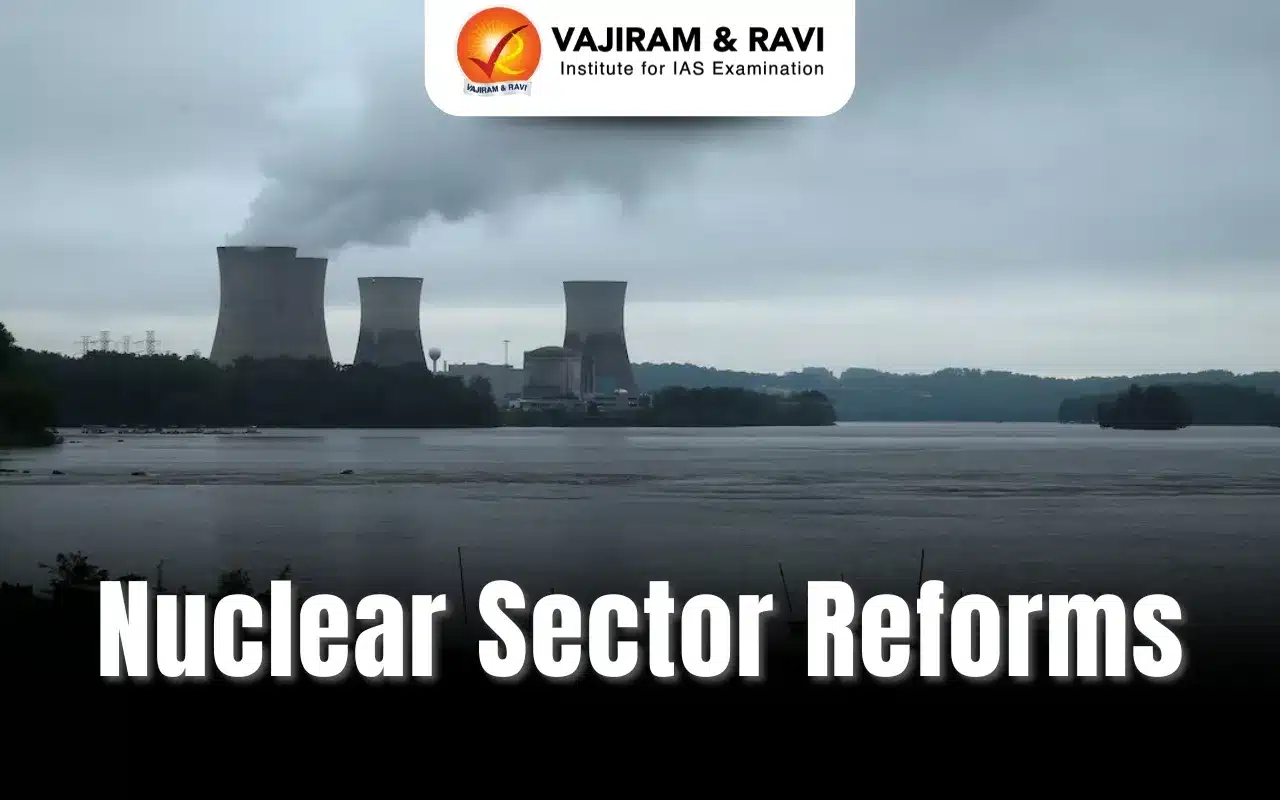
- India is preparing legislative changes to two major laws in its atomic energy sector to attract private and foreign investment.
- Amendments to the Civil Liability for Nuclear Damage Act, 2010 (CLNDA) aim to ease liability provisions, addressing long-standing investor concerns.
- Another key reform would allow private companies to operate nuclear power plants, potentially enabling foreign firms to hold minority stakes in future projects.
India Plans Major Changes to Nuclear Liability Law
- The government is working on amendments to the Civil Liability for Nuclear Damage Act, 2010 (CLNDA) to address concerns that have deterred foreign and domestic investment in the nuclear sector.
Foreign Vendor Concerns Over ‘Right of Recourse’
- Section 17(b) of the CLNDA gives nuclear plant operators the right of recourse against suppliers in case of defects in equipment or services.
- This provision has been flagged by companies like Westinghouse Electric (U.S.) and Framatome (France) as a major barrier due to fears of future liability.
Broad Definition of ‘Supplier’ Worrying for Indian Sub-Vendors
- The current definition of “supplier” is considered too broad, with no distinction between primary suppliers and sub-vendors.
- Indian equipment manufacturers have expressed concern that they too may be held liable, creating uncertainty and reluctance to participate.
Proposed Amendments to Align with Global Norms
- Two key amendments are being considered:
- Diluting Section 17(b) to bring it in line with international nuclear liability standards.
- Clarifying the definition of ‘supplier’ to exclude smaller sub-vendors unless specifically mentioned in contracts.
Possible Caps on Vendor Liability
- Deliberations are also underway to limit the liability of vendors:
- Monetary cap pegged to the original contract value
- Time-bound applicability of liability
- This is expected to reassure both foreign and domestic suppliers.
Regulatory Oversight as a Safeguard
- All nuclear projects must be vetted by the Atomic Energy Regulatory Board (AERB), which can ensure that contractual clauses for recourse are properly defined, maintaining safety and accountability.
Move to Align Nuclear Liability Law with Global Norms
- Amendments to the CLNDA aim to align India’s liability framework with the 1997 Convention on Supplementary Compensation for Nuclear Damage (CSC).
- India became a party to the CSC in 2016, and the current legal tweaks would bring its national law in closer conformity with international standards.


Opening the Nuclear Sector to Private Participation
- The government is planning a major amendment to the Atomic Energy Act, 1962 to allow private companies to operate nuclear power plants—an activity currently reserved for state-owned entities like NPCIL and NTPC.
- The proposed reform could also enable foreign companies to take minority equity stakes in upcoming nuclear projects, paving the way for greater global collaboration in India’s atomic energy sector.
A Historic Shift in a Traditionally Closed Sector
- India’s atomic energy sector has remained closed to private and foreign players.
- These legislative reforms mark a transformational shift aimed at unlocking its commercial potential.
- Nearly two decades after the Indo-US civil nuclear agreement, the amendments are seen as a way to revive and capitalize on its unrealized potential, strengthening bilateral strategic and commercial ties.
- The nuclear sector reforms are also being positioned as part of a larger trade and investment framework with the U.S., possibly leading up to a formal trade pact currently under negotiation.
U.S. Clears Regulatory Hurdle for Nuclear Cooperation
- In March 2025, the U.S. Department of Energy granted a ‘10CFR810’ specific authorisation to Holtec International. This clearance allows:
- Transfer of unclassified small modular reactor (SMR) technology to India
- Collaboration with Holtec Asia, Tata Consulting Engineers, and L&T
- Earlier, this regulation barred U.S. firms from manufacturing or designing nuclear components in India, which had stalled cooperation.
- The responsibility now lies with India to enact the two key legislative amendments to unlock the full potential of the Indo–U.S. civil nuclear deal and expand its domestic nuclear energy capacity.
Conclusion
- Experts underscore the economic necessity of these amendments to attract foreign vendors and enable domestic manufacturing in the nuclear sector.
- With global legal alignment, domestic clarity on liability, and U.S. cooperation now secured, passing these reforms could finally activate the long-awaited civil nuclear partnership and bolster India’s energy security and industrial capability.

 Last updated on Oct, 2026
→ UPSC 2027 Notification will be released on 13 January 2027 at upsconline.nic.in.
→ Asian Games 2026 are being held in Aichi-Nagoya, Japan, from 19 September to 4 October.
→ Check Nobel Prize 2026 Winners List here.
→ Download PIB PRiSM Monthly Magazine 2026 here.
→ Check UPSC Monthly Current Affairs Magazine The Recitals here.
→ Check out the latest UPSC Syllabus here.
→ Download UPSC Model Answers for Mains 2026
→ UPSC Mains Question Paper 2026 is out now for Essay & GS Paper 1, 2, 3 & 4.
→ UPSC Calendar 2027 has been released.
→ Enroll in Vajiram & Ravi’s UPSC Mains Test Series 2027 for structured answer writing practice, expert evaluation, and exam-oriented feedback.
→ Join Vajiram & Ravi’s UPSC Mentorship Program 2027 for personalized guidance, strategy planning, and one-to-one support from experienced mentors.
→ Go through the UPSC Mains Previous Year Papers to enhance your preparation.
→ UPSC has released UPSC Toppers List 2025 with the Civil Services final result on its official website.
→ Also check Best UPSC Coaching in India
Nuclear Sector Reforms FAQs
Q1. What are the key nuclear sector reforms? +
Q2. Why is Section 17(b) of CLNDA controversial? +
Q3. What’s the benefit of aligning with CSC? +
Q4. What role does the U.S. play in reforms? +
Q5. How will reforms impact India’s energy future? +
Tags: mains article nuclear sector reforms upsc mains current affairs