Space-Based Surveillance-III Programme
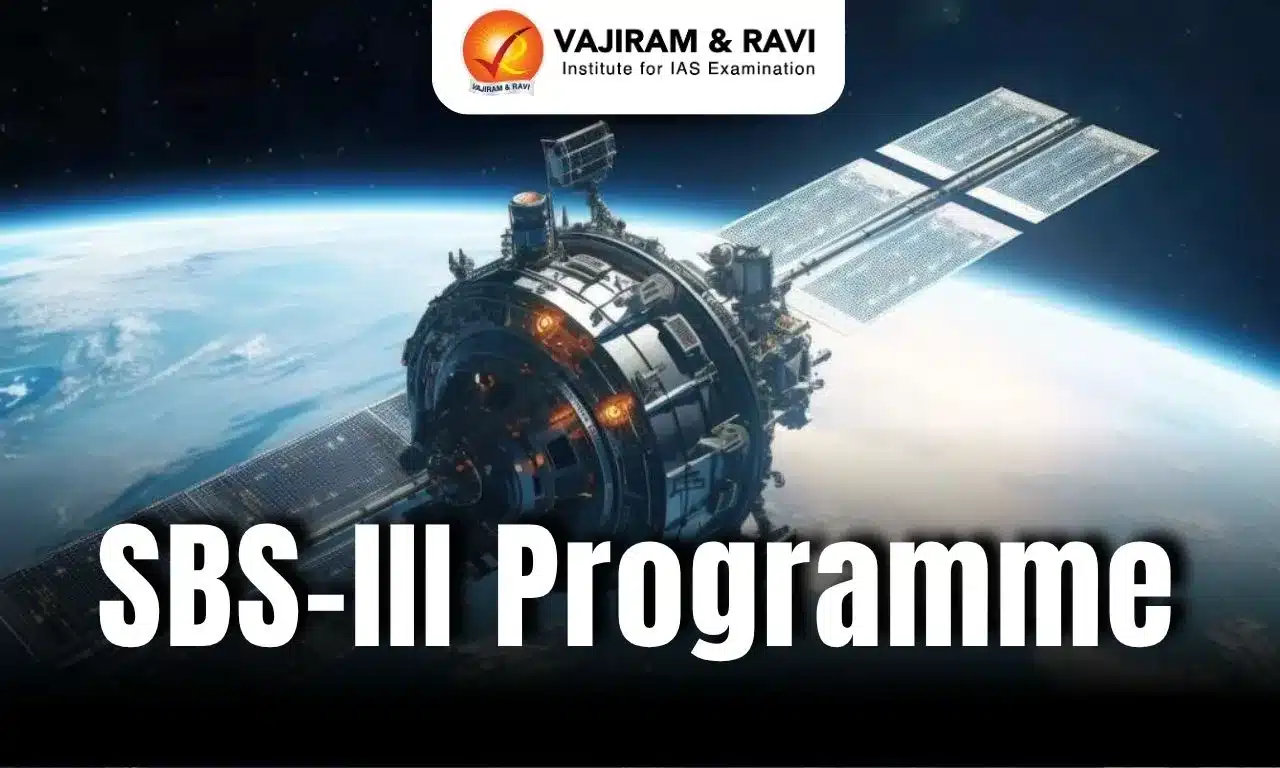
The Union government recently ordered the fast-tracking of the launch of 52 dedicated surveillance satellites under the SBS-III programme.
About Space-Based Surveillance-III Programme
- It was approved in October 2023, by the Prime Minister-led Cabinet Committee on Security to develop next-generation satellites over the next decade.
- It involves the construction and launch of 21 satellites by India’s space agency, ISRO, and 31 by three private companies.
- The first satellite is expected to be launched by April 2026, with the full constellation targeted for completion by the end of 2029.
- The aim of SBS-3 is to cover much larger areas of China and Pakistan, as well as the Indian Ocean Region, with shorter revisit times (interval between two consecutive surveillance sweeps of the same location) and much better resolution. The space doctrine is also being fine-tuned.
- It enables the Indian Army, Navy, and Air Force to monitor adversary movements deep inside hostile territory — including airfields, bases, and staging areas.
- These new satellites will utilise AI and will be able to interact with each other and thus gather GeoIntelligence more effectively.
- A crucial aspect of the project is the planned transfer of Small Satellite Launch Vehicle (SSLV) technology from ISRO to private players, which will allow for rapid satellite launches during emergencies.
- The satellites will operate in both low Earth and geostationary orbits, providing comprehensive coverage and countering China’s advanced anti-satellite capabilities, including kinetic and electronic warfare systems.
- The project cost of SBS-III is pegged at ₹26,968 crore.
- The Defence Space Agency (DSA), which functions under the Integrated Defence Staff (IDS) of the Ministry of Defence, is leading the project.
- Formed in 2019, the DSA replaced the Integrated Space Cell and now oversees India’s military space operations.
- It coordinates with ISRO, DRDO, and the armed forces to develop space warfare strategies and safeguard national space assets.
Source: TH


 Last updated on Oct, 2026
→ UPSC 2027 Notification will be released on 13 January 2027 at upsconline.nic.in.
→ Asian Games 2026 are being held in Aichi-Nagoya, Japan, from 19 September to 4 October.
→ Check Nobel Prize 2026 Winners List here.
→ Download PIB PRiSM Monthly Magazine 2026 here.
→ Check UPSC Monthly Current Affairs Magazine The Recitals here.
→ Check out the latest UPSC Syllabus here.
→ Download UPSC Model Answers for Mains 2026
→ UPSC Mains Question Paper 2026 is out now for Essay & GS Paper 1, 2, 3 & 4.
→ UPSC Calendar 2027 has been released.
→ Enroll in Vajiram & Ravi’s UPSC Mains Test Series 2027 for structured answer writing practice, expert evaluation, and exam-oriented feedback.
→ Join Vajiram & Ravi’s UPSC Mentorship Program 2027 for personalized guidance, strategy planning, and one-to-one support from experienced mentors.
→ Go through the UPSC Mains Previous Year Papers to enhance your preparation.
→ UPSC has released UPSC Toppers List 2025 with the Civil Services final result on its official website.
→ Also check Best UPSC Coaching in India
Space-Based Surveillance-III Programme FAQs
Q1. When was the Space-Based Surveillance-III (SBS-III) programme approved?+
Q2. What is the total number of satellites planned under the SBS-III programme?+
Q3. What is the main objective of the SBS-III programme?+
Q4. Which agency is leading the SBS-III project?+
Q5. What is the estimated total cost of the SBS-III programme?+
Tags: prelims pointers space-based surveillance-III programme upsc prelims current affairs