Electoral Roll Revision Latest News
- The Supreme Court of India declined to stay the Election Commission of India’s (ECI) Special Intensive Revision (SIR) of electoral rolls in Bihar, which is scheduled ahead of the upcoming Assembly elections.
- Amid concerns raised by petitioners over the timing and process of the electoral roll revision, the Court urged the ECI to consider Aadhaar, voter ID, and ration cards for verification purposes and scheduled a detailed hearing for July 28.
Background – Electoral Roll Revision in Bihar
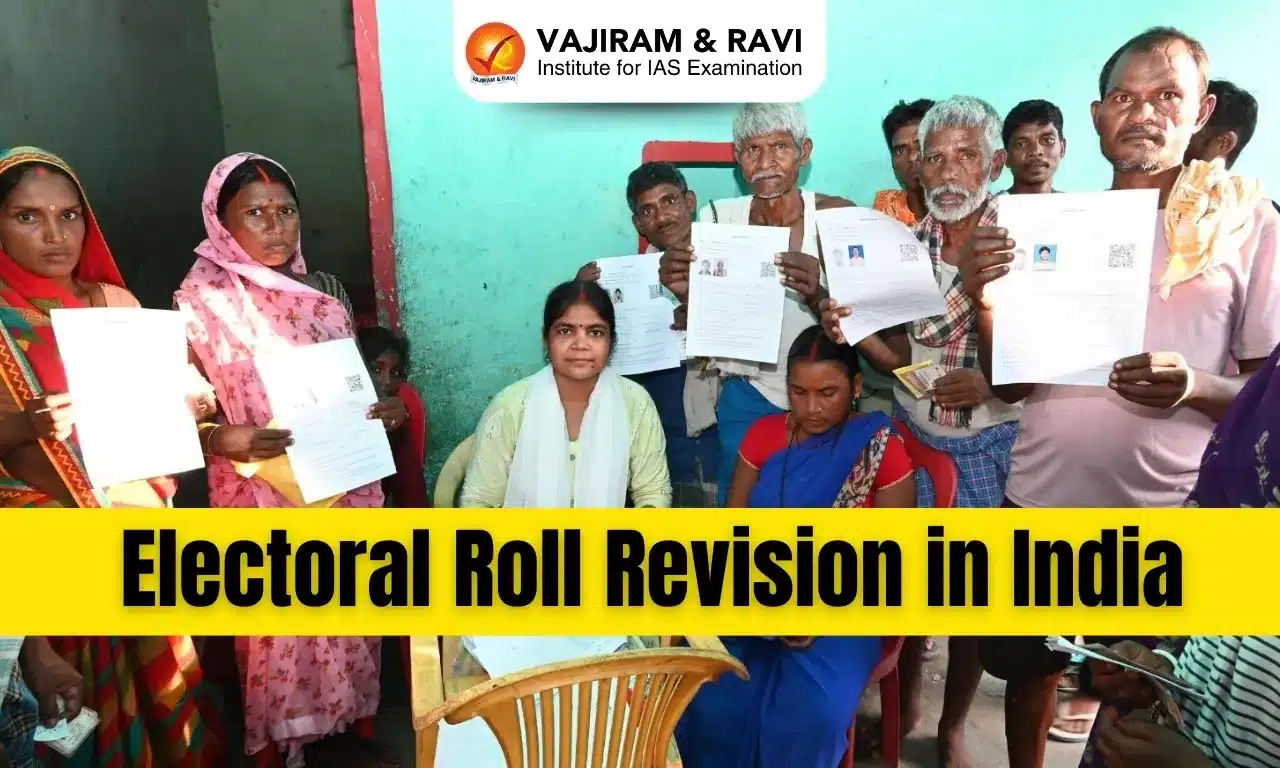
- Special Intensive Revision (SIR): SIR involves a de novo/ afresh preparation of electoral rolls through house-to-house verification by electoral registration officers.
- Applicability in Bihar:
- Those listed on the 2003 electoral rolls need only submit an extract from that roll.
- Those enrolled after 2003 must submit one or more of 11 prescribed documents and a pre-filled enumeration form to establish birthplace and date, indirectly serving as a citizenship determination process.


Supreme Court Proceedings and Key Observations
- Major concerns raised:
- Timing of revision:
- Petitioners argued that the electoral roll revision is timed too close to the November 2025 Bihar Assembly elections.
- Demanded delinking of the revision exercise from the election process.
- Document exclusion:
- Objection to exclusion of Aadhaar from the accepted list of identity/citizenship documents.
- Concerns of citizenship screening under the guise of voter verification.
- Risk of voter disenfranchisement:
- Petitioners warned that lack of accepted documentation could exclude genuine voters (particularly marginalized groups like EBCs, Dalits, minorities, and women).
- A Bihar government survey reportedly revealed most voters did not possess the required certificates sought by ECI.
- Timing of revision:
- Supreme Court’s stand and directions:
- No interim stay: Court allowed ECI to proceed with SIR but reserved right to intervene if violations are proven.
- Document suggestion: SC urged ECI to consider Aadhaar, voter ID, and ration cards—though left the final decision to the Commission.
- Rationale for transparency: ECI was directed to provide reasons if it chooses to exclude these documents.
- Three key legal questions identified by SC:
- Powers of the Election Commission under the Constitution.
- Procedure and methodology of SIR being adopted.
- Timing of the revision vis-à-vis the upcoming election.
Accessibility of Suggested Documents in Bihar
- Aadhaar card:
- Aadhaar is available to over 88% of Bihar’s population (approx. 11.48 crore people).
- Saturation level (eligible people with Aadhaar) stands at 94% across the state.
- Some districts like Kishanganj and Katihar show saturation above 120%, indicating coverage exceeding projections.
- Adult coverage (18+ years): 70.29% of total Aadhaar holders.
- Voter ID (EPIC card):
- Issued compulsorily to all enrolled electors.
- Bihar has 7.89 crore registered voters, almost all of whom hold a Voter ID.
- Used presently only for identification, not for eligibility verification.
- Ration cards:
- Cover about two-thirds of Bihar’s population.
- 1.79 crore ration cards cover around 8.71 crore beneficiaries (as of July 10, 2025).
- Easily accessible to low-income and marginalized groups, including EBCs and minorities.
Election Commission’s Position and Defence
- Key submissions by ECI:
- The list of 11 documents is not exhaustive, and room for additions exists.
- Aadhaar is not conclusive for citizenship, hence not mandatory.
- Extensive public outreach ongoing via:
- Mobile notifications to over 7.89 crore electors.
- House-to-house verification and real-time monitoring via ECINET.
- Rebuttal to citizenship allegations:
- ECI claimed that it has no intent to remove voters arbitrarily.
- Exclusion will happen only if required by law and supported by evidence.
Conclusion
- The Supreme Court has upheld the ECI’s constitutional autonomy in revising electoral rolls but emphasized accountability and transparency.
- The July 28 hearing is expected to address the legal validity, procedural fairness, and timing concerns of the SIR process ahead of Bihar’s crucial elections.
- It will also try to balance documentary rigor with universal suffrage, underlining the importance of institutional accountability and voter inclusion in India’s electoral democracy.

 Last updated on Oct, 2026
→ UPSC 2027 Notification will be released on 13 January 2027 at upsconline.nic.in.
→ Check Nobel Prize 2026 Winners List here.
→ Download PIB PRiSM Monthly Magazine 2026 here.
→ Check UPSC Monthly Current Affairs Magazine The Recitals here.
→ Check out the latest UPSC Syllabus here.
→ Download UPSC Model Answers for Mains 2026
→ UPSC Mains Question Paper 2026 is out now for Essay & GS Paper 1, 2, 3 & 4.
→ UPSC Calendar 2027 has been released.
→ Enroll in Vajiram & Ravi’s UPSC Mains Test Series 2027 for structured answer writing practice, expert evaluation, and exam-oriented feedback.
→ Join Vajiram & Ravi’s UPSC Mentorship Program 2027 for personalized guidance, strategy planning, and one-to-one support from experienced mentors.
→ Go through the UPSC Mains Previous Year Papers to enhance your preparation.
→ UPSC has released UPSC Toppers List 2025 with the Civil Services final result on its official website.
→ Also check Best UPSC Coaching in India
Electoral Roll Revision
Q1. Examine the constitutional mandate and autonomy of the Election Commission of India (ECI) in the context of the Special Intensive Revision (SIR) of electoral rolls in Bihar.+
Q2. Discuss the implications of excluding widely held documents like Aadhaar, Voter ID, and ration cards from the eligibility criteria for electoral roll inclusion.+
Q3. Analyze how the timing and procedure of the SIR exercise in Bihar may affect the credibility and inclusiveness of the upcoming Assembly elections.+
Q4. Do you agree with the view that the current SIR process resembles a citizenship verification exercise? +
Q5. Critically evaluate the Supreme Court's approach in balancing the ECI’s constitutional independence with the need to ensure voter inclusion and transparency.+
Tags: ains articles electoral roll revision in india upsc current affairs upsc mains current affairs