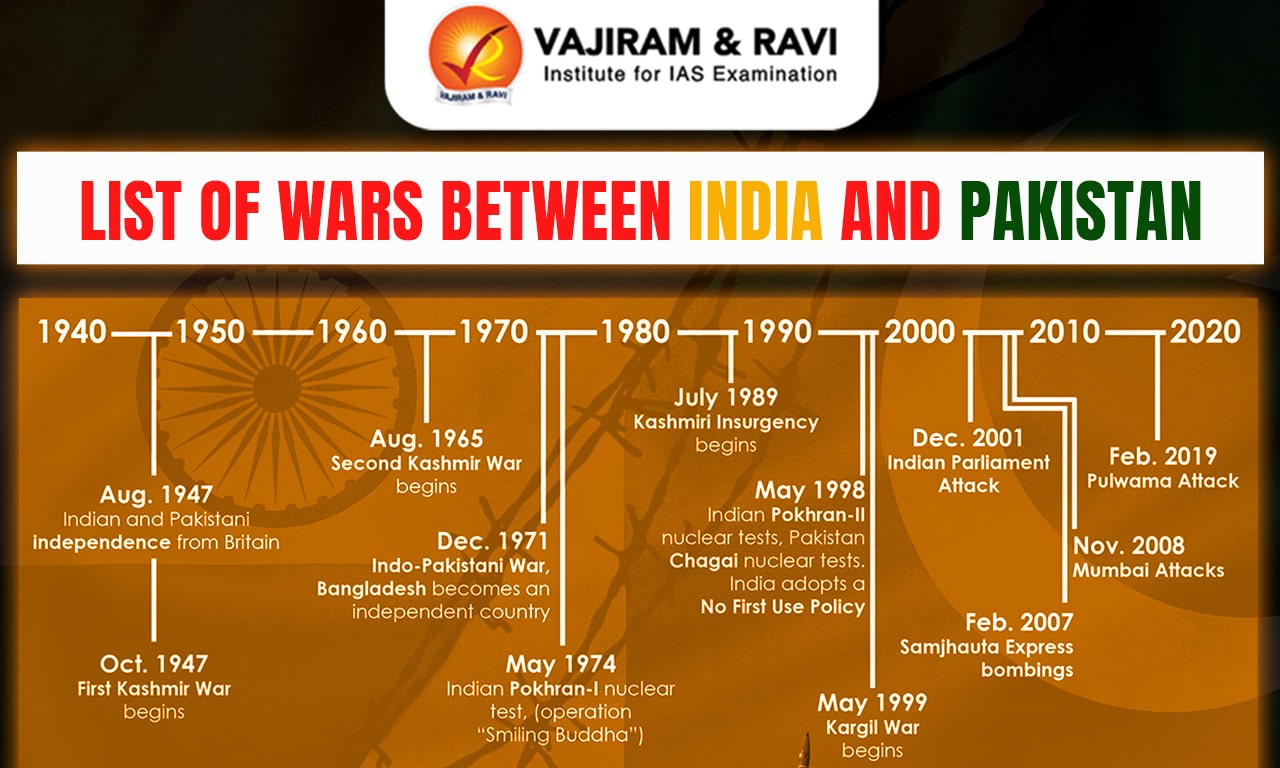
The partition of British India in 1947 gave birth to two nations, India and Pakistan. The division, grounded in religious and political differences, led to widespread violence, displacement, and a bitter legacy. Since independence, India and Pakistan have fought four major wars, engaged in numerous military standoffs, and have experienced countless border conflicts and terrorist attacks. The article below includes the List of Wars Between India and Pakistan from the First Kashmir War of 1947 to the recent Operation Sindoor of 2025 including key facts, triggers, outcomes, and their broader implications.
List of Wars Between India and Pakistan
Since 1947, India and Pakistan have experienced several military confrontations, most of them rooted in the long-standing Kashmir dispute and cross-border tensions. These clashes have ranged from full-scale wars to limited strikes and standoffs, each with its own background, trigger, and outcome. The table below offers a List of Wars Between India and Pakistan over the years.
| List of Wars Between India and Pakistan | |||
| Conflict / War | Year | Cause / Trigger | Outcome |
|
First Kashmir War |
1947-1948 |
Accession of J&K, tribal invasion |
LoC established, Kashmir dispute unresolved |
|
Second Indo-Pak War |
1965 |
Pakistan’s Operation Gibraltar |
Tashkent Agreement, status quo restored |
|
Indo-Pak War / Bangladesh |
1971 |
Bengali independence movement |
Creation of Bangladesh |
|
Kargil War |
1999 |
Pakistani intrusion in Kargil |
Indian victory, global condemnation of Pak |
|
Siachen Conflict |
1984-2003 |
Control of Siachen Glacier |
India holds key positions |
|
Military Standoff |
2001-2002 |
Indian Parliament attack |
De-escalated via diplomacy |
|
Surgical Strikes |
2016 |
Uri attack |
Terror camps destroyed |
|
Balakot Airstrike |
2019 |
Pulwama attack |
First IAF strike on Pak territory since 1971 |
|
Operation Sindoor |
2025 |
Pahalgam terror attack |
Massive punitive retaliation, ceasefire |
Major Wars Between India and Pakistan
First Indo-Pak War (1947–1948): First Kashmir War
- Duration: October 22, 1947 – January 1, 1949
- Cause: Accession of Jammu & Kashmir
- Outcome: Ceasefire brokered by UN, establishment of the Line of Control (LoC)
Background:
Following independence, princely states were given three choices: accede to India, join Pakistan, or remain independent. Maharaja Hari Singh, the ruler of Jammu and Kashmir, initially chose to remain independent. However, when Pakistani tribal militias invaded in October 1947, he sought help from India and signed the Instrument of Accession, making Jammu & Kashmir a part of India.
Course of War:
The Indian Army was airlifted into Srinagar and successfully pushed back the infiltrators. Key battles were fought in Uri, Baramulla, and Jammu. However, Pakistan retained control over a portion of the territory now known as Pakistan-occupied Kashmir (PoK).
Result:
A UN-mediated ceasefire came into effect on January 1, 1949. It led to the establishment of the LoC, dividing Jammu and Kashmir between the two nations. The Kashmir issue, however, remained unresolved and a perpetual flashpoint.
Second Indo-Pak War (1965)
- Duration: August-September 1965
- Cause: Dispute over Kashmir, Pakistani Operation Gibraltar
- Outcome: Tashkent Agreement (January 1966) – Status quo ante bellum
Background:
Pakistan initiated Operation Gibraltar, sending soldiers disguised as locals into Jammu and Kashmir to incite rebellion. The plan backfired as locals did not support the intruders, and the Indian Army responded with full-scale retaliation.
Course of War:
The conflict spread across the International Border. Major battles were fought in Lahore, Sialkot, and the Rann of Kutch. The Indian Army made significant gains, and both sides suffered heavy casualties.
Result:
After intense fighting lasting 17 days, a UN-mandated ceasefire was declared. The Tashkent Agreement, brokered by the USSR, restored pre-war positions. However, the war did not resolve the Kashmir dispute, and both nations claimed victory.
Indo-Pak War of 1971: Bangladesh Liberation War
- Duration: December 3-16, 1971
- Cause: Political crisis in East Pakistan; support for Bengali independence movement
- Outcome: Creation of Bangladesh, Decisive Indian victory
Background:
East Pakistan (present-day Bangladesh) had been agitating for autonomy. Following the denial of electoral victory to Sheikh Mujibur Rahman’s Awami League and subsequent military crackdown by West Pakistan, a refugee crisis emerged with over 10 million people fleeing to India.
Course of War:
India supported the Mukhti Bahini (freedom fighters) and launched military operations on both the eastern and western fronts. The Battle of Longewala in Rajasthan and naval blockade of Karachi were strategic successes.
Result:
On December 16, 1971, Pakistan’s Eastern Command surrendered in Dhaka with over 90,000 troops taken as prisoners of war. The war led to the birth of Bangladesh. The Shimla Agreement (1972) was signed, where India returned captured territory in the west in exchange for peace commitments from Pakistan.
Kargil War (1999)
- Duration: May-July 1999
- Cause: Pakistani infiltration into Kargil sector
- Outcome: India regained all lost territory, diplomatic victory
Background:
Pakistani troops and militants infiltrated into Indian positions along the LoC in the Kargil region. Their aim was to cut off National Highway 1A, thereby disrupting Indian logistics in Siachen and Kashmir.
Course of War:
India launched Operation Vijay, combining infantry assaults, artillery bombardments, and air strikes. Major battles took place at Tololing, Tiger Hill, and Batalik.
Result:
Indian forces successfully recaptured all the occupied positions. International pressure, especially from the United States, forced Pakistan to withdraw. The war exposed Pakistan Army’s duplicity, as then-Prime Minister Nawaz Sharif was kept unaware of the operation by the military leadership.


Other Major Conflicts and Military Engagements
India and Pakistan have experienced a series of high-stakes military confrontations since their independence in 1947, with several conflicts emerging even in the post-Kargil era. While full-scale wars have been largely avoided since 1999, tensions have remained high due to terrorism, border conflicts, and strategic rivalries. The table below summarizes key India-Pakistan military engagements and operations from 1984 onwards, highlighting their causes, actions taken by India, and their outcomes.
| Other Major Conflicts and Military Engagements | ||||
| Event | Period/Date | Trigger/Cause | Action Taken | Outcome |
|
Siachen Conflict |
1984-2003 |
Strategic control over Siachen Glacier |
India launched Operation Meghdoot |
India gained and maintained control over key heights on the glacier |
|
2001-2002 Military Standoff |
Dec 2001 – Oct 2002 |
Indian Parliament attack (Dec 13, 2001) |
India initiated Operation Parakram (massive troop mobilization) |
Full-scale war was averted; high tension persisted for months |
|
Surgical Strikes |
Sept 29, 2016 |
Uri attack (19 Indian soldiers killed by Pakistani terrorists) |
Cross-LoC surgical strikes on terror launch pads |
Marked a proactive shift in India’s counter-terror strategy; received wide domestic support |
|
Balakot Airstrikes |
Feb 26, 2019 |
Pulwama attack (40 CRPF personnel martyred) |
IAF conducted airstrikes on terror camps in Balakot, Pakistan |
Escalated into air combat; Wing Commander Abhinandan captured and returned by Pakistan |
Operation Sindoor (2025)
Operation Sindoor 2025 was launched in direct response to the tragic Pahalgam terror attack on April 22, 2025, which claimed the lives of 26 innocent civilians. India initiated a swift and coordinated military offensive on May 7, 2025. The operation spanned approximately four days and concluded on May 10, 2025. The primary objectives of this mission were to dismantle terror infrastructure across the border, and deliver a strong message of deterrence to hostile elements.
| Operation Sindoor (2025) | |
| Phase | Details |
|
Phase 1: Precision Strikes |
Targets: Terrorist camps of LeT, JeM, Hizbul in PoJK and across Pakistan Weapons Used: SCALP missiles, BrahMos, HAMMER bombs, loitering munitions Notable Platforms: Rafale, Su-30 MKI, drones |
|
Phase 2: Pakistani Retaliation |
Pakistan launched drones and missiles at Indian military bases India’s air defense systems intercepted many threats India responded with deep strikes targeting airbases and radars inside Pakistan |
|
Phase 3: Escalation & Ceasefire |
India struck major Pakistani airbases like Sargodha, Rahim Yar Khan, Bholari Destruction of 6+ fighter jets, 2 surveillance aircraft, 10+ drones, and missile systems Pakistan requested a ceasefire within 88 hours |

 Last updated on Oct, 2026
→ UPSC 2027 Notification will be released on 13 January 2027 at upsconline.nic.in.
→ Check Nobel Prize 2026 Winners List here.
→ Download PIB PRiSM Monthly Magazine 2026 here.
→ Check UPSC Monthly Current Affairs Magazine The Recitals here.
→ Check out the latest UPSC Syllabus here.
→ Download UPSC Model Answers for Mains 2026
→ UPSC Mains Question Paper 2026 is out now for Essay & GS Paper 1, 2, 3 & 4.
→ UPSC Calendar 2027 has been released.
→ Enroll in Vajiram & Ravi’s UPSC Mains Test Series 2027 for structured answer writing practice, expert evaluation, and exam-oriented feedback.
→ Join Vajiram & Ravi’s UPSC Mentorship Program 2027 for personalized guidance, strategy planning, and one-to-one support from experienced mentors.
→ Go through the UPSC Mains Previous Year Papers to enhance your preparation.
→ UPSC has released UPSC Toppers List 2025 with the Civil Services final result on its official website.
→ Also check Best UPSC Coaching in India
List of Wars Between India and Pakistan FAQs
Q1. How many wars have India and Pakistan fought since independence?+
Q2. What was the main reason for the First Indo-Pak War in 1947–48?+
Q3. What was the outcome of the 1971 Indo-Pak War?+
Q4. What was the significance of the Kargil War in 1999?+
Q5. What is the Line of Control (LoC)?+
Tags: list of wars between india and pakistan